By Greg Brundage
For The Silk Road Kung Fu Friendship Tour Part 48, click here.
This article, part two of a miniseries on the history and martial arts of the Shang Dynasty, reviews Shang Dynasty chariots, weaponry and armor, the Shang Dynasty government’s (lack of) involvement in military training, and oracle bone records referring to unarmed martial arts during the Shang Dynasty.
December 29, 2024 pm – Yinxu Museum
 Replica Shang Dynasty war chariot display at Yinxu Museum, Anyang. It is likely for the vast majority of people in history who saw anything like this in real life, it was the last thing they ever saw, as war chariots were the nuclear weapons of their time. (All photos in this series of article are by this author unless otherwise noted.)
 Stylized oracle-bone inscriptions (OBI) above the main entrance to the Yinxu Museum. The inscription reads: 大商邑 (dàshāng yì) with the literal meaning of: “Great Shang Dynasty City” usually translated as: “Capital of Shang Dynasty.”
 Painting of Shang Dynasty warfare in the Yinxu Museum.
The Yinxu Museum in Anyang is the first national-level museum wholly devoted to the preservation and exhibition of Shang Dynasty artifacts. See: https://news.cgtn.com/news/2024-02-26/New-building-of-Yinxu-Museum-opens-to-the-public-1rvylpy8WWc/p.html for a short video and photos.
An article by Selena Lai and Waka Takahashi Brown published by the Stanford Program on International and Cross-Cultural Education (SPICE), Nov. 1996, asserts four contributions from Shang in particular "define the dynasty: the invention of writing; the development of a stratified government; the advancement of bronze technology; and the use of the chariot and bronze weapons in warfare." (See Lai, Selena and Brown, Waka Takahashi, 2007 in References.)
This writer would add to those remarkable achievements, the middle/late Shang Dynasty capital of Yinxu contributed, 5) large scale, more advanced industrial style production (compared to that in early/middle Shang Dynasty in Erligang/Zhengzhou) and 6) greatly expanded trade routes.
An outline map in the Yinxu Museum clearly makes that point.

The middle three circles in the map above are the territories of the early, middle, and late Shang Dynasty. The outermost boundary is the influence range of commercial culture.
Many thanks to National Museum of Chinese Characters’ most excellent tour guide Feng Yuxiao for explaining the colored lines for me after I got back to Beijing and was scratching my head over this photo. There was a small map key/legend in the lower left corner of the display but in Chinese and somehow, I missed it. Feng Yuxiao was a big help in answering other questions as well and has an encyclopedic knowledge of the Shang Dynasty.
The above map also illustrates Shang Dynasty occupied a very large territory amounting to the equivalent of an empire. Perhaps more than anything, it was the more widespread use of bronze that made expanding and maintaining that dynastic empire possible, in addition to innovations like an improved multi-tiered government and more evolved communication systems.
 Source: Pollard, A., et al. (2017) Bronze Age Metal Circulation in China
Chariots, weaponry and armor
For a scholarly review of Shang military rituals and war preparations, battles, communications and logistics, with a focus on chariots, refer to Wu, Shu-hui (2014) along with a link for download in the References at the end of this article.

Chariots
The Chinese word for “Chariot” in traditional Chinese is 戰車, and modern simplified Chinese 战车zhànchē. In English that means “war vehicle.”
According to CGTN news, “One of the most fascinating finds at Yinxu are Shang Dynasty (1600-1046 BC) horse-drawn chariots, the earliest physical evidence of animal-drawn vehicles in Chinese archaeology.” (Quote from: https://news.cgtn.com/news/2024-09-27/Echoes-of-Shang-Civilization-Rumbling-chariots-and-neighing-steeds-1xeKVLCeRJS/p.html)
The origin of the use of Chariots in China is closely related to the domestication of horses in China. See for example: https://www.travelchinaguide.com/intro/focus/weaponry-bronze.htm
Some of the most glorious charioteers appear to have been buried with their chariots and horses, as can be seen in many displays at the Yinxu Museum.

Museum replication of Yinxu chariot and charioteers’ burial.
For more details, see: https://worldhistoryedu.com/the-shang-dynasty
“According to written sources from ancient China, the chariot is reported to have been first used during the Xia dynasty. A Xia minister by the name of Xi Chong is credited with its invention, and the chariot is also said to have been deployed during the Battle of Gan in the 21st century BC.
“With regards to archaeology, it has been suggested that, at earliest, the chariot was introduced around 1200 BC, which corresponds with the reign of King Wu Ding of the Shang dynasty. This dating is based on a curious artifact known as a “bow-shaped implement” discovered in several chariot pits. These artifacts have also been found in more readily datable contexts, including the Tomb of Fu Hao, where oracle-bone inscriptions provide a reliable date.
“It has been suggested that the chariot performed different functions during its usage in Chinese history. Originally, the chariot was used as a symbol of prestige and a vehicle for hunting, much like the Assyrians during the eighth and seventh centuries BC. Unlike the Assyrians, however, the Chinese chariot was gradually used as a weapon in war. In its initial stages, the chariot is said to have been used as a mobile command platform, in line with its role as a status symbol. During the Zhou dynasty, however, the use of chariots in warfare became more widespread, and may have played a decisive role in the overthrow of the Shang dynasty during the 11th century BC. By the time of the Spring and Autumn period (between the eighth and fifth centuries BC), chariot warfare, in which chariots were pitted against chariots, had spread throughout China.”
Chariots for combat

Life-size model of Shang Dynasty war chariot and horses at Yinxu Museum.

Model war chariot - posterior view – quite roomy actually.
Did China independently invent chariots, or were the designs imported from earlier Mesopotamian civilizations in the west? Evidence supporting the latter assertion include:
“Archaeologists have also speculated that the chariot was not a Chinese invention but imported from the Caucasus via Central Asia. Two important technical similarities have been pointed out between these two types of chariots. Firstly, the wheels of both types of chariots had between 18 to 28 spokes. Secondly, the position of the axle in these chariots was under the middle of the chariot box. By comparison, chariots from elsewhere in the Bronze Age world normally had wheels with only four to eight spokes. Additionally, their axles were located at the rear, rather than under the middle of the chariot box.”
As evidence goes, that appears rather skimpy. Trial and error could have led both ancient Mesopotamians and Chinese to similar designs.
When the lives of soldiers who are friends and even family members, and fate of the nation depends on producing the best weapons, craftsmen are driven to envision optimal designs. One might think the reward for producing a superior design might be well worth a little experimentation.

War chariot wheel with 22 spokes
A short video showing archaeologists excavating burial pits designated for chariots and horses within the new building of Yinxu Museum. can be found here: http://en.people.cn/n3/2024/0328/c90000-20150741.html
Dagger Axe Ge (戈), Spears (Qiang 枪 or Mao 矛) and Battle Axes (Yue 钺)
 From top down, battleaxe, Ge and spearheads
What most people would call a knife or dagger, was called “Ge” or “dagger-axe” during the Shang Dynasty. Frequently they were mounted on a pole and thus called “dagger-axe.”
Shang Dynasty (1600 – 1045 BC) and Western Zhou Period (1045 – 771 BC)
In ancient times, the earliest swords in China were short and made of bronze; little more than daggers. In Chinese history, the earliest known dao (knife) dates to the Shang Dynasty and was 11.8 to 19.7 inches (30 to 50 cm) long. Since their curved blade was hard to cast in bronze longer than this, they remained short until the development of iron swords much later (Yun, 2009, p. 3-4).
https://swordis.com/blog/china-oldest-swords January 13, 2025
There was however a “pole saber “(da dao 大刀) found in Lady Fu Hao’s tomb.

Da dao 大刀 Pole saber illustration from Wu (2013)
What kind of glue or other binding substance did they use to fasten the blade into the pole or handle of a knife, and/or for artistic embellishments like jade inlay on weapons and other items? An answer can be found here: https://www.sciencedirect.com/science/article/abs/pii/S0305440315001612
 Ge - Dagger Axe (a)
 Ge - Dagger axe
For details on “Ge” see: https://www.chnmus.net/sitesources/hnbwy/page_pc/WeeklySelection/Gedagger-axeInscribedwithYuany/list1.html
 Jade ge dagger from the Tomb of Fu Hao (Tomb 5 at Xiaotun), late Shang dynasty, 1200 B.C.E., Yinxu, Anyang, Henan. See Xue, et al. 2017 in References for more information on jade ge dagger during the Shang Dynasty.
For more on ancient Chinese weapons in different millennia, see: https://encyclopedia.pub/entry/29087
Spears

As the above display at Yinxu Museum illustrates spears were primarily the domain of infantrymen. They were certainly useful in stopping other infantrymen and as a weapon against horses pulling chariots. A bit later in history it was the mighty spear that ended the Age of the Chariots.
The Battle Axe - Yue 钺

Battle Axe with Tiger Patterns. (Photo from Lady Fu Hao’s tomb.)

Battle Axe with dragon patterns. (Photo from Lady Fu Hao’s tomb.)
Battle axes were marvelous for cutting through or at least smashing armor of all kinds, including helmets. Lady Fu Hao is usually pictured with a battle axe, and several were found in her tomb. One might think to wield one of these weapons efficiently, the warrior would have to be very, very strong. But one never knows. With the right technique even a person of average strength could learn quite efficient use of this most formidable weapon.
Hooks

Bronze hooks. (Photo from Lady Fu Hao’s tomb.)
Armor

Life-size model of armored Shang Dynasty warrior holding a “Ge” Dagger Axe in his right hand.
 Closeup on warrior armor
“From the Shang dynasty (c. 1600-1046 BCE) leather was used to make tailored armor, and it would continue to be a popular choice for centuries. The most common source of leather was cowhide but the skin of buffalo and rhinos is also recorded (the Sumatran rhino was common in China prior to the 5th century BCE). The tanned and stiffened leather, sufficient to deflect bronze age weapons, was fashioned into two pieces to protect the chest and back of the warrior.”
https://www.worldhistory.org/article/1143/armour-in-ancient-chinese-warfare/
The Sumatran Rhino? Sumatra is now part of the Indonesian archipelago. That suggests the trade routes of at least the Zhou Dynasty (which immediately followed the Shang Dynasty) were larger than most histories assert.
Helmets
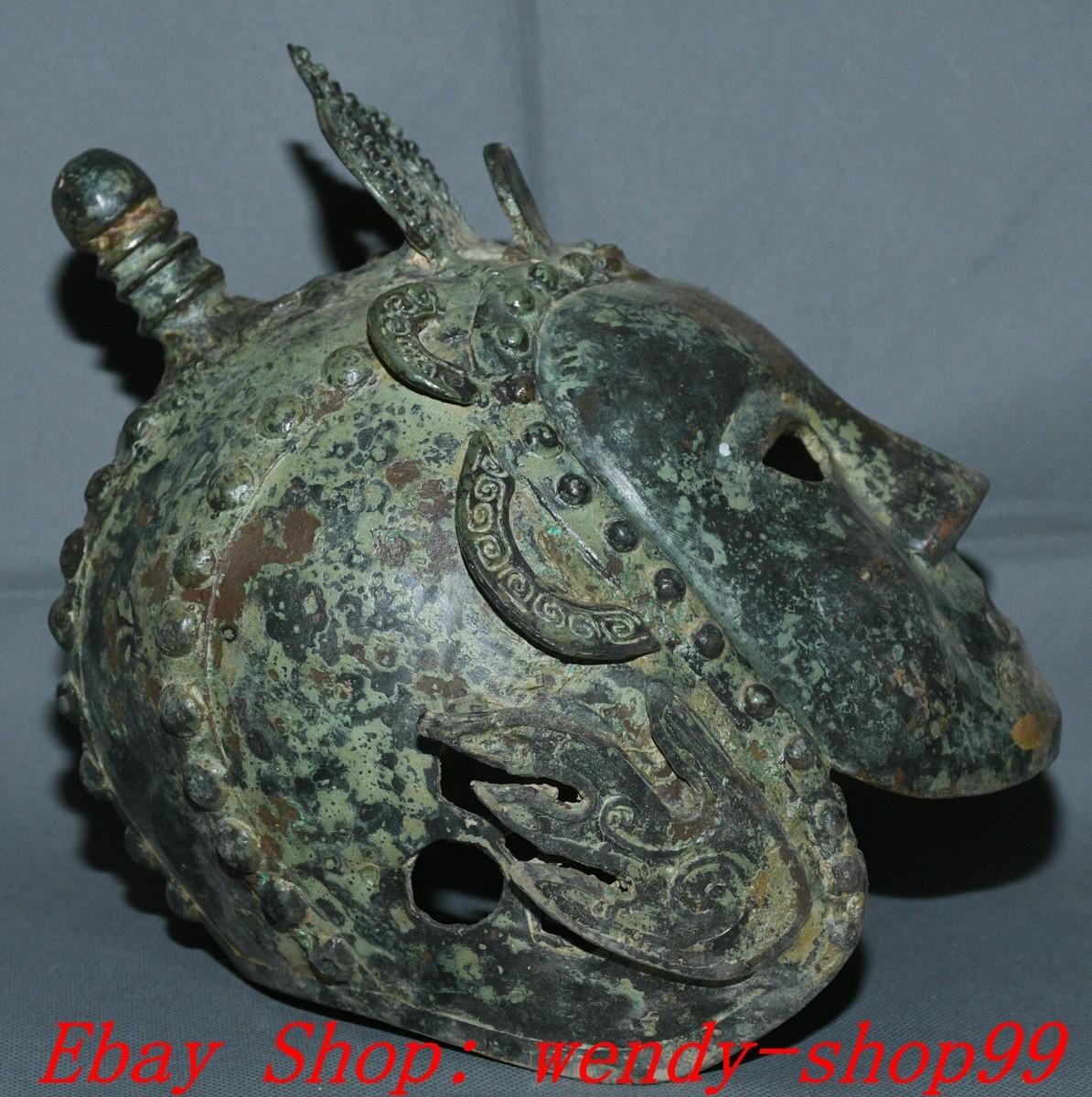
I didn’t see any complete helmets on display in Yinxu Museum, however a quick internet search revealed several on different auction sites.

Possibly a charioteer’s helmet. Does Christies sell replicas? If this photo is of an authentic Shang Dynasty helmet, that price seems very cheap. https://www.christies.com.cn/lot/lot-a-bronze-helmet-china-late-shang-dynasty-6276857

Possibly the helmet of an officer or nobleman https://p1.liveauctioneers.com/7405/273501/143326933_1_x.jpg?height=512&quality=70&version=1672205037

Reported to be Shang Dynasty Helmet, for sale on Ebay. https://i.ebayimg.com/images/g/P1MAAOSwVQpj9LXQ/s-l1200.jpg
The authenticity of those helmets however is far from certain. Nevertheless, museums often reject artifacts unless they are discovered by professional archeologists. So, farmers around archeological sites that find artifacts in their fields sometimes sell them in gift shops and even on blankets on roadsides. And of course, there are plenty of fakes on the market. It appears to this Silk Road traveler (since 1992), the wealth of the ancient world is in 1) private collections scattered around the world and 2) large mostly western museums. In Toledo, Spain as a child (1967, age 11) I visited a shop that made seemingly perfect replicas of antique weapons and armor. And so, I am well aware of how real, fakes can look.

Shang Dynasty Chinese Martial Arts
It does not appear the Shang Dynasty government trained their soldiers
There was a sign that sometimes warned the king not to establish a zhong or call up men: 貞勿立中 . . . 令X勿登人 (“Divined. Do not establish the zhong and do not let X summon troops.”) (HJ 7374/ZJ 184)
Once the desired number of men had been summoned and organized, the king sent them straightaway to reinforce the troops in the field,68 meaning that these men who responded to the call already possessed sufficient military training either from their families or their clans, the basic units of Shang society. Ralph Sawyer’s observation is accurate, namely that the training of troops was neither conducted under government supervision nor delivered in a highly structured form, because oracular writings provide no evidence of such formal training. 69
Wu (2013) P. 104; Ref. 69 above is Sawyer 2011, 237. Both are in the Reference section at the end of this article.
Though scholars disagree on this point, some believe that hunting was considered a form of military practice and was an activity both royalty and commoners routinely engaged in.

Oracle Bone sacrificial hunting Tu Zhu ox bone inscription. Image from: http://www.shufaziliao.com/maobi/20220789.html
Most older martial artists at least in the west are familiar with the definition of “martial arts” posited by Donn F. Draeger and Robert W. Smith in their classic book: Asian Fighting Arts (1969). They reported that traditional Asian martial arts are by nature secret and kept within the family and tribe. Thus, it is entirely possible many or most of those called for the Shang military already had extensive martial art backgrounds before joining in government sponsored military action.

Shang Dynasty unarmed martial arts
Wrestling as distinct from boxing can be found in Shang Dynasty oracle bone inscriptions.
Shang Dynasty Wrestling existed as early as the Shang Dynasty, where it was commonly known as "dou," meaning two people fighting bare-handed, reflecting combat and confrontation. Oracle bone inscriptions reveal that "dou" activities among Shang kings and nobles are some of the earliest recorded military activities, marking the earliest historical records of wrestling in China.
Xu, Naidan (2024) A Brief History of Ancient Chinese Wrestling, Beijing Sport University
Jinfeng Lu (2020) found the word 鬥 -> 斗 dòu to mean unarmed fighting.
“This is like two people fighting with bare hands, is also the word fighting, now from the ancient character shape view from the shape of the ancient characters, the character for “fighting” is “鬥”... [31] From the point of view of glyphs, the symbolism of the character “鬥” is that two people are fighting against each other. Symbolizing that when two people fight each other, they only use their arms to fight, but not their lower limbs.”
 Evolution of the word “Dou” (Jinfeng Lu, 2020)
Nevertheless, just looking at the oracle bone inscription symbols for “Dou” in his article, one gets the distinct impression kicking is involved.
 Jinfeng Lu
I blew up those tiny photos of oracle bone inscriptions to get a better look.
 Photo 0152 looks very much like two people kicking.
 Likewise, oracle bone print 14584 looks very much like kicking.
An objective observer looking at the oracle bone inscriptions above would have to at least consider unarmed fighting involving kicks dating back to at least the later Shang Dynasty. To that, I will suggest a combined wrestling/kicking/punching art in China is probably far older than that. Finding evidence to support that belief, however, might take time.
Other experts infer boxing appears to go only as far back as Han Dynasty.
Han Dynasty Boxing in China
Long after the end of the Shang Dynasty, the Spring and Autumn Period unfolded during the Eastern Zhou Dynasty, 771 to 481 BCE).
As early as the Spring and Autumn Period and the Warring States Period, there was the word "fist bravery".
The Qin and Han dynasties did not have a special name for "boxing", and the meaning was similar to "Bian" and "hand fighting". "Hanshu Mourning Emperor Ji" said: "Filial piety and elegance are not good, and I watch Bian shooting martial arts from time to time." Su Lin's note: "Hand-to-hand combat is Bian, and wrestling martial arts is also." "It's clear that hand-to-hand combat is not the same thing as wrestling. In the military skills category of "Hanshu Art and Literature", there are "six articles of hand-to-hand combat." This shows that hand-to-hand fighting has developed into a specialized skill with a variety of methods of fighting.
https://zhidao.baidu.com/question/370435288747651692.html
That experts suggest a punching and kicking art did not evolve earlier in Chinese history is surprising especially given the clear representations of kicking in oracle bone inscriptions presented by Jinfeng Lu.
This author’s hypothesis regarding Shang Dynasty unarmed martial arts
In this writer’s opinion, expecting the ancients to divide wresting, punching and kicking into three different arts appears overly reductionistic given that very early period, which was metaphorically at the “dawn of civilization.”
And so, primarily based on the oracle bone inscriptions and some of the translations presented by Jinfeng Lu, combined with the definition of “martial arts” by Donn Draeger and Robert W. Smith, this author will hypothesize: 1) wrestling, boxing and kicking arts were one art during the Shang Dynasty and called “斗 dòu,” 2) almost certainly kept secret within families, which is why there is such a paucity of written records regarding the early evolution of unarmed Wushu Kung Fu in China and 3) there is little in the written records about that art because the Shang Dynasty government did not do military training as per Wu, 2013 P. 104, quote above, and the royalty and high priests and priestesses (the government at that time) were the only ones recording history in the Shang Dynasty.
To that, I would add the original martial arts training in the Shang Dynasty was almost certainly also coded in their traditional dances, as that is the norm worldwide. For example, to quote from this writer’s , <a href=" https://www.kungfumagazine.com/news/master-interviews/silk-road-kung-fu-friendship-tour-part-40-chiang-mai-thailand-s-rose-and-martial-art-heaven-continued">Silk Road Kung Fu Friendship Tour Part 40: Chiang Mai - Thailand’s Rose and Martial Art Heaven continued</a>, during an interview with Master Cho (full name of Chanuphon Yodsamai ) of the ancient Chiang Mai region's traditional martial art Krabi-Krabong, he said: “...the “forms” of armed Krabi-Krabong are also practiced and performed as dance.”
To that this writer added: "It was remarkable to see him demonstrate even briefly how a sword form can transform, without really changing, into a Thai traditional dance." https://www.kungfumagazine.com/ezine/article.php?article=1698
Also, I know African martial arts are likewise coded in each tribes’ dances. During the 1980s I trained in African dance with Sierra Leone native Ferne Yangyeitie Caulker, founder of Ko Thi Dance Company and learned there are dances for all of life’s turning points, including spring planting, harvesting, birth of a child, becoming an adult, marriage, death, and of course, war. (https://emke.uwm.edu/entry/ko-thi-dance-company)
The war dances are unique to each tribe and contain most of the basic elements of their martial arts. And so, to add to my hypotheses above, I will add that the Oracle bone pictographs photographed above (Jinfeng Lu, 2020) could equally refer to either fighting and/or dancing; specifically, the war dances of specific Shang Dynasty cultures (given it was an amalgam, both temporally and geographically).
Incidentally (perhaps) boxing was well developed in Mesopotamia and Egypt by the 3rd to the 2nd Millenium BCE (Mohamed, Fawziah, 2020). However, the pharaonic governments did engage in and promote martial training, which the rulers of Shang Dynasty appear to have not done, if the experts quoted above are correct.
In the next article, Part 3 of this mini-series on the Shang Dynasty origin of martial endeavor in China (Silk Road Kung Fu Friendship Tour – Part 50 Anyang City) we will review the life of Warrior Queen and High Priestess Lady Fu Hao, her family and tomb, and Religions of the Shang Dynasty.

References/Bibliography
Lai, Selena and Brown, Waka Takahashi (2007) The Shang Dynasty, 1600 to 1050 BCE. (Excerpt from Chinese Dynasties Part One: The Shang Dynasty Through the Tang Dynasty, 1600 BCE to 907 CE) Published online by http://spice.stanford.edu
https://spice.fsi.stanford.edu/publications/the_shang_dynasty_1600_to_1050_bce and:
https://fsi9-prod.s3.us-west-1.amazonaws.com/s3fs-public/ShangDynasty.pdf
Li Guoan (2004) A brief history of the development of wrestling in ancient my country [J]. Journal of Wuhan Institute of Physical Education, (05): 36-38. DOI: 10.15930/ j.cnki.wtxb.2004.05.012 https://www.doc88.com/p-9085923865552.html
Lu, Jinfeng (2020) Study on Wrestling in the Shang Dynasty Based on Oracle Characters and Oracle Inscriptions (殷墟甲骨文及卜辞所见商代摔跤考) Journal of Chengdu Sport University (成都体育学院学报), Vol. 46 No. 2. [年(第 46 卷)第 2 期] DOI:10.15942/j.jcsu.2020.02.006. Retrieved from: https://cdtyxb.cdsu.edu.cn/CN/Y2020/V46/I2/28
Mohamed, Fawziah (2020) Early Evidence of Boxing in Ancient Egypt and Mesopotamia: A Comparative Study, Shedet, Issue nu. 7 (2020), pp. 74─86 Retrieved from: https://www.academia.edu/54303229/EARLY_EVIDENCE_OF_BOXING_IN_ANCIENT_EGYPT_AND_MESOPOTAMIA
Pollard, A. & Bray, Peter & Hommel, Peter & Hsu, Y.-K & Liu, Ruiliang & Rawson, Jessica. (2017). Bronze Age metal circulation in China. Antiquity. 91. 674-687. 10.15184/aqy.2017.45.
https://www.researchgate.net/publication/317346631_Bronze_Age_metal_circulation_in_China
Sawyer, Ralph D. 2011. Ancient Chinese Warfare. New York: Basic Books
https://www.amazon.com/Ancient-Chinese-Warfare-Ralph-Sawyer/dp/046502145X
Wu, Shu-hui (2013) Fighting for His Majesty (II): The Shang Art of War, Journal of Chinese Military History 2, 89-126
https://www.researchgate.net/publication/270530461_Fighting_for_His_Majesty_II_The_Shang_Art_of_War
Xing Jinshan (2012) Research and interpretation of "Jiaodui" - exploring the historical evolution of ancient wrestling J. Oriental Collection, (07): 32-34.
Xue, Cheng, and Xu, Yingzhi (2017) On the Origin of Early Jade Dagger-Axe: A Brief Analysis, Archaeological Discovery, 2017, 5, 178-186. Retrieved from: https://www.researchgate.net/publication/318735246_On_the_Origin_of_Early_Jade_Dagger-Axe_A_Brief_Analysis
Xu, Naidan (2024), A Brief History of Ancient Chinese Wrestling, Beijing Sport University Retrieved from: https://inwr-wrestling.com/wp-content/uploads/2024/05/A-Brief-History-of-Ancient-Chinese-Wrestling-xunaidan-1.pdf
 Author:
For more on Greg Brundage, see the following: For updates visit his website: Silk Road Kung Fu Friendship Tour - https://srkffriendshiptour.org.
Other social media includes:
SILK ROAD MARTIAL ART FRIENDSHIP TOUR
YouTube Collection: @silkroadmartialartsfriends7329 -
https://www.youtube.com/@silkroadmartialartsfriends7329 Creator: Greg Brundage (“Coach Stone” / 石龙教练)
TikTok Collection: @Silk Road Martial Art Nomad - tiktok.com/@user5051237932857
Creator: Greg Brundage (“Coach Stone” / 石龙教练)
Twitter: @SilkRoadStudy - https://twitter.com/SilkRoadStudy
WeChat: naturalman2014 - naturalman2021
Email: gregbrundage@live.com - director@silkroadresearchcenter.org
Thread
https://forum.kungfumagazine.com/t/the-silk-road/57531