
 East is East and West is West. For example, compare how east and west look at the number 10. In Roman numerals, it is represented by an "X". In contrast, the Chinese character is a cross "十". In the Chinese martial arts, the term "10 character (shi ji 十字)" is used to describe movements such as kicking with your right leg while punching with your left. That might sound a bit complex but it’s actually pretty basic for Kung Fu. To simplify this, some translate this as "cross character" instead of "10 character." It's one of those instances where the pictogram of Chinese calligraphy is used to describe something, and these are often twisted up in translation to English. I only bring this up because 2018 marked the 10th Tiger Claw Elite KungFuMagazine.com Championship.
It boggles my mind that a decade has gone by already, a decade of being under that giant white circus tent that is the South Hall of the San Jose McEnery Convention Center. It’s been a hell of a journey staging these ten tournaments. I wish I'd documented them all in these post-Tiger Claw Elite Championship blogs, but I didn’t start until the third one (never mind the one-off I did for the 10th anniversary of our print magazine). Now post-TCEC blogs are force of habit, partially my own confession, partially my therapy, partially closure on our annual circus, but mostly because I like to have the last word. Call it publisher’s prerogative.
Manning Up on the Set of MAN AT ARMS: ART OF WAR
You know who really has the last word? Death. Death always has the last word. Our decade milestone was overshadowed by the passing of my master, Kwong Wing Lam. He passed away just a few weeks prior to TCEKFMCX. At the time, I was in L.A. on the set of El Rey Network’s MAN AT ARMS: ART OF WAR, working on Season 2 with my cast mates. Just prior to leaving, my Simui (younger martial sister 師妹), Carol Collins, told me to contact our Sifu. I hadn’t seen him in over a year, although we kept in contact. At her request, I did reach out then but not in person. We actually never got together after he revealed he was suffering from cancer, much to my regret. And at that moment, I was too preoccupied with the upcoming MAN AT ARMS shoot. Being part of a reality TV show is quite novel for me so I had as much trepidation as I had anticipation to be back on set. So in my self-centeredness, I didn’t visit, thinking that we had more time to do so upon my return. We didn't.
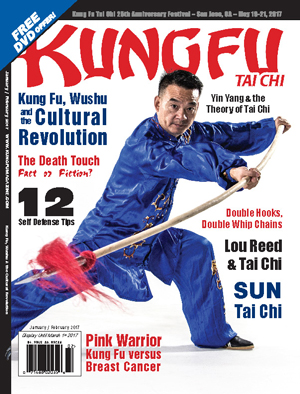 Carol was actually our very first got qi girl (back then she went by her maiden name Carol Wong). She is also a cancer survivor. She shared her personal story with our readers in "Pink Warrior Fighting Tactics" (JAN+FEB 2017). Of all our Kung Fu siblings, she understood what our Sifu was going through the best, so naturally she became his trusted advisor as he went through cancer treatments. I should’ve listened to her. I should have made space in my schedule somehow and visited him one last time before I left for L.A. Another Simui from Lam Kwoon let me know when he passed – Lori White, one of our copy editors and a frequent contributor to Kung Fu Tai Chi. She and her husband, my Sidai (younger martial brother 師弟) and our primary copy editor, Gary Shockley, had been bedside the day before along with several other of the disciples. Our Sifu passed in the hospital that night.
When I first arrived on set, I mentioned to some members of the cast and crew that my master was ailing, but I only let a few of them know when he died – the directors and showrunners, and those with a martial background who could understand the impact of such a loss. It was early in our shoot and I didn’t want to dwell on it because we all had a job to do, an intense one at that. We all needed to stay positive and focused because putting together a TV show is grueling work. It was my solitary burden and I worried that condolences might throw me even more off my game. When the camera is actually on you, there’s dozens of crew people working hard to make everything look good and you don’t want to let them down. It’s a lot of pressure.
If there’s one lesson Kung Fu propounds that is always applicable in life, it’s chi ku (吃苦), "eat bitter." Not only is this a guiding principle in Kung Fu, it's a fundamental cultural concept one must understand to even begin to comprehend China. In practice, we suffer the pains of training, endure the bitter in our schools, so it doesn’t faze us in the real world. This reminds me of another story about the founder of Zen and Kung Fu, Bodhidharma, and when he first met Huike. Huike was Bodhidharma’s first disciple and eventually became his inheritor, but when they first met, things didn’t go so well. Huike was so offended by Bodhidharma’s teachings that he struck him in the face with his Iron Beads, breaking Bodhidharma’s two front teeth. Bodhidharma knew that if his teeth fell to the earth, China would be cursed with three years of drought, so he swallowed his teeth, blood and all. Sometimes you just got to do that – eat bitter and swallow your teeth. Stay sharp and move on.
MAN AT ARMS: ART OF WAR is a show about weapons, ancient cold arms, swords, spears – heck, we even built a huge ballista for Season 1. I’ve written a lot about it online and in our July+August 2017 issue, and rest assured, I’ll have more to come when Season 2 launches later this year, both online and in our upcoming WINTER 2019 issue. My Sifu and I shared a deep love for ancient weapons. We were both sword makers – professional sword makers – as odd as that looks on our resumes. His passing made working on Season 2 more poignant, because I wouldn’t even have been cast on this show without his influence. I’m sure my Sifu would’ve been proud of me for the work I do on MAN AT ARMS: ART OF WAR, but I don’t think he ever saw our show.

MAN AT ARMS: ART OF WAR Season 2 L-R: Danny Trejo, Gene Ching, Kerry Stagmer. Photo courtesy of El Rey Network.
A Funeral, a Symphony and a Judge’s Meeting
The day after we wrapped and I flew home, I went to Sifu’s viewing at the funeral. I was exhausted, but so grateful that I was able to be there. There’s a lot of timing that governs Daoist funerals, Feng Shui stuff, and I was worried it would take place when I was already committed to TCEKFMCX duties. There was some overlap, and I just had to swallow those bitter teeth, but I was able to bear witness to most of it. As a small reprieve, my drive to the cemetery was spectacular. The wildflowers were all in peak bloom. It was this ephemeral corridor transporting me to and from my last look on the body of the man who started me on my Kung Fu journey – the man who laid my martial foundation and cemented my life’s path. Such a blessing were those wildflowers, so brilliant and so fleeting.
Another reprieve came that evening because my wife and I had tickets to the Santa Cruz Symphony. It was a performance of Symphony No. 2 by Gustav Mahler. Anyone who knows classical music will understand how poignant that was for me to hear at that moment. For those unfamiliar with the classics, this is also known as the Resurrection Symphony. It’s Mahler’s musical exploration of death, resurrection and the afterlife. It moves from despair and mortality to hope, redemption and eternal life. The chorus rang so true.
O believe, my heart, O believe:
Nothing to you is lost!
Yours is, yes yours, is what you desired
Yours, what you have loved
What you have fought for!
The next day was the burial and reception. Unfortunately it was also our Tiger Claw Judges’ Union meeting, the first of two to prepare our judges for the Tiger Claw Elite KungFuMagazine.com Championship X. I lead those meetings and there were a lot of rule changes this year, more than ever before. There was no way I could be absent. There was no one else to do it. It was time to swallow those bitter teeth again.

Our pool of TCJU judges are a mix of traditional Kung Fu and modern Wushu masters. The traditionalists, they all knew my master, knew our connection, and knew he had passed. They were quick to offer their condolences. The modernists, some of them knew, but most of them did not. This generation gap is closing, but will surely still be with us for years to come. That is reflected in TCEKFMCX, and our latest rule renovations hoped to reconcile some of that.
The main culprit has been my other lineage, Songshan Shaolin, or, more specifically, the martial arts practiced at Shaolin Temple today. Shaolin Temple has always been a chronicler and keeper of Chinese martial arts. That’s how it has earned its place in history. And for it to stay vital, the temple has incorporated Modern Wushu. It’s ironic because this is looked upon with disdain by traditionalists, but inclusiveness is actually the tradition of authentic Shaolin. It mucks up the division between traditional Kung Fu and Modern Wushu at tournaments, because the same Songshan Shaolin form can be played with either a traditional or modern emphasis. For wushu exponents, wushu is wushu, and the term Traditional Wushu (chuantong wushu 传统武术) makes perfect sense. They don’t care if Songshan Shaolin competitors bust an aerial in their rings. They expect it. East is east, west is west, and Modern Wushu is Modern Wushu. For traditionalists, they do care, especially when they are bested by Modern Wushu practitioners. The gymnastic trappings of Modern Wushu have no place in traditional rings so aerials and other Wushu trickery are frowned upon. The rub is that if a competitor has the athletic skill to make such a move, they are physically superior and can often outshine their competition. What's more, Modern Wushu is designed for competition, so their forms are intrinsically more appealing to the audience and to novice judges. Traditional practitioners are highly offended when a Wushu athlete wins in their divisions, and rightly so.

Here in the San Francisco Bay Area, there is a massive number of Shaolin masters. In our November+December 2007 issue, we published “The Gold Mountain Monks: 38 Shaolin Immigrants to the San Francisco Bay Area.” Thirty-eight in 2007. Since then, we’ve lost count. There are so many. I used to make a point of meeting every fresh-off-the-boat master from Shaolin. Now I can't even keep track in my own neighborhood. So to meet the needs of our populous local Shaolin community, we created a separate division just for Songshan Shaolin, distinct from Traditional Kung Fu and Modern Wushu. Local Shaolin Masters Chen Fei and Xu Dezheng helped organize the local Songshan Shaolin schools and oversee this new division. That was no easy task given some of the volatile rivalries between some of the Shaolin schools. Even though Songshan Shaolin masters are from the cradle of Zen, they are martial artists first. Some aren’t even Buddhist. Just like in any lineage in the martial world, there’s some bad blood between certain factions.
On top of that, we launched a new Showcase Championship, the Ku Yu-Cheung Bak Sil Lum Championship. Bak Sil Lum is Cantonese for Northern Shaolin. It’s a lineage of Kung Fu that is distinct yet connected from Songshan Shaolin. It came to prominence during the Republic of China period (1912–1949) and followed Grandmaster Ku Yu-Cheung to southern China, thus the Cantonese. Popular in Hong Kong, this was also my foundation style of Kung Fu, the style that Grandmaster Wing Lam taught me. It’s strictly traditional.
In the end, that Sunday TCJU meeting went really well overall. I don’t know if the judges in attendance were just being compassionate with me, knowing that it was the funeral weekend for my master, or what. It didn’t matter, but I was grateful it went so smoothly. It was actually one of the best meetings we've had. The judges were very engaged and we had lots of very positive discussions on how to improve our tournament. After my duties were done, I rushed to catch up with my Lam Kwoon family at the reception. It was so good to be reunited with fellow mourners including some Kung Fu siblings that I had not seen in several decades. For some of them, that might be the last time we ever cross paths. I can't imagine another event that would bring us all together again.

As for Tiger Claw Elite KungFuMagazine.com Championship X, there will be full coverage in our next issue, the FALL 2018. What’s more, subscribers will get an exclusive DVD of TCEKFMCX as an added bonus. In order to receive this DVD, subscribe by July 31, 2018.
And of course, I'll continue with this post-TCEC blog in our next installment. Stay tuned and stay sharp.
About author:
Subscribe to KungFuMagazine.com here.
Get your print edition of the MID-AUTUMN 2026 here.
Gene Ching is the Publisher of KungFuMagazine.com and the author of Shaolin Trips.


