
 On November 15, 2015, AMC launches Into the Badlands, an unprecedented television series that caters directly to the martial arts genre. I had the privilege of attending the Hollywood premiere where I spoke with Charlie Collier, AMC President & General Manager. Collier is the maverick behind AMC’s previous game-changing successes, Mad Men, Breaking Bad and The Walking Dead. “The martial arts fans are underserved by television,” he told me. “We want to serve fans of the martial arts genre just like we served fans of the horror genre with The Walking Dead.” As a lifelong fan of martial arts films, his comment warmed the bottom of my heart.
The star of Into the Badlands is Daniel Wu, who I interviewed a year prior for our NOV+DEC 2014 issue for my column installment: Chollywood Rising: Interview with Daniel Wu. That interview was ostensibly about his film, The Last Supper, but we discussed many things, including Into the Badlands and his history as one of the pioneers of Wushu in America. Wu founded the University of Oregon Wushu Club, one of our nation’s very first collegiate clubs. “It’s cool that it’s still going,” said Wu with delight. “I went back a few years ago to give a talk. I visited the club and saw kids there I don’t know anymore. I made a small speech. I go, ‘You know, 15 years ago when I started this club, I had no idea that it would be lasting this long.’ And this kid raised her hand and she goes, ‘I was 3 years old.’ (laughs) I was like, ‘My god. You made me feel super old.’ But it’s cool to think about that. When that kid was three years old, I started that club, and that kid knew nothing about Wushu and somehow they found Wushu. They’re working out there and learning it and spreading the knowledge. It’s cool to be able to see that.
“Martial arts to me was always about not just the fighting part. It was about the spiritual side, the cultural side, and trying to spread it to as many people as possible. To see that happen through the Wushu club and also through film, hopefully Badlands will inspire more kids to learn martial arts. That would be really cool.”
 After graduating with a degree in architecture, Wu went to Hong Kong to witness its return to China and was discovered by chance. He rose to become an A-list actor in Asia, starring in nearly 70 films ranging from thrillers to drama to comedy. And yet, he remains virtually unknown in his own homeland. Americans might know him from a few of his crossover projects. In Inseparable (2011), he starred alongside Kevin Spacey, which was the first time a major Hollywood star appeared in a completely Chinese-financed production, a precursor to the increasingly prevalent attempts to court the expanding Chinese film market today. He was also in Europa Report (2013), about a failed Mars mission, which had an international cast including Michael Nyqvist (The Girl with the Dragon Tattoo (2009), John Wick (2014)). But martial arts fans might know him for his action films with Jackie Chan such as Gorgeous (1999), Around the World in 80 Days (2004), Rob-B-Hood (2006), Shinjuku Incident (2009), Chinese Zodiac (2012). He also starred alongside Russell Crowe and RZA in The Man with the Iron Fists (2012). Wu has won both of Asia’s most prestigious cinematic awards: a Hong Kong Film Award for his work with Jackie in New Police Story (2006) and Taiwan’s Golden Horse for directing The Heavenly Kings, a mockumentary spoof on Asian celebrities, in which he also starred as a caricature of himself.
Wu enjoys his American anonymity. He can come home and be like a regular person. Many of his Into the Badlands co-stars had no idea how famous he is on the other side of the Pacific. As part of a preparatory acting exercise, Wu was asked to go on a faux date with his co-star, his character’s love interest in Badlands, Madeleine Mantock. Mantock felt a little awkward about it after meeting his family, but was really shocked to hear him recount about how he had to fend off the paparazzi at the hospital when his daughter was born. “I had no idea,” confessed Mantock on the magnitude of Wu’s celebrity in Asia. Nevertheless, Wu is now eager to show his homeland what he’s got, even if that means losing his “normal” status here in the States. “I think it’ll be interesting,” says Wu wistfully. “I’ve always been a person that does things his own way. So to come in this way that’s very different than anyone else, I’m excited about that. It could work. It could not work. But at least I’m doing it my way. That’s more satisfying to me than anything else.”
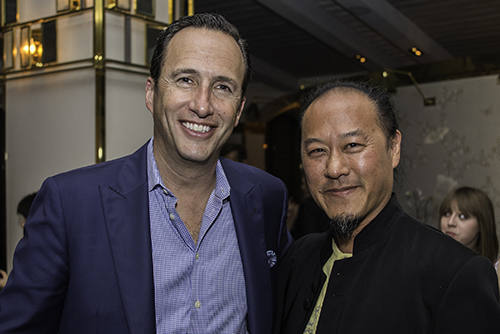
Charlie Collier (AMC President & General Manager), Gene Ching
The Rise of Martial Arts Television
Wu was originally brought on to Into the Badlands as an executive producer, not as the lead. “In the end, it ended up being a dream project,” admits Wu. “While I was thinking about doing it, I had my producer’s hat on so I wasn’t thinking about me. This is not, in any way, a vanity project. It wasn’t like I thought up this project for me as a perfect dream. We thought it up as a perfect project. And then somehow I fit into it. The other producers wanted me to do it from day one, but were passive-aggressive about it.” He was thrilled by the creative leeway AMC gave his team as the project was developing. “To go into a genre they know nothing about, which is martial arts, and then trust us with that, is a whole other thing. It’s great. They gave us so much freedom in terms of creativity, how the story went, how we design things, how we created the world for the Badlands. They gave us carte blanche on how to do that. And in terms of the martial arts action, they really stepped back. They were like, ‘You guys obviously know what you’re doing.’ They saw the first scene that we pre-visualized. Before we started filming, we pre-visualized a scene and shot it just in the workout room that we were working out in and then presented it to them. And they were so impressed by that that they just stepped back and let us do what we wanted. It was pretty amazing of them to do that.” Wu is cast as Sunny, a name that’s a nod to the Monkey King, Sun Wukong, from where Into the Badlands draws some inspiration. Sunny is the top assassin, known as a Clipper in Into the Badlands. Sunny’s constant battles to stay on top lend themselves to plenty of fight scenes in every episode.
Wu brought a fight team from Hong Kong, led by his longtime filmmaking partner Stephen Fung and fight choreography veteran Dee Dee Ku. Together, the three of them worked with the cast in an extensive “fight camp” prior to filming. Most of the actresses had a background in dance. Under the fight team’s seasoned hands, the cast became proficient very quickly. Wu was impressed by how well Emily Beecham progressed. Beecham’s character is the ultimate fighting femme fatale. The world of Into the Badlands is ruled by Barons, and Beecham plays a Baron named the Widow. Wu explains, “There are very strong female characters like the Widow played by Emily Beecham. She is a baroness that has come to power by force. You can see that she has very feminist ideals. Her entire group of Clippers are called ‘the Butterflies’ and are all females. She’s into female preservation so there is a sort of gender issue that happens in the Badlands.” It was Beecham’s first exposure to Hong Kong fight choreography and she loved working with Daniel, Dee Dee and Stephen. “They are so dedicated to their work,” she gushed.
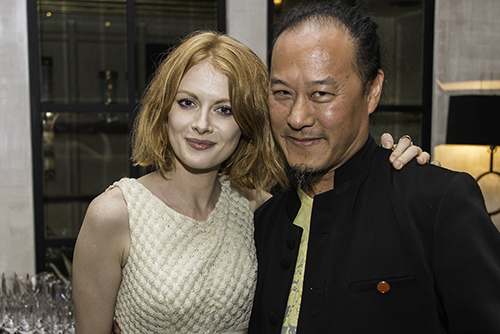
Emily Beecham, Gene Ching
The rest of the cast enjoyed working with the Hong Kong fight team as well. Ally Ioannides, who plays the Widow’s daughter and top Clipper Tilda, really got into the practice. The teenage actress was inspired to pursue Wushu on her own time, outside the camp. And Aramis Knight, whose athletic background is in basketball, was very proud of the fight scene he has with Wu on the Fort Gate towards the end of the season. Knight plays M.K., Sunny’s disciple, or Colt as they are called in Into the Badlands. And just as Sunny is a nod to Sun Wukong, M.K. is a nod to “monk” – specifically the historical Buddhist monk Xuan Zang (602-664 CE) who plays a fictionalized role in the Monkey King classic, Journey to the West. In that tale, all of the demons want to eat Monk Xuan Zang because taking his flesh and blood is the key to power and immortality. The Monkey King is charged to protect the monk on his perilous quest to get the Buddhist sutras. InInto the Badlands, Sunny must also protect his Colt M.K., and there’s something about M.K.’s blood that has all the Barons wanting him too, but I don’t want to spoil it. Apart from some wirework, Wu claims most of the fight scenes are as analog as possible. Only Knight’s fights have a lot of CGI effects, and that’s because of M.K.’s special blood. Watching all her co-stars in fight scenes left Mantock a little jealous. “I really want to have a fight scene but my character is peaceful. I hope that if the series continues, my character will be forced to fight.”
AMC is leading the pack by marketing Into the Badlands so overtly to martial arts fans. Recently, there have been several shows with martial arts elements such as Arrow, Marco Polo, Daredevil, Kingdom, and more to come. However, as Wu has spent most of his time working in Asia, he hasn’t seen the trend here. “I don’t know. Is it trending? I have no idea. I think there’s definitely an audience for this kind of action on television. I don’t know if it’s trending but it’s definitely something that can be serviced because there’s a huge audience. From what I’ve heard and seen online, people’s reaction to videos of the Badlands trailer, is that they’ve all been waiting for something like this on television. And we know why. It’s incredibly hard to make. I think having these shows on television is definitely feeding a particular audience. That we can spread it to a wider audience is pretty cool.”
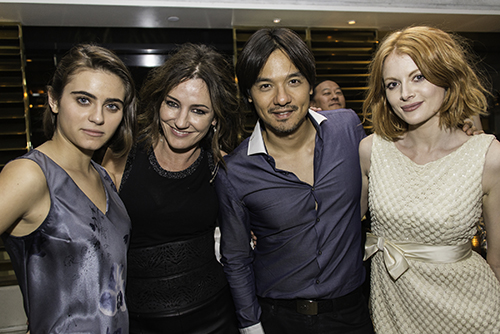
Ally Ioannides, Orla Brady, Stephen Fung, Emily Beecham
Polishing Sunny’s Swords
Now in his forties, Wu was tentative about accepting the role of Sunny at first because he worried that he couldn’t deliver the level of action required. Despite his background in martial arts, he intentionally avoided roles that might typecast him as “just an action star” and even left Jackie Chan’s JC Group after signing on, just to strike out on his own. He has parlayed that move into a diverse and eclectic number of roles, completely escaping being pigeonholed in Asia. But he’s happy to return now. “It’s interesting that it’s come full circle for me because, as a kid, I got into martial arts because of watching films. And now, I’m doing it and I’m hoping that Badlands will inspire a bunch of kids now to start learning martial arts. Keep that tradition going.”
What’s more, Into the Badlands gave him the opportunity to explore some of his martial dreams, like creating his own sword with the renowned weapon-makers of Lord of the Rings and The Hobbit, New Zealand’s Weta Workshop. “Weta Workshop – yeah,” says Wu admiringly. “Amazing stuff. The rubber swords that we used to fight with are amazing. Even when you’re holding them, they still looked really real.” Sunny’s swords look like katanas in long shots, but that’s just because the distinctive ito braided cord on the handle is so closely associated with Japanese sword handles. Chinese swords are often misrepresented with plain wood handles, but historically were wrapped like any sword handle, sometimes even with a twisted braid like a Japanese ito. “We worked with several people, some people in New Zealand that our show-runners had worked with before, and then I drew up tons and tons of different swords I thought would be cool and finally we came down basically to a straight single-edged katana in a double form. We found that that was going to be the most versatile shape, weight and body to work with for the shoot. And I just liked it. So it was cool. (laughs)” Wu says the straight edge makes Sunny’s swords akin to a Chinese jian, but because he uses two, he plays it more like a twin dao.
During the fight camp, Wu found himself getting back into his old sword techniques and really enjoying swordplay again. “It’s hard, hard on the wrists, hard on the forearms, hard on the joints because you have that extra torque on the end of your hand, so a lot of fighting with that takes its toll on the elbows and wrists.” However, despite Wu’s trepidations about his age, having his own custom-made swords and a solid fight choreography team has kept him safe. He feels his body is holding up pretty good so far, all things considered. “The only injury I got was a cracked rib from a wire mishap and that was it, I think. I was surprised that was the only injury I got through the whole shoot. I didn’t get any twisted ankles. I didn’t get anything messed up. I had predicted it would be much worse (laughs). I’ve gone through pretty major injuries in the past. I’ve torn my ACL, I broke my ankle, I have numerous back problems from doing too much Wushu. All that stuff never really cropped up on me while we were filming, so I was pretty lucky.
“I’m on a shoot right now with Ringo Lam, and on the second day of the fight scene, I got accidentally head-butted in the nose and broke my nose. I’m coming out lucky with Badlands. I’m doing really good.” From watching Into the Badlands, it seems Wu’s initial plan of having a younger man play Sunny might not have worked as well. Wu brings more maturity to the role that would have been completely absent with a younger star.
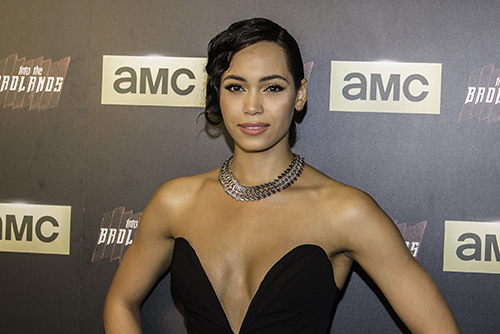
Madeleine Mantock
The Future Looks Sunny
For Daniel Wu, doing things “his way” means having a lot of projects in the queue on top of Into the Badlands. Slated for a summer 2016 premiere is Warcraft, a film based on one of the world’s most popular massively multiplayer online role-playing game, or MMORPG as they are called. Set in a world of swords and sorcery, Wu is motion-captured for the role of the orcish shaman Gul'dan. However despite all the medieval weapons, Wu doesn’t get to show off his martial skills in this one. “It was more traditional fighting. We talked about that because I know Roger Yuan worked on that, who is also a very good martial artist. But I think we talked about the fighting being more orc-like than human-like. It would be weird for an orc to all of a sudden pull off a twist. It was more like giant fighting versus martial arts fighting.” Given its worldwide following of dedicated players, Warcraft might be a global blockbuster. Wu also has a role in Geostorm, slated to premiere in early 2017. Starring Gerard Butler, Geostorm is a Hollywood production about an astronaut trying to prevent weather-controlling satellites from creating a catastrophic storm while his brother tries to prevent a presidential assassination plot.
Back in Asia, Wu is working on the aforementioned Ringo Lam film. “We’re doing a movie called…actually I don’t know what the English title is. It’s called Tian Fo, which is like ‘Sky Fire.’ Ringo is somebody who I haven’t worked with before in the past but I’ve always wanted to ever since the first day I got in the business, just because he’s such a legend. He approached me last year to do a project, which is out now, Wild City, and I was not able to do it at the last minute. My mother got sick and passed away so I had to go back to the States. I ended up backing out of the project at the last minute. But then after he finished Wild City, he wrote this new script and brought me on board again. I’m really happy to be working with Ringo.” Unfortunately, the final installment of the Tai Chi trilogy with Into the Badlands fight choreographer Stephen Fung is still on hold. “We did a very interesting thing because Tai Chi Zero and Tai Chi Hero were released within two months of each other. That kind of sequel release had never been done before and so the marketing wasn’t done well on the release of the second episode. It didn’t do as well as the studio had planned. So they put Part 3 on hold until then.”

Madeleine Mantock, Gene Ching
AMC hopes Into the Badlands will help them penetrate that lucrative Asian market, so although the American reaction is important, there’s a much bigger game afoot. In late October, Wu and Fung returned to their home turf in Hong Kong to present Into the Badlands at the Cable and Satellite Association of Asia in Hong Kong, where it was picked up to premiere at the same time as it will premiere in the United States. This all looks very promising for AMC. “We are definitely working on the second season now. I think the studio still has a few things that they need to look at before they green-light it, but content-wise they love the show. It’s a very expensive show to make because it’s all world-building. We’ve got to bring the budget down a little bit. Once we do that, then they’ll green-light it. Working on balancing that budget right now. Any kind of show where you’re building a whole world, the first season is going to be expensive because all the clothes are custom-made. A lot of sets are built or modified from previous things. So there’s a lot of start-up costs. It’s like a start-up company. But once it gets running, it gets efficient. We’re just at that stage now, trying to get it to run efficiently.” There are already rumors of the production moving from Louisiana, where the first season was shot, to New Zealand. Wu is optimistic and teases the possibilities of this Journey to the West allegory with the other two characters from the classic, Pigsy and Sandy. “As we venture out of the Badlands, those characters may come into play.
“There’s so much about Badlands that’s great. The action is great. I think the drama and the story is really compelling. There’s so much to take out of it from different perspectives. That’s my own personal thing that I’m stoked about, that it can have that power to inspire young kids to learn martial arts, but there’s so much other things as well. People will get stuff out of the story. Martial arts practitioners will be excited about the action itself. It’s hard to say what one thing I want to get out of it.”
Right now, Daniel Wu is the martial artist to watch. “Yeah. A lot of cool things happening all over the place.”
About author:
Subscribe to KungFuMagazine.com here.
Get your print edition of the MID-AUTUMN 2026 here.
Gene Ching is the Publisher of KungFuMagazine.com and the author of Shaolin Trips.


