
 Anyone who has attended one of our Tiger Claw Elite Championships knows Greg. As a videographer, he has been documenting our championships through his company Bad Ass Bunny Productions since 2010 for our YouTube channel. He has also video-ed some Shaolin events for us, travelled to Shaolin Temple personally, and contributed several freelance articles and photos to Kung Fu Tai Chi over the years, beginning in 2008. However, although he’s dabbled in the Chinese Martial Arts, that isn’t where I first met him. We met back in the late '70s in Salle DeCesare, a fencing academy in the heart of Silicon Valley, right when personal computers were just beginning. Now he’s returned to fencing with a new documentary he’s made with another old fencing teammate of mine, Doug Nichols.
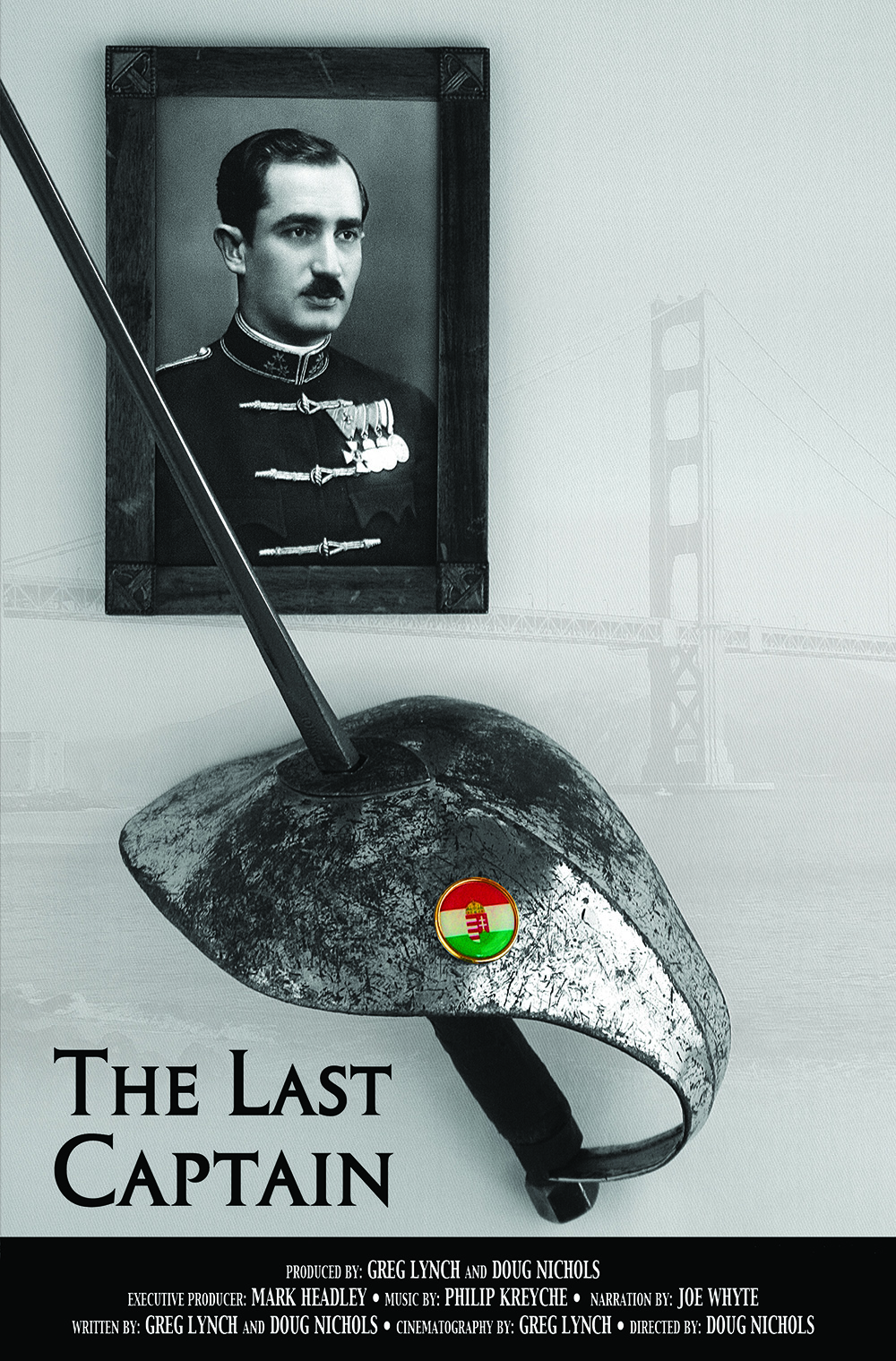
THE LAST CAPTAIN is a documentary of one of the greatest fencing masters of the last generation, George Piller.
GC: So before we get into THE LAST CAPTAIN, tell me, what was some of your favorite experiences with the Tiger Claw Elite Championships?
GL: Although not a part of TCEC, I think shooting the Ray Park cover has to be the highlight. I got to spend two hours with Darth Maul and have him do martial art poses. Closely following that would have to be meeting Grandmaster Tu and learning about the Iron Crotch. I met him at the Szechuan Earthquake Benefit. There was an amazing group of athletes putting on magnificent displays. But Grandmaster Tu always seems to be in a class by his own. And it was at the 25th anniversary shows that I finally got to see him lift. He was just warming up, testing out his gear, and his daughter Jenny called me over to see if I wanted to see him lift. Did I want to see him lift? I’d been trying to see that for the last decade. I almost missed the shot he was going so fast. I had just pressed record on the cameras and he had already started. He casually lifted about 400 lbs with his penis. Later on Sunday, a different Iron Crotch specialist, billed as the world champion, lifted about 100 lbs of medals. He also inadvertently flashed the audience. At some point there has to be a lift off between these two.
GC: What made you want to tell Master Piller’s story?
GL: I’ve been a photographer since I was in high school. I received my BA in Screenwriting. I’ve been in the film industry for the last twenty five years but in the construction side. It’s always been my dream to make a movie on my own. But if you go to Hollywood, you quickly find out that there are millions of people with the same dream.
About five years ago, I helped THE LAST CAPTAIN’s director, Doug Nichols, set up a website for the West Coast Fencing Archive. The WCFA is Doug’s passion project to catalog the history of fencing on the West Coast of the United States. One of the stories that Doug had researched was the story of George Piller. Doug told the story of Piller to the financial backer of the Archive who idly said he would pay a lot of money to see that film. That seemed like a challenge. Doug and I put a budget together and he gave us the money to do it.
Initially, it was purely mercenary on my part to make THE LAST CAPTAIN documentary. I didn’t know Piller from a hole in the ground. But here was a chance to make a film and I leapt at the opportunity. But the more research I did and the more I found out about Piller, the more I wanted to tell his story.
GC: And how did documentary making go for you?
GL: One of the best parts of making THE LAST CAPTAIN was separating out the truth from the myth. Granted, Doug Nichols and I are not journalists. I’ve been in set construction for the majority of my career and have only recently turned to filmmaking as a pursuit. Doug worked in Animation at all the big firms including Disney, Pixar, and more recently for Lucas Film. But there was something satisfying about finding the facts that lay beneath the myths of George Piller. The adage goes, when the legend becomes fact, print the legend. In our case, the facts seemed so much more interesting than the legends that started us on this project.
GC: When documenting the Chinese martial arts, there’s a wealth of historical sources for me to mine. Was that the same for fencing?
GL: Fencing doesn’t seem to have much use for its own history. It’s mostly concerned about the here and now. It’s concerned about what is the best way for me to defeat my opponent in front of me. It doesn’t matter how those methods came about. To quote yet another movie, as Raul Julia said in The Gumball Rally (1976), “What’s behind me, it’s not important.”
So, the history of Fencing is an oral one. And an unreliable oral history as well. Our jumping-off point for the history of George Piller came from lectures of Charles Selberg. Selberg taught fencing in the Bay Area, most notably as the coach at UC Santa Cruz. Everyone agrees that Charlie was a fabulous raconteur. Everyone also agreed that Charlie would never let facts get in the way of a good story.
But he was our starting point. I went through hours of videotape that Charlie had recorded over the years of his seminars and classes. It’s where I found traces and bits of the George Piller story to build on the research Doug Nichols had done.

GC: I knew Maestro Selberg. I even took a few lessons from him and heard some of his Piller tales firsthand. I imagine that would have been challenging to untangle and validate.

Fencing Master George Piller.
GL: One of the main stories in the films that we took as fundamental was that an Italian man named Italo Santelli living in Budapest, Hungary, and László Borsody, a military fencing instructor, got together and revolutionized the sport of saber fencing. And their prime example of this new technique in saber fencing was embodied in George Piller. Piller for a string of years could not be beaten as a result of this new training.
GC: Maestro Santelli was a legend. His son Giorgio had a tremendous impact on fencing in America, training a stable of U.S. champions and founding one of the first fencing supply companies here. And Maestro Borsody, well, you tell it.
GL: What a great story. It could be a film all by itself. But as we were to find out during the course of making the film, there were some glaring inaccuracies in the story. The most basic of all was that far from being colleagues, Santelli and Borsody were tremendous rivals.
Santelli and Borsody had competing fencing schools in Budapest, Hungary. Santelli had been brought over from Italy because he did have new techniques in fencing saber. The Hungarian fencers had been humiliated at an 1896 exhibition by the Italian fencers using these new techniques.
GC: I think it’s important to mention that fencing was much more than just a sport in those days. People still fought duels with live swords. So it was still a very viable and lethal martial art.
GL: Santelli’s school taught everyone, especially Jewish fencers. The Jews in Budapest at the time were subject to be challenged to duels. They needed to learn to defend themselves. Santelli was one of the few who would teach them.
László Borsody taught at the Toldi-Miklos military academy. His job was to train officers and soldiers. George Piller was in the military and trained with Borsody. He was Borsody’s top student. Borsody would send Piller and his other students to Santelli’s club to test themselves against his pupils.
GC: Maestro Santelli was dubbed “The Father of Modern Saber Fencing.”
GL: One of our interviewees would have us believe that Santelli offered nothing to the school of modern Hungarian saber fencing. That all the success of the new techniques of modern Hungarian saber fencing was due to Borsody. But here again, we had to be careful even though we were talking to a Borsody and Piller scholar, a man who had written books on the subject. Although, he wanted to dismiss Santelli’s contributions, two of the greatest fencers at that time, after Piller, were Santelli’s students. It helped us in our quest for the facts that we listened to a lot of different voices and went to a lot of various sources.
At one point, I grew afraid that this quest for facts might lead us to a place I didn’t want to go. The time between World War 1 and World War 2 was a turbulent time in Europe, especially in Hungary. Antisemitism and fascism were prevalent everywhere and I was afraid that George Piller might have had some skeletons in his closet.

Some of Piller’s medals.
Piller was in the military. He was part of the elite group that guarded the Hungarian Regent, Miklos Horthy. According to the books I read, World War 2 caused a lot of problems for Hungary. Hungary got through the majority of the war unscathed. But strong elements in the country wanted them to ally more fully with Nazi Germany. Towards the end of the war, Horthy was deposed and the Nazis took full control. Jews were being rounded up and shipped off to concentration camps. I was afraid that Piller might be involved and these atrocities.
Fortunately, Dr. Gergeley Sallay of the Military History Museum in Budapest had documentation that exonerated Piller. It was a letter from Piller’s Jewish neighbor that talked of how Piller helped this neighbor avoid deportation.
It’s also interesting to note that at the end of the war Piller found himself on the way to a Russian internment camp. How he escaped from that forms one of the incredible elements of THE LAST CAPTAIN.
GC: How many interviews went into THE LAST CAPTAIN?
GL: We did 5 interviews here in California. We traveled to New York and the East Coast and did 8 there. One quick stop in Louisiana to interview the United States Fencing Historian, Andy Shaw. And then 10 more in Budapest, Hungary.

Coach Andy Shaw, official historian for the US Fencing Association.
GC: What’s one of the surprising stories that came out of your research?
GL: There is Frank Iszak. Sometime in your quest for facts you come across an amazing story that has little or no place in our story. Iszak, like Piller, was a refugee from Hungary. He did not know Piller in Hungary but met up with him at the Pannonia Athletic Club in San Francisco. They spent many nights playing cards at the club and were quite good friends.
But the amazing thing I learned about Iszak is that he was the first Airplane Hijacker. During 1956, Hungary was in crisis. Years of communist rule had decimated the economy of the country and people were getting restless. The people either wanted a change in the government or they wanted to get out of the country. At that time, Hungary was a satellite country of the USSR and was taking their orders from Moscow. The Soviets were not about to let Hungary change their government. This conflict led to the Hungarian Uprising and the subsequent crackdown of the uprising by the Soviet military.
Before those October events, though, Iszak and some compatriots came up with a plan to get out of the country. They hijacked a plane and flew it to West Germany. It was a daring escape that Iszak recounts in his book, Flight to Freedom.
Iszak felt that he should have been made a hero for his exploits, lionized in newspapers around the world for thumbing his nose at the Soviet Empire. Unfortunately for Iszak, the Hungarian Uprising took place a few months later and drove his story to the back pages of the newspapers. People wanted to hear about the Hungarian Olympic team, including George Piller, defecting during the games in Melbourne, Australia, not about a couple of people flying a plane to West Germany. Iszak is still a little disappointed his story isn’t more widely known.

Dr. Col. Vilmos Kovács.
GC: Now that THE LAST CAPTAIN is available to stream, what’s next for you?
GL: When we finished up THE LAST CAPTAIN, we still had some money left in the budget. We were also looking for something to do while THE LAST CAPTAIN made the round of festivals. During college at SJSU, Doug Nichols was a student of an equally interesting fencing master by the name of Michael D’Asaro. I took lessons from him as well down in Los Angeles.
GC: Full disclosure – Maestro D’Asaro was my coach when I was at SJSU.
GL: D’Asaro’s life story was equally compelling and Doug and I moved on to telling that story. We are currently in post-production on STRO and hope to be showing it early next year.

L-R: Greg Lynch Jr., Olympic fencing medalist Peter Westbrook, Doug Nichols.
About author:
Subscribe to KungFuMagazine.com here.
Get your print edition of the MID-AUTUMN 2026 here.
Gene Ching is the Publisher of KungFuMagazine.com and the author of Shaolin Trips.


