
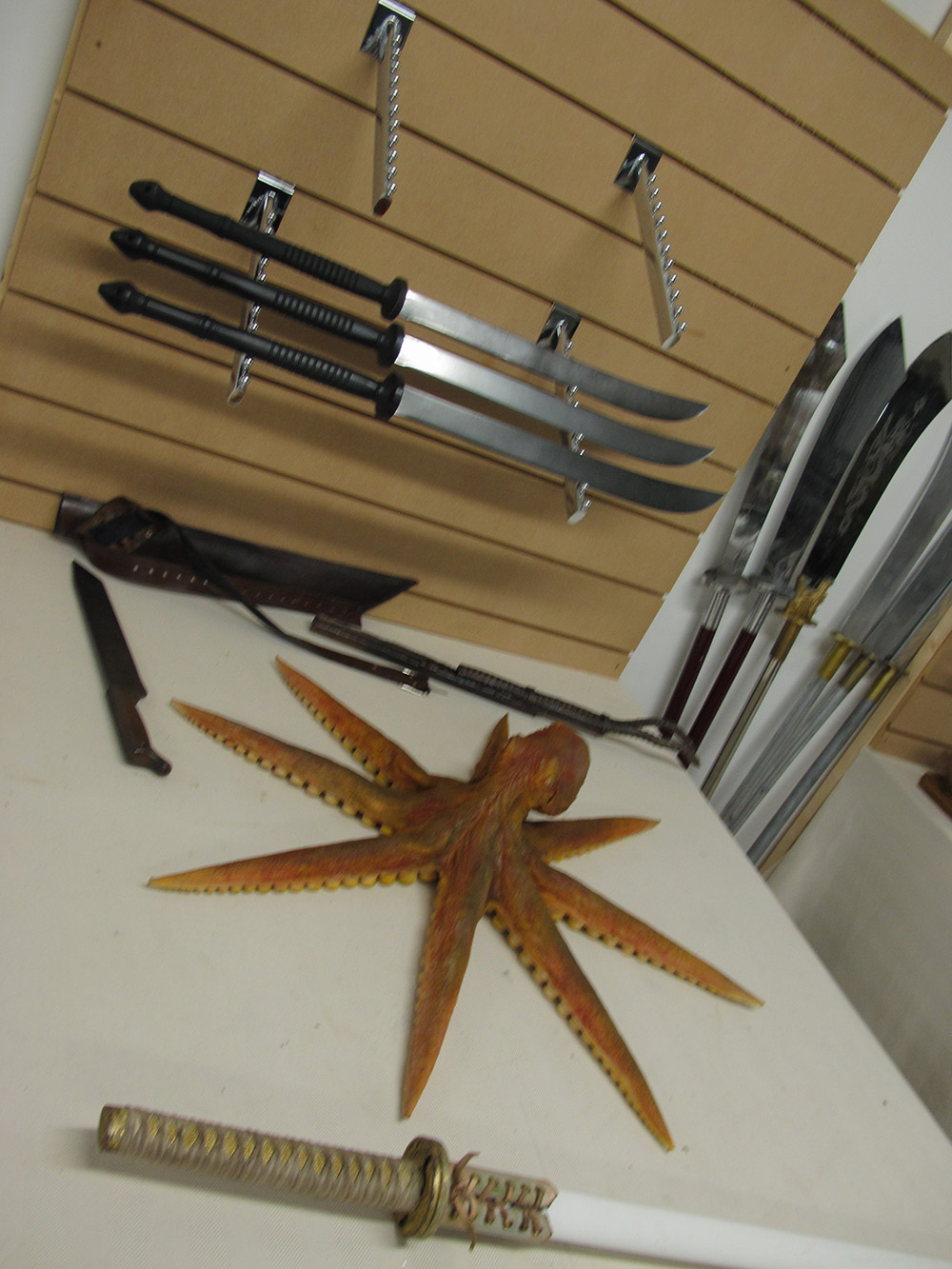
 Ally Ioannides really wants us to poke the octopus. Transfixing our small band of reporters with her hypnotizing blue-green eyes, the young actress who plays Tilda in INTO THE BADLANDS insists that prodding the cephalopod is well worth our time. “I was literally just playing with it before. I was down in the Armory and one of our Armory guys was there and I was like, 'Can I touch the octopus?' And he was like, 'Be careful.' [laughs] You should definitely go poke the octopus. It's really fun.”
An octopus in the Armory? Welcome to INTO THE BADLANDS, Season 3, where anything can become a lethal weapon. In Episode 6 “Black Wind Howls,” Bajie (Nick Frost) improvises with some seafood and in an inspired moment, creates the now infamous Octopus nunchuk, a tentacled tribute to Bruce Lee. It's a funny and furious fight scene, something that only Frost can make work. For Season 3, AMC granted unprecedented access to the press, including an opportunity to visit the Badlands Armory and chat with the weapon makers.
“This is a more rubbery version, not so camera friendly," explains Daniel O’Flaherty as he points to the splayed octopus conspicuously sitting in the middle of a table brimming with weapons. O'Flaherty is the Weapon/Action Prop Coordinator for the show. “We had some silicon ones that looked extremely real. But in the script, it does read that it's nunchuks, you know? Octopus nunchuks. So we sculpted this guy from scratch, and then molded and made different variations. So this variation, he can maybe hold them and do that, and maybe flip him around, but – yeah, it's sculpted from scratch and then rubber is injected – we made sure with all the versions on the set – these are crazy versions.”
And it wasn’t just the octopus that was combat ready. There was a whole pescatarian banquet at their fighting disposal. “It's a massive fish market,” continues O’Flaherty, describing the fight scene location. “We actually made 600 fish that were fight safe, so they could grab something and clunk with it. And you don't want to fill a set with fish anyways because it's bad for two days. It's going to be horrible. So we went ahead and tasked it. We made everything in rubber. So there was rubber eels; there was rubber fish. It comes up in the script really quick and it has to be fight safe. It can't hit. I mean it has to look good, with that shine on it, have a look. Get a different one, that's more sturdy. This one is a little too crazy. It's just good to start with something anyway. But you have 600 fish on that set. And then loads of these guys to use as nunchuks. I don't know how but they did a really good job. It was cool to watch it.”
“In the Badlands, anything can become a weapon, you know?” adds Mark Maher, the Lead Model Maker for INTO THE BADLANDS. “With Nick Frost, with Bajie's character, he can pick up anything and the more comedic it is, the better. And then to really turn it into something that looks very impressive in a fight. You would never think you're going to pick up an octopus and use it as a weapon, but…”
“...But when you read it in the script it's like, 'Are you serious?'” chimes in O’Flaherty. "We have to make an octopus nunchuks? But it ended up being really cool. You can see the comedic element to it and it kind of looks good.” O’Flaherty remembers when Frost first laid eyes on the octopus. “When he walked past it, I said, 'You're going to do an octopus nunchuk fight scene.' I don't think he believed me at first.”

Badlands Blade Makers

blind assassin swords
Beyond fake fish and silicon octopus, O’Flaherty and Maher lead a crack team of artists responsible for the most critical props in the Badlands – the weapons. For such a visionary show, each weapon is unique. All of that has to be dreamt up, designed and built – and built to take a beating. They can’t have sword props breaking in the middle of a fight scene. A tremendous amount of thought and craftsmanship goes into each piece, whether it be a new weapon or something as absurd as an octopus nunchuk.
Daniel Wu, who plays Sunny, explains. “We have some new things to keep it fresh. Swords, swords, swords all the time – we want to make new weapons. So we have cool old school Kung Fu weapons that are going to be modified in a new post-apocalyptic kind of way. We have the hammer comet thing – it’s also part of a mace that turns into that. We’ve got a lot of interesting weapons too now. That’s the fun part of the show too, as being a martial artist, I get to help design some weapons. It’s fun doing that – just kind of like brainstorming things and seeing what works and seeing what doesn’t work. Like you’ll work on a design: ‘Oh, looks so awesome.’ And then you’ll pick it up and, ‘Aw, it’s shit. That’s not so great.’ Balance is off or something like that. And then when you come across something that’s great, we try to repeat that and use it quite often. Because all that stuff is really important. We’re using them so much – the balance and how it feels in your hand is really, really important. If there’s any detailed carving on the handle, that’ll just tear your hands up, you know. So you learn a lot while you’re making the show, working on designing props and all that kind of stuff. It’s fun.”
Back in the Armory, O’Flaherty and Maher go into greater detail about their extraordinary craft. Obviously they aren’t forging weapons out of steel. That would be too costly, too extravagant and too lethal for a television production. “We do a carbon rod, basically,” reveals O’Flaherty. “Then we scoped and digitally print the handle. And then we put the carbon rod and we’ll just spray it. And we have a chroming machine down there. It’s the only one in Ireland. And then we chrome it. And we get a really nice high shine finish on it. So when the guys are in action, you do see that shine. So when they first come out of the workshop, you’ll see the reflection. And that’s quite important, I think, for the show, so they don’t look like it’s sprayed out of a can.”
“It’s often the challenge to make something that a stuntman can fight with,” explains Maher. “Our blind swordsmen swords, which are here [Maher picks up an example]. I’ll show you those in carbon fiber. They’ve got a really long handle. These have seen a lot of action. That’s a two-handed. Weight-wise, this is all carbon fiber.”
“Different than the weapons that we usually make,” adds O’Flaherty, “and for some reason these would definitely break and we had to come up with something. So the carbon fiber rod was the way to go.” Maher holds aloft one of the blind swordsmen weapons admiringly. “And we’ve seen them give this a real hammering,” he says with pride. “They really survive a swordfight.”

The blind swordsmen are featured in Episode 4 “Blind Cannibal Assassins,” loosely inspired by the classic Japanese blind swordsman Zatoichi. “He was a blind warrior and he had a very long handle,” recalls O’Flaherty. “And I just mentioned it to Miles [Millar – one of the show’s creators] and Miles seems to really like that idea. We had nearly kind of a human flesh finish. That was the idea behind it. But the fact that they could move in unison together – so that was the idea.”
Maher discloses the backstory. “There’s a part of the storyline where mutineers had captured Ryder (Oliver Stark) and they were blinded by Waldo (Stephen Lang). And they actually end up in an underground hospital. So they’re all blind, and when Sunny and Bajie stumble across them, they move in unison almost like with a sixth sense. And they move throughout a darkened building in unison. And each move is choreographed as a unit. And these are the swords they wield for that. Some of the scenes are really, really amazing the way they fought with them, all moving in synch, you know?”
O’Flaherty clarifies. “We’re trying to put a thought into each character as well, you know? Like even the Totemists, they brought out a kind of chill – they weren’t violent at all. So when we were making their weapons, it was kind of ivory. You know, there was nothing dangerous looking to it compared to the other guys, so we’re given these real relaxed kind of hand-carved finish look, then compared to these guys who look more violent as well. So we’re not just banging weapons out. There’s quite a lot of thought to make sure they’re signed out with Daniel and Miles and Al [Gough, the other show creator]. And Philip Murphy [Production Designer] would have a good bit of input into it as well. And then Daniel, he spends countless hours going, ‘No. That looks silly.’”

“What we’re tasked with really is starting with the script,” continues Maher. “And then really come up with some concepts, that we then take to Miles and Al, and see that that is going the direction aesthetically that they are looking for. And after we get through that process, we normally talk to Andy Cheng [Co-Producer and Fight Unit Director], and to Daniel Wu and Master Dee Dee [Huen Chiu Ku – Co-Executive Producer and Action Coordinator] about how they feel they're going to work for – and sometimes the weapons get suggested back from the fighting crew, from Master Dee Dee and from Andy Cheng. But in a lot of cases, first thing we do is take it from script through a concept to Miles and Al. And then we got to go and see if that's going to work for Fight Unit.
“And also this season, with everything, the sets, props, weapons, everything, it's always trying to go a little step further and a giant leap in a lot of cases, from what we've done last year and what was done in the first season.”
Stay tuned for INTO THE BADLANDS Season 3: Arming the Badlands Part 2 – Moon's Hand.
About author:
Subscribe to KungFuMagazine.com here.
Get your print edition of the MID-AUTUMN 2026 here.
Gene Ching is the Publisher of KungFuMagazine.com and the author of Shaolin Trips.


