
 The rhythmic clacking of wooden horizontal posts shifting abruptly against an austere beam of timber echoed through the small Hong Kong flat. The device known as the Wooden Dummy sat in perpendicular fashion to its outstretched arms like a ritualistic obelisk before the master as he performed the martial routine he had strived to perfect for decades. He employed Tan Sau (摊手), the dispersing, layflat hand technique whilst pulling the effigy’s arm down. The device’s limb and trunk responded with a sinking percussive tone as two edges of unyielding wood succumbed to the maneuver. This movement was followed by a palm strike to the jawline of the mannequin with an accompanying deep thud. The master continued the sequence on and on, drifting off to some bygone dream of a long lost era...
This scene is indicative of every film in Wilson Yip’s Kung Fu saga starring veteran Martial Arts Superstar Donnie Yen as the titular character, Ip Man. Yet what is depicted in the latest installment of the esteemed franchise is that the years have not been kind to Master Ip, who has weathered the storm of many tumultuous years yet still perseveres regardless of his hardships. In this way, the film is a perfect example of what the Ip Man movies have always been for Yen, the right role at the right time. As the Wing Chun ambassador who was once primarily regarded for his prowess in Wushu announces his retirement from the Martial Arts genre, so too does this film depict the final story in the series about the life of Grandmaster Ip Man. It becomes very apparent when watching the movie that both the series and Yen have aged masterfully to fulfill each other’s destiny in this poignant tale.
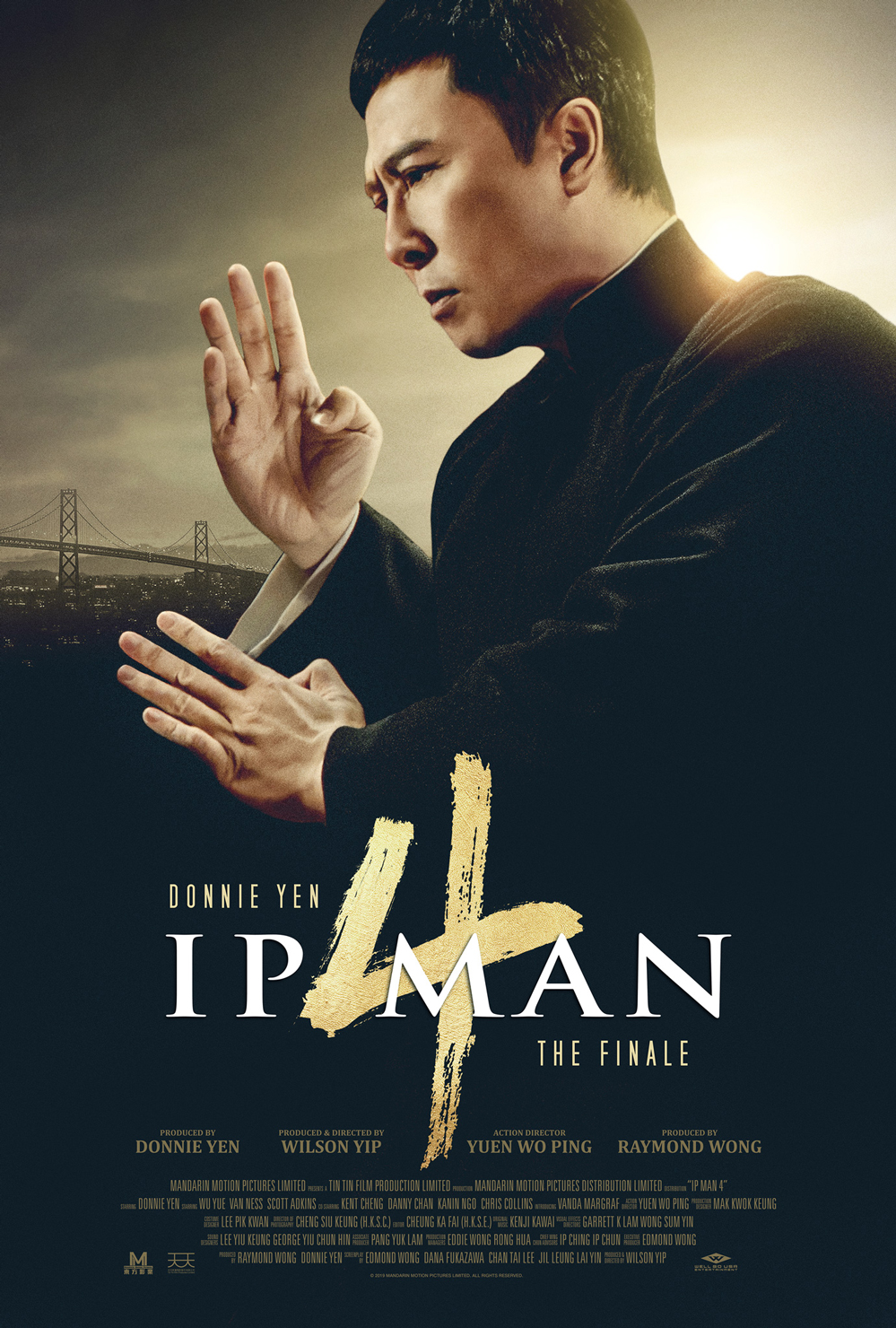
IP MAN 4: THE FINALE tells the story of Grandmaster Ip Man coming to terms with his mortality as he travels to America in search of a better life for his son, Ip Ching and to pay a visit to his most famous student, Bruce Lee who is now a master himself, teaching Kung Fu in San Francisco. During the journey he encounters fellow martial countrymen struggling to find their place in an America that does not want them, an aggressive Karate Sensei with a desire for dominion over the Martial Arts world, and a tyrannical Marine Sergeant whose hatred holds no bounds. Like many of the most celebrated of adaptations and classic Kung Fu films, the thrust of the story is fictitious with real life characters and scenarios peppered in for good measure. While some may be quick to point out the compromised validity of this story, the truth is IP MAN 4 is a worthy successor to the series and closes out the saga in a satisfying manner.
The sumptuous production design is apparent in every frame of the 105-minute running time. Great care and detail were taken to give a vibrant, if not entirely accurate, impression of 1960’s San Francisco Chinatown from the iconic pagoda lamp posts, to the store front signs of local eateries like Far East Cafe. For those familiar with the neighborhood, inaccuracies including locations of streets and proximity of landmarks abound, but like the story itself it is best if viewers take the entirety of the production as some alternate history of the reality we know that is visually compelling nonetheless.
Legendary fight impresario Yuen Woo Ping fires on all cylinders depicting the lyrical nature of screen fighting with his trademark high octane mix of originality and masterful framing. Yen is more than firmly rooted in the Wing Chun method and brings his explosive, rapid fire pugilism stateside with some impressive sequences adding depth to the already monumental fight scenes of the film’s forerunners.

Wu Yue portrays Wan Zhang Hua, a Tai Chi master who comes into conflict with Ip based on their differing ideologies. Although this type of scenario is ever present in all of the films of the series, the character of Wan differs from his antecedents, as he is not a gruff, hungry, ruffian but rather a refined gentleman who exudes a calm yet intense presence. The combative nature of his Tai Chi is elegantly supple and equally foreboding with the luxurious ferocity of a crashing wave. The fights between him and Donnie Yen are a sight to behold as the interplay between Wing Chun versus Tai Chi becomes a physical manifestation of Yin and Yang.
Collins Frater, the hand to hand combat instructor of the U.S. Marine Corps who refuses to acknowledge the merit of any Martial Art other than his own Karate is played by Chris Collins. His onscreen performance is at once intimidating and invigorating as he brutally dispatches many of his rivals in the film with ferocious militaristic efficiency. This is made all the more impressive considering that he himself, is not normally a practitioner of Karate, but one of Wing Chun Kung Fu’s premier exponents, teaching the style as part of the extensive curriculum at his Hong-Kong-based Martial Arts Studio Chris Collins Action and was responsible in real life for the style being implemented into the Marine Corps’ hand to hand combat training during his nine years of service.

Fans of the genre will immediately be familiar with Danny Chan Kwok Kwan’s depiction of Bruce Lee. This should come as no surprise as a fair part of the native Hong Kong actor’s career revolves around playing Lee, from his initial appearance in Stephen Chow’s comedic martial arts romp, SHAOLIN SOCCER (2001) to the CCTV television series THE LEGEND OF BRUCE LEE (2008). In fact Chan even played a younger version of Bruce in the prior film in the series, IP MAN 3 (2015). However, in this film collaboration with Director Wilson Yip and Choreographer Yuen Woo Ping, Chan’s portrayal practically bursts off the screen during a stellar Bruce Lee action set piece in a fashion that no one save Lee himself has accomplished to date. While Bruce Lee has long been depicted and reimagined since the time of his passing over four decades ago, no one has truly captured his essence the way it is done in this film. Others may scream out his classic cat like shriek and thumb their noses defiantly, but there was always something to him that was indeed greater than the sum of his equal parts. Given that Lee had a fairly extensive background in dance, there is a cadence to his fight scenes which is often overlooked and irreplicable. However with Chan’s experience as a dancer himself, his undeniable physical resemblance to Lee, and under the watchful eye of Yuen Woo Ping this impossible replication is made nearly whole. The swaying of body weight punctuated by pinpoint thrusting kicks as well as the overall swagger of the late great Little Dragon seemingly returns to celluloid once again. This alone is worth the price of admission and will leave many hoping that the team of Yip, Yuen, and Chan will come together for a subsequent Bruce Lee film in the near future.
Scott Adkins shines as the dastardly villain that fans will love to hate, Gunnery Sergeant Barton Geddes. As the main adversary of Ip Man, Adkins takes the stage with all the exuberance and strut of some of action cinema’s most memorable heavyweights. There is an undeniable physicality which he brings to the role that is ever present even during the non-action scenes of the film. Given the current geopolitical climate between the U.S. and China, the character of Geddes as an imperialistic western power who is in direct conflict with Ip Man’s portrayal as the epitome of traditional Chinese Confucian doctrine seems somewhat apropos. Regardless of any subtext in the films narrative, Adkins proves himself a very worthy adversary and counterpoint to Yen during the film’s climactic final battle, supplying all the visceral, high impact, hand to hand combat expected from an Ip Man movie.

The film like all stories that properly conclude a series, acknowledges its predecessors, elevates the work, and most importantly, resolves the character’s story arc in a deep and meaningful way. Throughout the Ip Man saga one of the most insightful themes has been the toll that the constant striving for martial excellence takes on not only the master, but on those he loves most, his family. While the first three movies in the series showed the devastating burden that Ip Man’s wife, Cheung Wing Sing endured, culminating in her untimely passing, the final film shows how these burdens have laid waste to his relationship with his son, Ip Ching. During Ip’s travels he learns from his past transgressions and repairs the relationship with his son. This is the true jewel of the film and the writing team as well as Director, Wilson Yip are to be commended for keeping this very human core of the story throughout the film. While many Kung Fu films serve to impart lessons to the uninitiated, IP MAN 4 strives further with a life lesson for all those who pursue a path martial or otherwise, whom are prone to tunnel vision in their pursuit of greatness. For what one gains can only truly be measured by what is lost in the process.
Although it is bittersweet to learn that this is the culmination of the Ip Man series, fans will be delighted to know that the movies have never lost their focus or the principles of what makes them classics in the world of Kung Fu films. In similar fashion to the art of Wing Chun itself, their greatness lies in the focus of a concept, a centerline if you will. For the Ip Man films, the concept of martial virtue and the cost which comes to those who strive for excellence has always been a truth that audiences, regardless of generation or origin, can learn from.

IP MAN 4: THE FINALE opened nationwide in limited release on Wednesday December 25, 2019. Consult your local listings to see if it is playing in a theater near you.


