
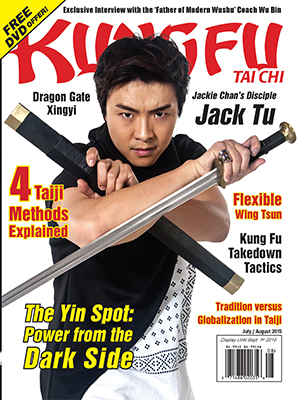
 This is the second installment of Kung Fu Tai Chi's Associate Publisher Gene Ching's interview with Jackie Chan's sole disciple, Jack Tu. Jack is featured on the cover of our JUL+AUG 2015 issue. For Part 1, click here.
GC: China films are all about rom-coms nowadays.
JT: Now Chinese movies are just about war, about romance, about comedy. For this action film, the style is like Ong Bak, but how we make our enemy into our friend. Because all of these boxers, all of these fighters, the whole main thing is we using our skills to convince them that we can kill them, in just a few hits, but we have to gather all our energy to fight against all the corruption. That's the thing that flips all these things around. There's lots of people making dirty money in China but there's not many films talking about it. I want to be the first one to do this.
GC: What about Wang Baoqiang? I really liked his fight scenes in Kung Fu Killer.
JT: Wang Baoqiang is a different one. To the Chinese audience, he's just a joke. Everybody focuses on that. The new film that he did with Donnie Yen, the lines that he said, it's supposed to be serious but in the movie theater, when he say that, everybody laughed. 'Kung Fu is a killing skill.' When he say that, people just laughed.
GC: Really? So it's kind of like if Will Ferrell were to do an action film here, I guess. I suppose that's all in the wake of the success of his blockbuster comedy, Lost in Thailand.
JT: So that's why I want to do two different kinds of films in the year, one comedy, one pure action. I want to see which one the audience likes for me in China. If they like more on the action side, okay, so for the next few years, I'll start focusing on this. Comedy? Okay, so I start playing with the action a little bit on this.
It's like Jet Li and Jackie Chan - two different styles. And Donnie Yen . They're all different. To me, I'm more towards comedy. I like something that's more funny because it makes people happy. I don't want to make people tense, saying like, 'Ow, that hurts. Ow, the bones broken,' because I don't want to make myself too tough. There will be a lot of challenges. [laughs]
GC: Are you getting challenges? I mean like martial challenges.
JT: Not yet. Well, with all those stunt doubles. But I was thinking for my future direction, I don't want to make myself too Donnie Yen. I still want to make more towards Jackie Chan. Music still keeps going because all of these movies have music done by me. We're going to release our album. [laughs] It's just so funny when I say, 'I have an album coming out.'
GC: I remember you weren't comfortable with singing at first. But that's pretty much a requirement for every Chinese movie star nowadays.
JT: But now, because everything is under control, I think this is just for fun, for playing with the Lucky Sevens. At least it's one of those things that can get all of us to gather together, working together. I was thinking of pulling them into my film to work together, but I was thinking if one dies, everybody dies. So why not just use me as an experiment to see if I come out. Then I'll pull them up, one by one. And I'll start having them in my films and we'll be working together. This is like in the past with Jackie and Sammo Hung and Yuen Biao, working together to do those comedies. I really want to do that in the future.
GC: You've had the unique advantage of seeing filmmaking in both China and Hollywood. What do you see as a cultural gap between them?
JT: In China, they only want to make money. Hollywood makes money but they make the quality very good. Their quality and money are on the same level. China quality is there, but I want to have this money. Because all the investors in China, they don't have a sense of movies. They only think if this has Jackie Chan in it, I'm going to make money. So I'm going to put like 1 billion RMB in this. They make money. They get 2 billion back. But with this time, they only extract probably three to four to five months to create the film. Where in Hollywood, they can take one year, two years, to create a movie.
GC: Twelve years with Boyhood. [laughs]
JT: For us, it's like, 'If he's more famous than me, then he has the opportunity to do this.' Going to the bottom level. For 5 or 6 years, it's been like this, so I started creating a film myself. Like Eye of the Desert, if I want to create this, no one can stop me. And no one was doing this. This one goes to a film, people knows me. I can create a second one, instead of waiting for someone to come and offer me to come and do this film. They gave me a lot of hope and restrictions. But if I can create my own film, I can do everything. I'll try to make it like Hollywood style. The time on this is only two or three months. I'm trying to make it longer. In the past in China, they only take one or two months to create one big film. That for them is the limit, the max time. I want to take a longer time because, for an action film, I don't want to use a stunt double or some special effects.

GC: That would be in the tradition of Jackie. Do your own stunts.
JT: When I was on the phone with Xiaolong, I said, 'You have to train up now, because on that film, nobody can stunt double for you.' And he's really happy about this. He was like, 'So tell me when we are going to start.' 'We start in June.' He said, 'Okay, I'll have two months of training for it.' This is a time for me and him both, can come up again in China.
GC: Do you think being from America and having lived in L.A., near Hollywood, gives you any advantage in the China film industry?
JT: No, it's a disadvantage. We're too honest in America. Everything is by rules, by laws, by society. In China, they can say one thing today. Tomorrow there's another thing. Today is a story. Tomorrow is another story. It was hard for me. There was this time when I tried to find an investor. This investor got drunk and he said, 'I'll invest you 10 million.' 'Okay, sure! So we'll sign the contract tomorrow.' 'Sure, no problem. Bring the paper tomorrow.' 'Why can't we sign now?' 'Now I'm drunk. I can't read. I can't write. I'll do it tomorrow morning.' Next day I find him and give him the paper and he said, 'I'll think about this.' I can't say anything. Lots of people like that in China.
When we're doing a film, the schedule, the timing, it's whenever they're happy. There's no negotiation. Nobody can talk about this. The guy who controls the budget earns lots of money in China. They can say this item is $50 when actually it's only $15. It's the trust. I know that in China everyone wants to make money. Everybody wants to survive. But because of this, it makes them very 'money first,' very material. If we are not at a certain level like Jackie Chan, we have no right to talk. So it's really hard for me.
But in the states, everybody is treated equally. I work with two films: one is Outcast, with Nicolas Cage. I went down and helped them. I went there for a week. Liu Yifei was also in there too. It's really bad. [laughs] I'm an army captain in there. I got killed by that Anakin guy, Hayden Christensen. But when I was working there on the set, everyone was treated equally, the timing, the food, and also the resting time, the working hours. In China, there's no working hours. If they don't finish the scene by today, nobody sleeps. [laughs] And the food? If nobody finishes things today, nobody eats. The early Hong Kong time of filmmaking, it hasn't changed. That's why everything doesn't advance. We're very tiring in those kinds of films. I fight all day. Or sometimes we don't get to sleep. There was this time I fight [for] four nights, no sleep. I just sleep on the sets on the ground. Every time I hear, '3, 2, 1, action!' I just get scared and pop up, 'Where!? Cameras?!'

GC: I want to change the subject for a moment and ask you about the state of martial arts in China.
JT: Modern Wushu is going down, because modern Wushu to people is just dancing and acrobatics. Gymnastic people can do better martial arts. MMA and UFC is now invading China. There's KFC now, Kung Fu Champion. It's on the television. I was like, 'Wow, why is KFC in black letters, not red letters?' And then it came and people are fighting in a cage. 'Oh. Kung Fu Champion [laughs]!' They follow the UFC rules for that. It's pretty funny.
But I still want to keep it to traditional Chinese martial arts because in Vital Gate everything is traditional martial arts. I don't want to make it too UFC or too MMA like Donnie Yen. They have what they have but I use traditional martial arts, the pressure point fighting skill.
GC: What about Traditional Kung Fu in China?
JT: Only for old men. Kung Fu is only for old men now. All the new kids, they all went to dancing now. Martial arts alone is nothing now. That's why now, action films, not much in China. Even when they do an action film, it's all just the same old thing. There's never anything new. This time I'm trying to do the pressure point fighting skill using fingers, elbow, head and shoulder. I try to make something new. I try to combine everything because I don't want to do the same old thing.
GC: Sounds like you're getting busy. What's your dream project?
JT: What I really want to do is a Daoism movie.
About author:
Subscribe to KungFuMagazine.com here.
Get your print edition of the MID-AUTUMN 2026 here.
Gene Ching is the Publisher of KungFuMagazine.com and the author of Shaolin Trips.


