
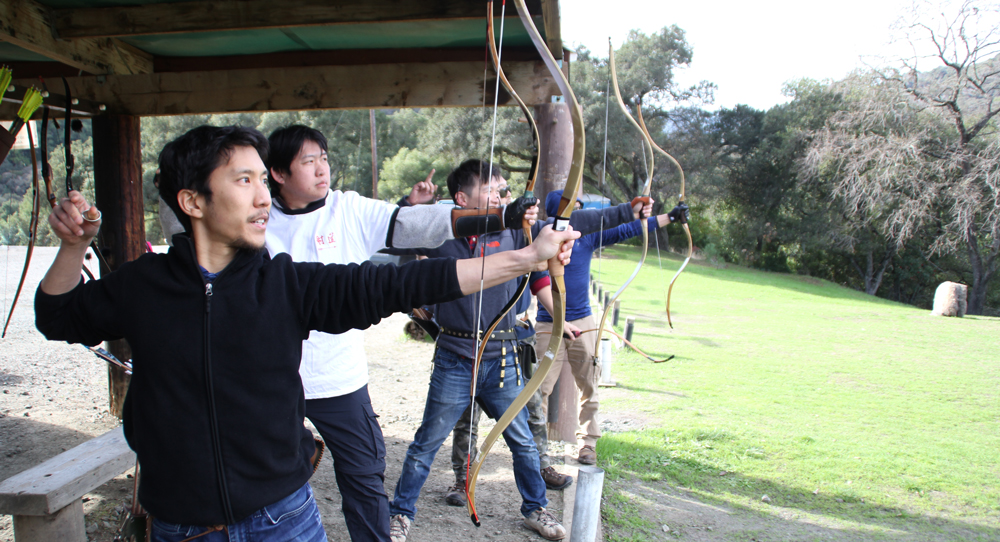
 In 2017, I worked on the TV show Man at Arms: Art of War for El Rey Network. For Season 1, Episode 4, "Weapons of the Mongol Horde," we examined the Mongolian composite bow, a weapon renowned for its effectiveness on horseback, so we brought in a specialist, expert horseback archer Chris Yung. Between takes, I cornered Chris to pick his brain about Chinese archery. Chinese archery is an overlooked field of the Chinese Martial Arts, which is somewhat surprising given that it was such a venerated skill in ancient China. I've always wanted to explore it more for our readers, so Chris put me in contact with Justin Ma, who he considered to be a leader in the field. By strange coincidence, Justin and I already knew each other. Justin was a member of the 2001 and 2003 U.S. Wushu Teams and an S.F. Bay Area local. Since leaving the Modern Wushu world, Justin began researching Chinese archery and has published a groundbreaking book on the subject, The Way of Archery: A 1637 Chinese Military Training Manual, co-authored by Jie Tian. He was kind enough to offer me a free lesson, so I spent a morning with his archery club at a range in the Cupertino hills last January, and was quickly schooled the initial points of Chinese archery. Justin is a tremendous resource for this topic, answering every question I asked with a voluminous response. It was far too much to squeeze into the article, "The Way of Archery: China’s Most Venerated and Overlooked Martial Art," which appeared in our May+June 2018 issue, so I've compiled the source interviews here, less what was used for the print article (you'll have to pick up the issue for that), for your further edification in this re-emerging art.
GC: How and when did you get into Chinese archery?
JM: My Chinese archery journey officially began in December 2009. Prior to archery, I was involved in Wushu as an athlete, judge, and tournament organizer until 2007, after which I stepped away from the art... Having come across depictions of archery in art and media, I thought, “Well, why not Chinese archery?” Archery was at once powerful and inspiring, yet analytical and empirical. Furthermore, the genre of Chinese archery appealed to me because of its simplicity (the Chinese bow has no shelves, no sights, no stabilizers), its novelty (in that year there weren’t many people practicing with a thumb ring, let alone in the Chinese style), and its deep cultural roots – as I would learn soon, archery was an integral part of Chinese founding myths, and it was the premier martial art for Chinese emperors, generals, philosophers, officers, and scholars. I had to start right away!
As there were no local Chinese archery coaches, in October 2009 I decided to enroll in a basic western archery course as a starting point, and I practiced with a western barebow recurve (a bow with a center cut shelf, but without sights and stabilizers) to retain some sense of simplicity. Still, I kept an eye towards transitioning to traditional Chinese archery at the first opportunity.
GC: What was available to you when you began?
JM: Technique-wise, in 2010, there were short surveys of various Chinese archery techniques in the literature, but due to the sheer variety, I often ran into dead ends while exploring each variation. Some styles looked cool, but were ultimately impractical at the range and had anatomically inefficient postures.
Fast forward to 2017, and you’ll find a whole spectrum of options available with far better quality all around.

GC: So you and your co-author Jie Tian sought to translate the archery manuals of the Ming dynasty (1368–1644 CE) archery teacher Gao Ying (高穎).
JM: Up to this point, despite that the Classical Chinese text had been available to the public for years, no one else had translated Gao’s full works to English (or even Modern Chinese). Scholars from the 1980s promised to translate the work, but those promises remained unfulfilled. As Jie and I studied the manuals and put Gao’s technical and philosophical teachings into practice, we continued to see tangible improvements. Eventually, a strong sense of duty and obligation grew from within our souls – Jie and I had to do our part to introduce Gao Ying’s work to a broader audience...
Finally, our hard work came to fruition with the publication of our book, The Way of Archery: A 1637 Chinese Military Training Manual (Schiffer Publishing), which debuted in 2015. With this book, and with the resources that we and others have published, we hope that new students of Shedao (“the Way of Archery” 射道) can avoid repeating our early mistakes so they can enjoy a straighter, faster journey towards the Way.
GC: Are there other systems or lineages of Chinese archery beside the one you propound?
JM: There is no continuous Chinese archery lineage because the political turmoil of the 20th century eliminated them. What we see today is the result of tireless research and reconstruction, and we owe much credit to all modern participants striving to recover the art. Fortunately, we still have the stories and history that serve as a cultural anchor for our efforts and that connect us to our archery ancestors.
China spans a huge geographic range and has a very long history. The result is a lot of variations in the way Chinese archers approached archery. Techniques often differed between time periods – for example, the Qing dynasty archers were known for their extra-long draws with very long horn composite bows. Yet even within the same dynasty, there was a lot of variation in technique. For example, the Han dynasty (206 BCE–220 CE) had at least 7 published manuals, including one by the “Flying General” Li Guang (died 119 BCE 李廣), the Ming dynasty (1368–1644 CE) had at least 14 different archery and crossbow manuals, and the Qing dynasty (1644–1911 CE) had manuals from over 14 different schools of archery. Despite differences in the physical execution of technique, all styles placed great emphasis on mental focus and concentration.
A simple way to classify the different Chinese archery styles is to describe them along basic dimensions such as (1) draw length, (2) arrow level, (3) whether to cant/tilt the bow and/or torso, (4) release action, and (5) stance (although stance will be fluid in mobile or horseback situations). This is not a comprehensive list, but it is a good start for acquiring the bigger picture.
For example, some Ming civil styles featured an upright posture with a vertical bow, as well as holding the arrow at shoulder level. Other Ming military styles adopted a horse stance and held the arrow at chest level, a canting of the bow, and an active thrust-snap release action. The canonical Qing dynasty Manchu style involved a very long draw length with arrow at mouth or shoulder level, a cant of the bow and torso, and a deliberate draw hand “untwist” release action.
The Ming military style that I teach (Gao Ying’s “Inchworm” form) involves a medium draw length, arrow at mouth level, a slight cant of the bow and torso with an oblique foot position, and a simple, smooth expanding release.
You can use the above criteria to classify archery techniques from other cultures as well. By doing so, not only can you identify variations within a single culture, but you can also identify and appreciate the commonalities in technique across different cultures.
GC: How big is the community of Chinese archers now in the U.S. and worldwide?
JM: In China, there are easily several thousands involved in practicing traditional Chinese archery. As Chinese archery courses continue to appear in universities and high schools, I anticipate the number of Chinese practitioners will grow much larger. Indeed, the Shaolin Temple has also begun practicing archery.
There are multiple annual competitions that attract several hundred attendees at a time. Because of this great interest, the Chinese domestic business for traditional Chinese archery equipment has been booming. New makers continue to enter the market, and established makers continue to hone their skill.
In the US, I estimate at least a couple hundred people are involved in Chinese archery. More concretely, our local Bay Area Asian Archery mailing list (which includes practitioners of other Asiatic styles) has over 140 members, and our friends managing the equivalent list in Southern California have over 45 members. Last year our inaugural North American Chinese Archery Tournament (in Cupertino, California) attracted 38 attendees. Our annual Chinese Archery Program, held at the Koppedrayer’s bamboo farm in rural Georgia [Kay Koppedrayer authored Kay's Thumbring Book on Asian archery and Jaap Koppedrayer is a renowned archer and bow maker], attracts about 30 participants per year from all parts of the US and the world including Europe, South America, and Australia.
In terms of online interest, our “Chinese Archery” Facebook group has 1,800 members. We regularly interact with the broader Asian Archery community, whose “Asian Traditional Archery Research Network” Facebook group has over 5,200 members.
Finally, to date we have sold well north of a thousand copies of The Way of Archery book, so we estimate a nontrivial fraction of that will include dedicated Chinese practitioners (as well as those just getting started).
For Part Two of this article, "Justin Ma on Getting Started in Chinese Archery" by Gene Ching, click here.
About author:
Subscribe to KungFuMagazine.com here.
Get your print edition of the MID-AUTUMN 2026 here.
Gene Ching is the Publisher of KungFuMagazine.com and the author of Shaolin Trips.


