
 We used to say, "If it's too loud, you're too old." Nowadays, if you haven't experienced EDM, you're too old. And if you don't know what EDM stands for, you're way out of touch. EDM stands for "Electronic Dance Music" and it's loud, especially when it comes to dropping the bass. It's bass so big that it'll shake you to the marrow. EDM has dominated the global music scene since the turn of the millennium. Emerging from the club and rave scene of the late '80s, it has grown to encompass many distinct genres such as ambient, dubstep, drum & bass, house, techno, trance, trap, trip hop and many more.
But what does this have to do with Kung Fu? One of the world's leading EDM DJs is a genuine Kung Fu master. Laidback Luke is a world-renowned DJ from the Netherlands, as well as a proponent of Choy Lay Fut under Grandmaster Doc-Fai Wong's expansive Plum Blossom International Federation. Through his music, he's bringing a whole new generation to Kung Fu by teaching his audience directly at EDM gatherings and advocating a healthy Kung Fu lifestyle through his substantial social media platforms.
One of Kung Fu Tai Chi's dedicated freelance contributors, Brian Kuttel, wrote "Laidback Luke A Kung Fu DJ" for our March+April 2018 issue, and I had the delight of chatting with Laidback Luke at the Federation's World Headquarters, the venerated Doc-Fai Wong Martial Arts Center on Taravel in San Francisco. This interview is completely distinct from Brian's article.
GC: For the benefit of our readers, explain what an EDM DJ does.
LL: So there's two things that a musician like me does. Produce the music, but produce the music with the help of a computer. We program the music. But we have knowledge over everything in the music. We have knowledge over drum patterns and melodies, bass lines, vocal arrangements, so it's like a whole breadth of knowledge, the all around thing of music. And then there's the performance side where I don't have like a guitar on stage, but what I do is play the music that I've made. And with that, we blend songs on a night as a DJ. And so we go from the one song to another song and just monitoring the crowd – who's dancing to this music – and then try and accommodate them and to lift the energy at a certain point where they go really wild. And that's what we do on a big stage, with a big LED wall, nowadays in front of big crowds.
GC: Huge crowds nowadays. That's a lot of energy to navigate.
LL: Yes there is! There is. And I make use of that. I can monitor the energy of a crowd. And I can see if the energy is a little bit lower, or technically if people start buying drinks or walk off the dance floor, we'll need to switch it up and play something they'll really like and that they can continue that.

GC: You make it sound almost like a Tai Chi Push Hands kind of thing.
LL: Yeah, yeah, exactly! It's almost like that. And sometimes we even have pockets of energy of people where you need to focus on them to eventually try and have the whole crowd join in.
GC: Well, if our readers want to learn about EDM, they should just go to one of your shows. Let's talk about Kung Fu. How did you get started?
LL: As a kid, I've always done martial arts, and obviously I'm from the same generation as Sifu [Brian] Kuttel, and so we grew up watching Karate Kid and Bruce Lee stuff. It was always No Retreat, No Surrender [1986], in like us being kids wanting to be Ninjas and everything. In my village where I grew up in the Netherlands, they didn't have a Kung Fu school. So the best thing I found was a Karateschool and I stayed there right up until just a week before my black belt exam. I bailed out. I was fourteen years old. And it was then I switched to focus my energy on music instead of martial arts. But about ten years in, I realized I needed to get back in shape. I was an adult now and I didn't want to just push weights or anything, and I thought, "You know, I always have this dream of wanting to do Kung Fu." And a singer I was working with, she said there was this really good Kung Fu school in a place called Leiden in the Netherlands where my Sifu, Hong Ying, is from. And I stepped in there one day. And I never left.
GC: Why did you pursue Kung Fu instead of continuing with Karate?
 LL: At a certain point I got really frustrated with Karate. Number one was we never used weapons. And number two was – at a certain point I did about seven years of Karate and sometimes the guys would ask me, "Can you punch really hard?" And I always tried and I could never pull it off. Somehow I never learned that in Karate. And I feel Kung Fu went so much more deeper than that – much more connection. Instead of just focusing on the physical, also on the mental aspect – just so much more broader than Karate.
GC: With your crazy touring schedule, how do you keep up your practice?
LL: Just got to make time for it. I do have this daily routine where when I land, or when I get to a new destination, I'll always take about 45 minutes to an hour in a hotel room for instance, or a hotel, find like a meeting space – I always go to the desk and I'll tell them, "Hey, I like your gym and everything but I kind of need a space to practice my Kung Fu and Tai Chi.” And they'll always try and charge me, but somehow we always manage to arrange a meeting room, and push the furniture aside, and then I can practice. This is the first thing I do because afterwards I tackle all the emails that I want, or listen to new music, or get my set ready. This is the first thing I need to do.
GC: We've worked with several musician martial artists before such as Lou Reed, the RZA and Mickey Hart of the Grateful Dead. So I've always felt that martial arts and music are parallel. Does that resonate with you?
LL: Oh, absolutely. For me, the two are integral with each other. Actually, I came from a place where I was very burnt-out as a musical artist. I couldn't keep up the touring. I couldn't deal with the jet lag or the stress constantly performing and keeping up a high level of expectation. About seven years ago, my Sifu sat me down and he said, "You know what we should do? We should take your Kung Fu to a higher level, which will benefit your career as well." And when he said that, sweat broke loose and I was like – because I had so many things to do – I was like, "I can't do this. I'm not able to manage this." And it terrified me. I didn't tell him, of course. So we started upping my routines and upping my training, and looking closely at my training, and surely, implementing qigong for instance. And just keeping a good mental mindset helped me with my career.

Now when it comes to expression, yeah, I do think Kung Fu and music has that individual appeal. So for instance, in the Plum Blossom Federation, everyone still wants to be Grandmaster. But no matter how close they get or how they want to do it, everyone is still an individual. You'll always have your own little characteristic in doing one move. And I often say in music, kids will always try to sound like someone else, or the people that they look up to, and it can sometimes frustrate them. And I always tell them to accept that because everyone's unique. You don't need to go and imitate anyone. Actually, the way you do it is unique enough and that's your expression.

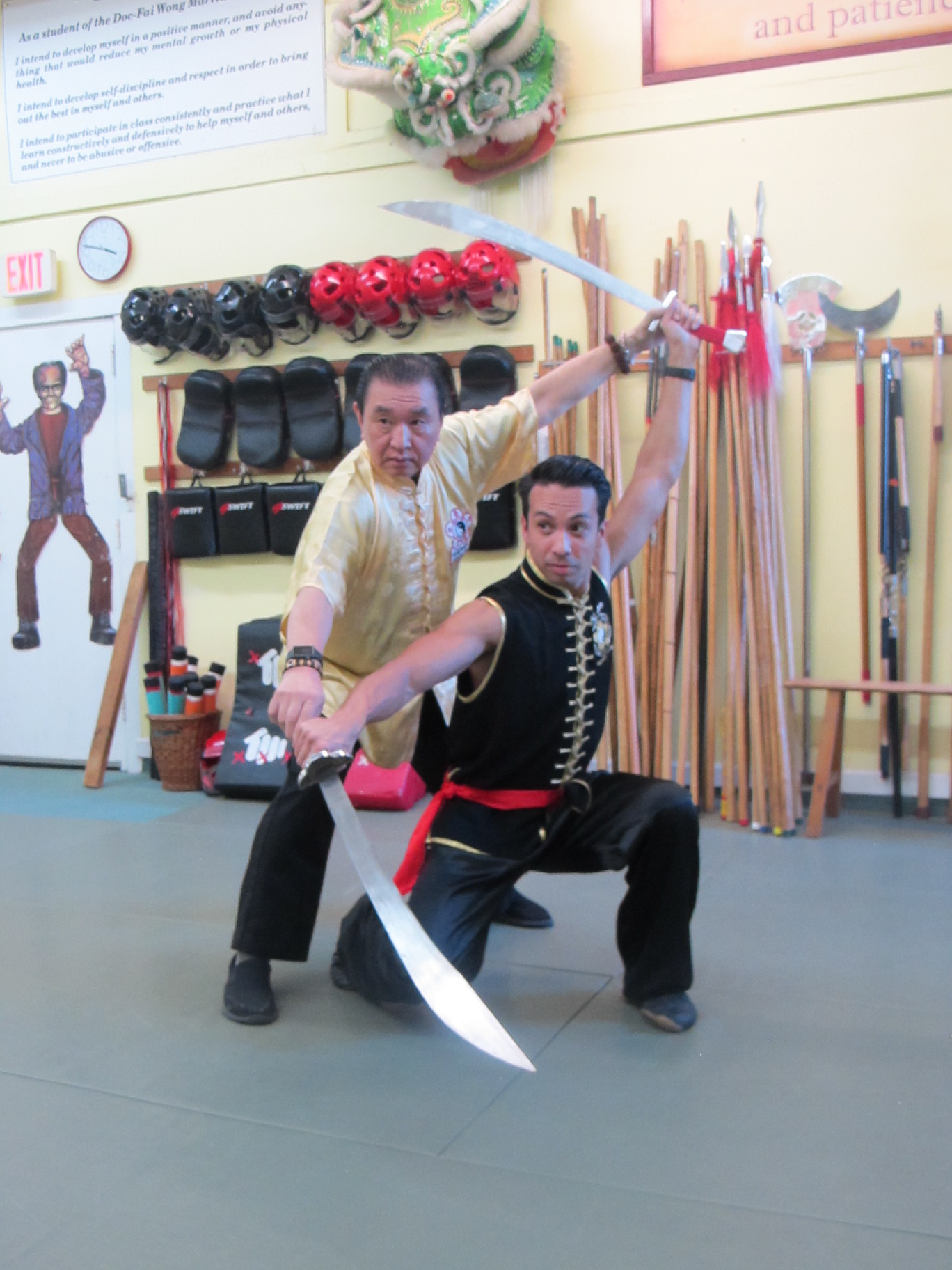
Sifu Luke with Grandmaster Doc-Fai Wong.
GC: Traditional Kung Fu is form-based, so you imitate the master to learn structure and basics.
LL: Yeah, so obviously the basic structure is important and the basic knowledge and needing to know what certain techniques stand for, but in terms of wanting to be someone else, I think it's like Grandmaster is Grandmaster. And I have no clue what he still wants to be like the great grandmasters, but obviously he has his own style and things. My teacher often says this as well: "You just take students to a certain level, but then they'll always leave their own characteristics in it." Yeah, I feel if I see people move in our organization as well, like if they would have a mask on, or you would only see like the stick form moves, I think I would pretty much be able to guess who's under there. And I think that's fantastic as an expression of art.
GC: In this way, forms are like songs.
LL: Yeah, exactly. So you could give five musicians the same guitar and the same riff, yet it will sound slightly different.
At this point in the interview, we took a break so I could feed my parking meter (this took place in San Francisco, after all). We'll pick up the conversation after when I got back with part 2 of this interview: "Laidback Luke on the Kung Fu of EDM."
About author:
Subscribe to KungFuMagazine.com here.
Get your print edition of the MID-AUTUMN 2026 here.
Gene Ching is the Publisher of KungFuMagazine.com and the author of Shaolin Trips.


