
 On October 4, 2018, the second season of MAN AT ARMS: ART OF WAR premieres on the EL REY Network and I'm proud to be returning as one of the Weapons Experts. I'm in the premiere episode and will rejoin the King of Badasses, our host Danny Trejo, along with the rest of our cast for several of the episodes this season.
If you haven't tuned in yet, MAN AT ARMS: ART OF WAR is about ancient weapons – swords, pole arms, and the diverse arsenal of warriors prior to the rise of firearms. Each episode is focused on two weapons from a particular country or genre. We discuss the weapon's history and cultural context, show the intense process of how it was made by making one using predominantly traditional methods (power tools are used because it would be way too much work to do otherwise), and then evaluate its lethality in some spectacular make-or-break tests. It's entertaining and educational, particularly for anyone interested in the legacy of martial arts.

L-R: Ilya Alekseyev, Gene Ching, Kerry Stagmer, Matt Stagmer.
At the heart of our show are the builders, master craftsmen from the esteemed American forge Baltimore Knife & Sword. Founded by Kerry Stagmer, who is joined by his brother Matt, BKS is the leading maker of stage combat weaponry. And I don't say that flippantly, because in a former life I worked in that unusual industry as well. Kerry and I didn't know each other prior to the show, but we were both fencers during the same time period. He knew the work of my previous employers, The Armoury, a division of American Fencers Supply, and whenever the topic arises, Kerry cannot resist chiding me for casting guards out of manganese bronze (that was never my decision – you can stop it anytime Kerry). Also in the cast from BKS but outside the Stagmer bloodline is master smith Ilya Alekseyev, whose expertise as a maker, a scholar and a swordsman adds immeasurably to our show.
In weapon-making circles, the men from BKS are well known, and sometimes even outside that circle. When we checked into the hotel we were housed in for this season, my cast mates were recognized by the staff. One of the workers asked them to autograph his pocket knife. Between takes, I pulled each of the BKS masters aside to chat about what Season 2 is bringing to your screens this time. These interviews are compiled for easier reading.
GENE: So guys, how's it going so far for you?
KERRY: I think one of the things that’s really noticeably different for us is that there’s not as much uncertainty as to how this will differ from the YouTube series so everything flows a lot nicer. It makes it easier for all of us to make decisions on how we’re going to build things and how we answer questions and who we’re going to talk to. Plus, while we have some new people on set, we have some old people on set that we know we’ve been working with and that makes it a lot easier.
GENE: Right. We should mention to any new readers that MAN AT ARMS: ART OF WAR began with your tremendously successful webshow, MAN AT ARMS: REFORGED.
ILYA: Our home is always the YouTube show. That’s where we get the direct interaction with the viewers in the comments. And we love that because those viewers are also our company’s customers. And television certainly has its place, but nothing feels so much like family like YouTube.
MATT: It’s fun being on TV but the YouTube is where it all started from for us. One of the things that really stands out is on the YouTube – I can connect with the fans. I see what they think immediately in the comments section and I reply to them if I wish. They’re like, "Hey, that was really lame! How you did blah blah blah." In the first couple of seasons of the YouTube show, people complained that we broke a lot of glass or vases and stuff like that, which is pretty lame to do with a sword, but that was like a slo-mo thing. And we phased that out. We listened. With the TV show, we put it up there and it is what it is. We don’t really know reactions unless you jump on a forum or read it or something. The connection to the fans for the YouTube, that’s always going to be a passion for me; but the TV show, it’s coming along nicely. I like where it’s headed.

The War Room: L-R: Danny Trejo, Ilya Alekseyev, Rebel Rodriguez, Gene Ching, Marko Zaror.
GENE: Not to drop any spoilers, but let's tease where we are headed with this season.
MATT: I think the big difference for me for this year compared to last year is that not only did we do 20 weapons instead of 16, but just the level of demonstrators and martial artists that we’ve brought this year. I really like how we’re telling a parallel story this year of both how the martial art grows with the piece – they’re figuring out how to work with the piece – and how we make it. So there’s two stories being told and I just think that completes the true "Art of War" theme of the whole show.
KERRY: We have more episodes this season so there’s a lot more to build. There’s a pretty dramatic difference in the way things were filmed. So even though the producers knew what they were looking for, we had so much more to do that instead of filming everything all the way through right to completion, we kind of filmed everything to almost complete, so that there would be a bigger jump when we got to the final photographs and then the testing, so people could see a bigger difference. As they watch these episodes, they’ll have to use a little bit of imagination at the end, and then they’ll see the finished piece, and then they’ll see how it works, rather than every single step as we went through. And that’s a pretty big difference in the way that we were used to filming where we try and catch every single second of every build. There was just too much going on in the amount of time that we had.
GENE: Let's go back to those demonstrations. This season we moved away from some of the more academic speakers and, much to my delight, brought in some martial specialists.
MATT: Certainly last season we had great demonstrations. You were one of them. But just having guys and ladies that were specifically trained in that weapon, not just a broad "Hey, I’m good with a sword" but "Hey, I train Filipino martial arts. This is my thing." We made Filipino weaponry. I just really enjoyed that. We got a lot of better demos this time, adding in the ballistic gel dummies, stuff like that I thought was a nice touch. I think everyone just being more familiar with each other – a lot of the talking points went smoother. The War Rooms went a lot faster. In general I felt a lot better about this season.
KERRY: I love it. I love to meet new people. And it didn’t have the same level of un-sure that we had in the first season where we didn’t really have a feel for their level of expertise. For the most part, the level of expertise of the martial artists coming in and their ability to talk about the weapons and the forms, you know, it’s a modern age so we can go on YouTube and watch what it is that they do already and find them on the internet and get a much better feel for them, compared to what a college professor’s going to say who doesn’t have a lot of hands-on experience, even though they may have a lot of knowledge. And sometimes, being experience-based people, we actually prefer that.
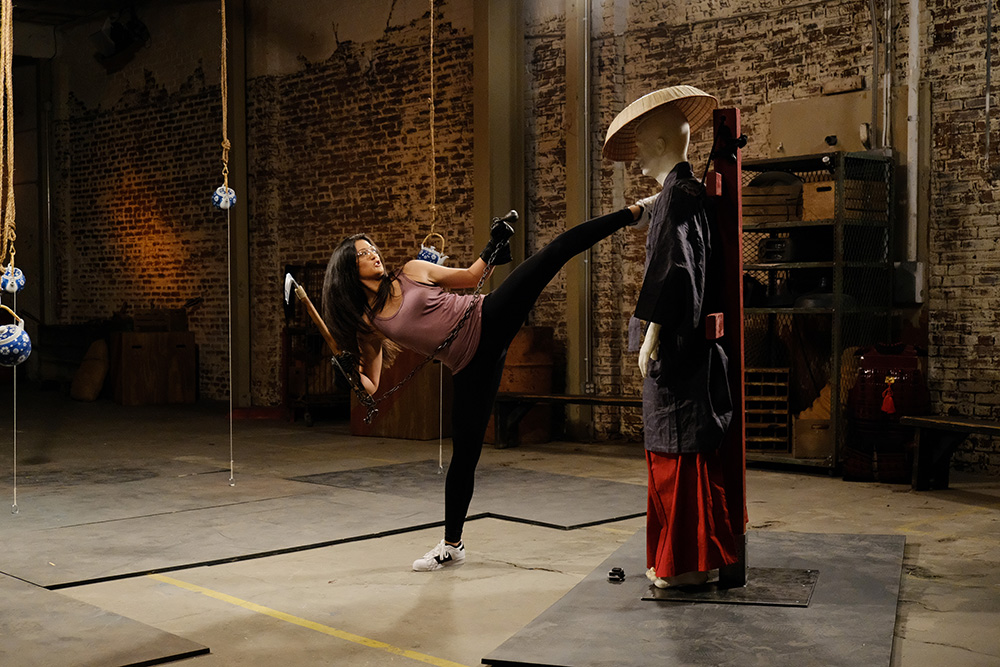
National Champion Isabella Caracta, one of the guest experts for Season 2 of MAN AT ARMS: ART OF WAR.
GENE: Got any thoughts for our readers? Aside from watch the show, of course.
KERRY: It’s funny because your readership is very eastern martial arts and my life has been very western martial arts; but for the most part, I know we’re all watching and seeing the same movies and the same television shows, and so a lot of us have that same inspiration. And so, maybe it was the books that I was reading that pushed me towards the western stuff. Maybe it’s that I’m a big red-headed guy, you know? But it’s really cool, and certainly speaking with you, Gene, we were in the same places at the same time, doing some of the same things, and so it’s really kind of neat to come back and for those two sides to meet together and see all of our commonality and our love of weapons.

L-R: Brendan Kennedy (DEFY Media Producer) and Kerry Stagmer, taking heads.
MATT: I appreciate everybody who supported the show. Keep on watching. Gene’s awesome. We love working with him. He saved our butt on Season 1. We can’t get into too much detail on that but he did a great job. I did a little Taekwondo when I was younger and I appreciate martial arts very much. To the readers and practitioners of Kung Fu or any martial art, keep doing it. Stay at it. Don’t quit like I did.
ILYA: In order to appreciate any martial art, the best strategy is go to a museum, look at the weapons that are excellent examples. Read about the metallurgy. For example, a lot of times you see, what I know in European martial arts, people treat the long sword as a very springy item, but it was not always the case. The metallurgy of the middle ages would’ve had a lot of sulphur in the steel and so forth and that would’ve impacted the martial arts. If you research about the history of the weapon, its cultural, religious and manufacturing context – what was the steel? Why did the people choose to make it like that? – it will give the reader a much better appreciation of the martial art they are studying right now.
The second season of MAN AT ARMS: ART OF WAR premieres on EL REY Network on October 4, 2018. New episodes are shown every Thursday except for Thanksgiving. STAY SHARP!
About author:
Subscribe to KungFuMagazine.com here.
Get your print edition of the MID-AUTUMN 2026 here.
Gene Ching is the Publisher of KungFuMagazine.com and the author of Shaolin Trips.


