
Photos courtesy Paul Bowmen
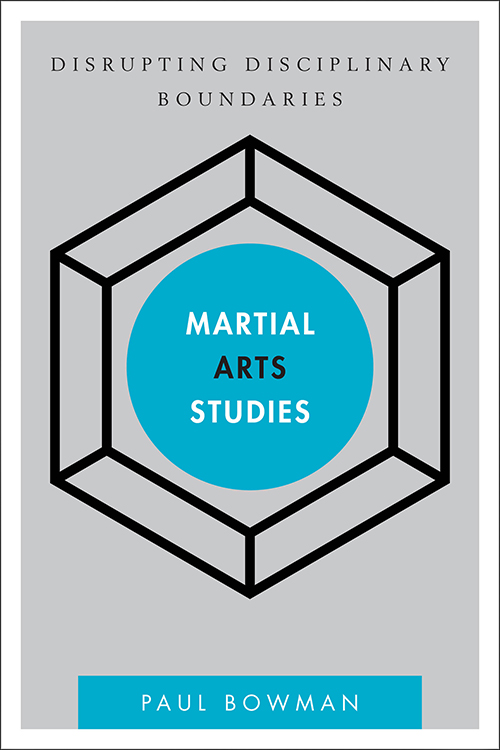 Paul Bowman is director of postgraduate research studies in the School of Journalism, Media and Cultural Studies at Cardiff University. He has also authored many academic monographs, including Theorizing Bruce Lee (2010) and Beyond Bruce Lee (2013), and is on the editorial board of East Asian Journal of Popular Culture, among others. He has just authored a new book, Martial Arts Studies: Disrupting Disciplinary Boundaries, published by Rowman & Littlefield. “Martial arts studies” is an emerging academic field rapidly gaining attention and interest. Many academic fields including history, philosophy, anthropology, and Area studies already engage the martial arts in their own particular way. Bowman’s new book poses the question, “Is there really such a thing as a unique field of martial arts studies?” We spoke to Dr. Bowman in search of the answer.
GC: For the benefit of our readers, what is your personal martial background?
PB: I trained for a while in Shotokan when I was 13. When I went to university, I trained in Taekwondo . Later I switched to kickboxing, but this fizzled out when I was doing my postgraduate studies. After quite a long break I started Aikido and really enjoyed it, but I was working on my PhD then and the class times clashed with times I had to be traveling and teaching. However, the day I finished my PhD I took my first Tai Chi lesson, and I fell in love with that. In 2003 I switched classes and styles and studied Buk Sing Choy Lee Fut alongside Tai Chi. I qualified as an instructor and started learning Xingyi. But in 2009 I dislocated my foot and broke my ankle in three places, including right through the malleolus. This devastated my ability to practice styles that involve sinking into low stances. It took me a long time to realize that I was never going to recover fully, and as this dawned on me, my Tai Chi and Kung Fu tailed off. I would flip from denial to being depressed about it. But then I tried Escrima, mainly because I was attracted by the weapons. Fortunately, I found this to be less harsh on my ankle joints, so I have stuck with Escrima for the last three or four years. I still practice my Tai Chi forms and occasionally push hands with people, but my ankle injury really limits this kind of training to short bursts. It’s a pity, but such is life.
GC: What inspired you to pursue this discourse?
 PB: What inspired me to write about martial arts in an academic way was my conviction that there was something really important going on between the realms of martial arts films and martial arts practices that no one seemed to be thinking about. I wrote a book about Bruce Lee on this subject, one that I thought no one would read, but in the end it proved to be rather popular, and I ended up being asked to research and write more about this. People think I’m a “Bruce Lee expert,” but really that was never my aim, nor the point of those books. Really, I was looking for a way to think about the impact of film and media on martial arts practices, beliefs, hopes, dreams, expectations, fantasies, and all of that. In the end, thanks mainly to the internet and particularly to blogs, more and more like-minded scholars have managed to make contact with each other, and we have now agreed to call this newly emerging approach “martial arts studies.” The field is multi-disciplinary and emerging fast.
GC: How far away do you think we might be before Martial Arts Studies is established as an academic field?
PB: I think it’s happening now. More and more scholars are calling what they do “martial arts studies.” We’ve published books, started to have annual conferences, established an academic journal and even begun to win grants to develop the field. The first few things I just mentioned (books, conferences, journals) show the dedication of the academics involved. The last thing on the list (winning research grants) shows that the field is being recognized by important academic institutions and bodies. So we are in the thick of it now.
GC: What do you consider to be the biggest misconception about martial arts as an academic study?
PB: The idea that they are trivial. There is a long history of this. People think they are trivial, kids’ stuff, or weird. We’re showing this to be unfounded. Martial arts link up with and feed into so many important issues – gender, race, ethnicity, culture, class, nation, globalization, community, identity, and so on.
GC: And what might be the biggest obstacle to martial arts becoming an academic study?
 PB: Actually, it has long been possible to carry out studies of martial arts in many kinds of disciplines. You can do studies of aspects of martial arts in sociology, anthropology, history, film, media, psychology, criminology, sports science, health, and so on, and so forth. You name it. But the point is that these have always been studies of martial arts that take place within a different field or subject area. What is happening now is that martial arts studies is emerging as a field in its own right. So, in one sense, it already exists. But will we see martial arts studies programs in US and UK universities? In actual fact, there already are some. These are mainly connected with sports schools and departments. But academics like Douglas Wile have argued that such degrees could also easily be introduced as programs in, say, Chinese or East Asian Studies schools, and so on. The obstacles, however, will always boil down to whether the powers that be within universities allow such programs to be set up. Resistance to new programs always takes the form of two questions: first, is this a legitimate scholarly area? Second, will there be enough students to make it financially viable? We are answering the first question. I’m sure others are tackling the second.
GC: Do you foresee Doctoral programs in Martial Arts in major U.S. universities?
PB: I’ve always worked in the UK, so I’m not entirely familiar with the way US universities work. But I know that many US programs have produced what we would now call martial arts studies scholars. There have long been PhD projects focusing on martial arts history, culture, society, and so on, in schools and departments of anthropology, sociology, ethnography, history, etc. Similarly in film and media there are always PhD projects on martial arts. However, there is a key difference between US doctoral programs and those elsewhere. In the UK, people apply to develop a project of their own devising, and schools accept such applications if they feel they can supervise them. I’m not sure that it happens quite like that in the US, where I think PhD students first follow a core course as a group and only later develop their own individual project based on what they have learned. So in the US context, the emergence of martial arts studies programs could be an uphill battle. However, other routes are still available: individuals can develop their research projects within the contexts of established programs.

GC: MARTIAL ARTS STUDIES has a heavy focus on Chinese martial arts. Why is that?
PB: Well, you research what seems interesting and important to you and you write about what you know. For a long time Chinese martial arts enthralled me, and during that time I was carrying out research into them. The first really significant find for me was the work of Douglas Wile, who has translated and written great essays on the emergence and development of Tai Chi Ch’üan (Taijiquan). There’s also Stanley Henning, and again his work is primarily on Chinese martial arts. Adam Frank’s work on learning Tai Chi in Shanghai was fascinating and I wanted to respond to that too. Then the blogger Ben Judkins has long written great essays on Wing Chun, which spoke to my own questions and interests. So most of the scholarship I was exploring was about Chinese arts, and of course I was studying Chinese martial arts at that time, so this was at the core. At the same time, I am also reluctant to say potentially controversial things about arts I have not practiced. So although I will occasionally write about arts and styles that I have not trained in, I will not treat them in the same way as arts I have experienced. For instance, there is a great deal of scholarship being done on BJJ, but I don’t train in BJJ so I am very careful about what I say about it. I think you have to know the feel of something to appreciate it. Could you imagine thinking you knew anything about boxing without ever having been punched repeatedly yourself? I don’t really feel comfortable writing about something unless I have experienced it as much as I can.
About author:
Subscribe to KungFuMagazine.com here.
Get your print edition of the MID-AUTUMN 2026 here.
Gene Ching is the Publisher of KungFuMagazine.com and the author of Shaolin Trips.


