
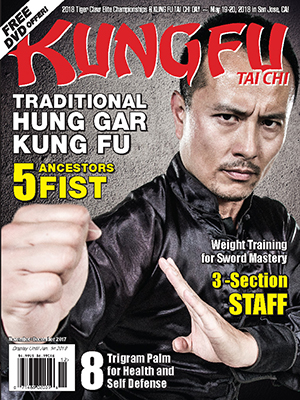
 There are a lot of ways you can describe Robin Leong: Kung Fu Master, Movie Star, TV Personality, Entrepreneur, Loyal Son, Devoted Father. At the moment, the top of my list for his accolades is Cover Master of the November+December 2017 issue of Kung Fu Tai Chi. I had the delight of indulging in a long interview with Master Leong for that cover story, but we were limited as to how much of it we could run in our print magazine. Our conversation navigated across many topics. Here now is more from that interview.
Confucianism demands that the first thing a martial reader must know about Master Robin Leong is that his father is the renowned Hung Gar Grandmaster John S. S. Leong, also a Kung Fu Tai Chi Cover Master. Grandmaster Leong was featured on our 100th issue, the January+February 2008 edition. Despite his bloodline, Robin never felt trapped into Hung Gar. He credits Kung Fu for giving him great hand-eye coordination and confidence for sports like basketball and baseball. Playing sports was much easier for him than other kids, and he’s always had great passion for it, especially baseball. “That's what I stress with the young kids of today. Doing any martial arts – it could be Taekwondo, it could be Karate, Kung Fu, Wushu. Get into a martial art and it will benefit you, not just the discipline, but physically, playing other sports. It just makes things easier... Kung Fu was the reason why I was able to play basketball and baseball. Baseball was actually my best sport. With the hand-eye coordination of baseball, it really helped. And I always give credit to my Kung Fu background, because of just the coordination, you know, playing any sport. So then I started going to tournaments, competitions, it's all about confidence. I never felt trapped but I learned to appreciate it, much more obviously when I started playing my sports because it was much easier for me than other kids. And it's because of the training. That training with hand-eye coordination really helps. That's how I felt.”
 Despite his father's illustrious reputation, Master Robin didn't remain hidden in his father's shadow. Part of what helped Robin's independence was that he struck out on his own, putting the Pacific between them. Robin explains, “I've been away for a couple years in Asia. That was my choice. I've always wanted to be in Asia ever since I was in high school, because I felt the U.S. was slow-paced. Well, maybe it was because of the city – I was from Seattle. It's a little slow. But I've always loved Asia. Being overseas, it gives you more perspective. And I think me going to Asia was very beneficial, obviously for me personally, you know, and even for the relationship between my father and myself. Because I believe that, just like any father, you like to see your son carry the traditions. But he never ever says, 'Oh, you have to do this or that.' That's why living overseas and having my career over there rather than here, it worked out nicely because I've been there twenty years now. Coming back, it's kind of full circle. The appreciation of everything, of my teaching, of my father, everything. It's just come full circle. Now I have my own family, and seeing them training, being there doing classes at my father's school in Chinatown, seeing that, I couldn't comprehend that because it feels like I was just there myself. But my father, he is a man of total conviction. I never felt he ever wanted to pressure me or my sisters – that we have to continue his school. Everything is looking very organic and natural. My father is eighty this year – not slowing down. I feel the things he has brought to America ever since he started his Hung Gar school in Chinatown, it's something that generations are going to benefit from. I feel that obligation of sharing that with the world. It's something that he started. He came to America with nothing. And he'd be okay with that, but he is a true example of someone who just – the righteousness of what you’re doing. Just do the right thing. His motto is 'Always do the right thing and you don't have to worry about anything.' That goes into train hard, you get the benefits, you know? Always helping people. Never cheating people. And you always come out good. It's just the simple rules of life.
“My father never sells,” adds Robin. “He just says, 'Watch. Learn. Do a class.'”

On Acting
Once in Asia, Robin began acting by chance. Initially he aspired to be a lawyer. He was discovered at random while living in Hong Kong one summer during his college days. A woman stopped him on the street and handed him a business card for Golden Harvest, one of the top film studios of the day. “The thing about my acting career is that was not in my cards,” confesses Robin. “That’s not what I wanted to do. I wanted to be a lawyer. When I was a young kid, I’ve always loved to do business. When I went to university, instead of getting into law I went to business school. I started performing when I was five, doing exhibitions and stuff. I was never comfortable in front of people – expressing myself – so acting was definitely not something I could do. But when I was in the university, even up until the end, I felt that I had to improve myself, be able to speak in public, so I was a speech com major, which was pre-law. And it helped me. I took classes like Essentials of Argumentation, the Art of Public Speaking, and it help me a lot. From that point on, because I went to Hong Kong in 1991.”
Robin took up that lady's offer and went to Golden Harvest for a screen test. He was signed that day and got a role as a lifeguard in Five Lonely Hearts (1992), a teen romance movie. Robin remembers his first movie experience fondly, even when he ran afoul of the director, Fruit Chan. “He had some award-winning movies, but back then, it was so funny. That was a great experience. I only shot for like five days, but it was a thirty-day shoot, the whole movie. And I remember he got so angry at me one time because he wanted me – I’m the lifeguard and I ride around on the Jet Ski – and he wanted me to jump off and save the girl. You know, I was a good swimmer but we were right in the middle of – I forgot – I think it was Repulse Bay or somewhere – but he just wanted me to jump. There was nobody around. I said ‘okay’ and just jumped normally. He goes ‘God dammit’ and he goes on the Jet Ski and he did my part on the jump off the Jet Ski. It was so funny. He was my stuntman. But it was fun. After that film – it took less than a week – an agent signed me on and she got me another film to do in that same summer. That one was fun because I was the bully in the school. It was another coming-of-age movie about kids growing up; Feng Bobo was in there, Eric Tsang – that was produced by Peter Ho. He’s now a famous director. He was just a producer at that time. It was done by UFO, a famous production company. And that whole thing, all my lines are in English and they just dubbed it. It’s funny. I was just saying, ‘Pepsi Cola Coca Cola,’ just talking for twenty seconds.”
After his summer in Hong Kong, Robin went back to college to finish his degree. But his time in front of the camera stayed with him as did the call of Asia. “I was doing modeling work. So that’s how I started. My intention was that after university, I went to Hong Kong. I just wanted to get away and I said, ‘I’ll spend another summer here.’ I just graduated and I didn’t want to do anything. I put my lawyer aspirations on hold for a while. But I never came back. So that was in '95 and I spent about a year and a half there. Then I was sent to Singapore to do an ad campaign to try to bring Hong Kong people to Singapore for the handover. And that’s why I first came to Singapore, and ever since that I’ve been living there for 20 years.
“The ironic thing was when I left Hong Kong for Singapore, that’s when I first met Daniel Wu. Daniel had just arrived in Hong Kong the same month I had left for Singapore. So we kept in touch ever since then because he would visit Singapore. It’s amazing because like Daniel, when he came there, he couldn’t speak any Chinese – I mean a little bit. He worked real hard. That’s not easy to do. Because you know, when you get the script, you need to really memorize your lines. For me, with the Chinese scripts in Singapore, jeez, especially not being a native speaker, even with a tutor, it helped but it’s not easy.”
Robin’s perchance entrance into acting has left him somewhat indifferent about getting into that industry. For aspiring martial artists looking to get into acting and stunt work, he has little to offer. “I know a lot of martial artists – they would love to live like this. There’s a lot of competition out there. People ask me, ‘Well, how did you break in?’ Just let it happen. If it happens, it happens. There will be an open audition or whatever.”

On Teaching
Unlike many action actors, Robin also spearheaded his own martial arts school franchise. Ch’i Life Studios is a family-based Kung Fu academy that Robin founded in Singapore. Today, it has branches in Shanghai and Redmond, Washington, with Robin scouting possibilities for another in California. Teaching traditional Kung Fu is challenged by the fast-paced short-attention span of modern-day students, but Robin endeavors to minimize compromising the old ways. “We have set minutes in all stances – horse stance, bow stance, cat stance – so they get that. I want to build a foundation – the legs, the hips – that is never compromised. But there's extra time to not just practice your forms but to also work on different aspects of their training, because they're also learning cartwheels, gymnastics movements, certain kinds of kicks like roundhouses, whatever it may be.” Nevertheless, some concessions to the young generation have to be made. “The classes are shorter. In my day, class was two hours, three or four times a week. Now the classes are 50 minutes up to an hour and ten minutes, depending on the age. The younger kids – three-years-old – are shorter. I realize with the younger kids that the attention span is not there. It would be more detrimental than beneficial.”
This doesn’t mean that Ch’i Life Studios is just a kid’s school. Robin nurtures the students who want to excel and compete. But his take on present-day competition betrays his sense of traditionalism. “There's competitions in Asia and China that haven't come to the U.S. I know here the competition circuit is very popular. What category if you're comparing that with a flashy Wushu set or a modified Shaolin set where they do an acrobatic double flip into a split? It's athletic, but that doesn't make it better. But that's subjective. Just that understanding of what it takes to do certain movements is kind of skewed because you get sidetracked, just like MMA. You get sidetracked – oh it's action! You see that guy do a double flip into splits and that's impressive. But does that make it less impressive when you see Hung Gar staying in a stance doing certain forms that take a lot of energy and qi. Does that make it less impressive? I don't think so. Maybe to the visual height it does.
“Shaolin is very aerial – powerful and fast. But Hung Gar, you're never in a rush. Hung Gar is a lifelong journey. That's what all traditional martial arts are, a lifelong journey. Not burning out after six months. It's just understanding the philosophy and respecting the traditions, just being able to become one with your training whether it’s a form that you're doing or it’s basic training. The only person that you are competing with is yourself and that's when you start to feel that character. That's what I like to tell people. You feel character, layers and layers of character. When you finally get it, whatever you're working on, it's just very satisfying. With MMA or the other things, I don't know if you get that same feeling. I get that feeling when I do Hung Gar and nothing compares to that.
“The proof is in the pudding. Like all the great Hung Gar masters, they don't have to sell that. The proof is in the pudding. Sometimes they just do. To show it off, just do. And you will be good. Some of the forms take minutes, and that's the beauty of it. When you're judging these thirty-second forms compared to two-and-a-half-minute forms where you're breathing and in stance – wow. It's like Tai Chi. I have a lot of respect for Tai Chi masters. Don't rush.”
There’s an implicit notion of time-on-task with Kung Fu. Good Kung Fu is developed over a long time spent practicing. This is quashed by the ADHD mindset of today’s Twitter-addicted generation. Robin sees how this affects martial arts competitions as well as films. “Action films are good for that hour and a half to entertain yourself,” he says about today’s cinematic offerings, “but the real meaningful ones, they leave an impression on you for a lifetime.” He’s talking about the Golden Age of Kung Fu films, when Hong Kong studios Golden Harvest and Shaw Brothers made those classic Kung Fu films that inspired generations. “These are the seventies, man. Chang Cheh – that genius! I don't think it gets enough credit. I'm such a big fan of the Shaw Brothers. And a lot of those actors are beautiful martial artists. Humble. That's a key word. My father says, 'Always be humble.' The proof is in the pudding.
“I'm very proud of my father and what he's accomplished. I just feel it's important in this day and age to continue that. It's very important because people are forgetting the roots, especially in this modern world of MMA, and all these pseudo-martial arts. Now people just want that big bang for the buck, you know? They say 'Oh. That's what I want. I want action.' But not understanding the philosophy. This is a lifelong journey, not just something you're going to do for a year. And that's what my father always stresses to his students.”
About author:
Subscribe to KungFuMagazine.com here.
Get your print edition of the MID-AUTUMN 2026 here.
Gene Ching is the Publisher of KungFuMagazine.com and the author of Shaolin Trips.


