
 It's autumn in San Diego, and though the city has lost its Chargers, the Padres still eat like mosquitoes (they suck) and they've had as much rain as the planet Mars. It's good for the soul to know that the city can consistently count on at least one, yearly Fall event that re-Chargers the spirit by hitting homeruns to create a downpour of 160+ films, from 20+ countries in 6 venues around the city. I'm of course referring to the San Diego Asian Film Festival (SDAFF) that runs from November 8 - 17 as it also reigns as the second largest Asian film Festival in North America. Now in its 19th year, SDAFF 2018 will help to remove the strain of global warming by featuring three cool martial arts movies, that highlight the high flying far-out, the physical gut wrenching reality and the traditional somber slice of combat that have become trademarks of the various martial arts genre.
In regard to Chinese fant-Asia films, born out of Tsui Hark's landmark movie, ZU: WARRIORS FROM THE MAGIC MOUNTAIN (1983), critiques often described this martial arts genre akin to Chinese cuisine like, "They elicit menus of succulent Chinese palatable tastes, beautifully wrapped into a spring role of luscious flavors sure to visually eviscerate your eyes leaving you screaming for seconds and thirds." So it makes sense that this year's Opening and Closing Night films, LITTLE FOREST and RAMEN SHOP center around Korean and Japanese/Singaporean delicacies, respectfully. Between the book-end-themed meals of magnificence, lie the staple foundation of Asian food, rice, a metaphor for the historical staple of Asian cinema, Kung Fu and samurai epics.
And speaking of Tsui, what better way is there than to have the second evening kickoff with Tsui's latest, CGI spectacle of fant-Asia pageantry, a film specifically shot in 3D but released outside of China in 2D, DETECTIVE DEE: THE FOUR HEAVENLY KINGS (DD3).
SDAFF's artistic director Brian Hu gleefully shares, "It's sleuth and palace intrigue, a Tsui classic filled with visual and kinetic extravaganza in 3D no less. Tsui has made a career of making fun hybrid films. I saw the 2D version and could tell by the way the action was orchestrated this would be much more fantastic in 3D. I requested 3D, they hooked me up and this is now the 3D, North American premiere of the film. It's hard to get these kinds of films because they have lives outside of the film festival. We want to find ways to make them more viable to our audience, finding a way to show it anew."
Though the latest wave of 3D films is dead in Hollywood, 3D is still huge in China, thus according to Hu it's still a way for people to recoup their budget adding, "Only a director with the clout of Tsui can pull it off when he says he wants to make a film that is specifically designed to be a 3D film."
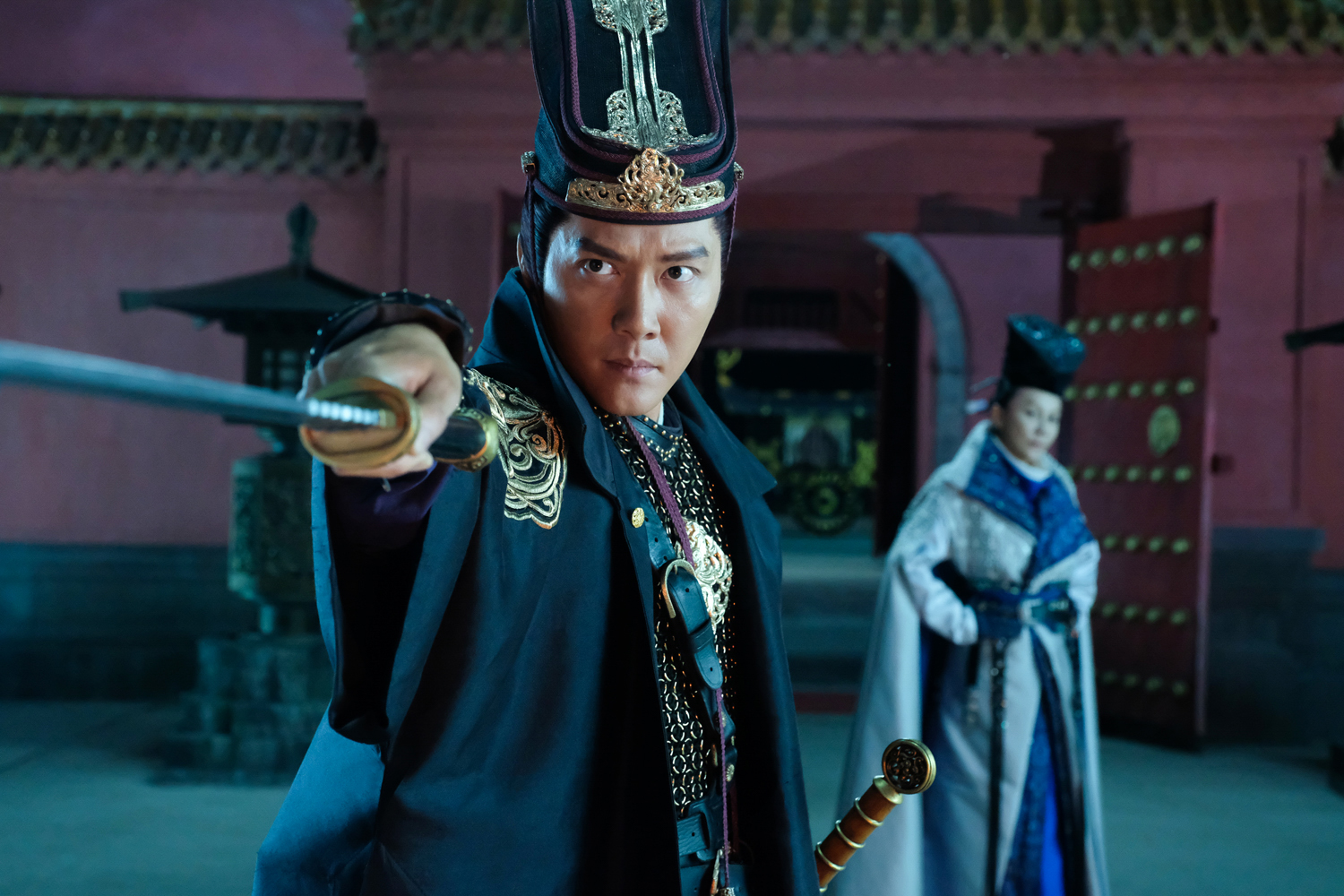
Three of 2018's latest big CGI Chinese productions all miserably failed at the Chinese box office: the $112 million budgeted ASURA was yanked from theaters after three days; GENGHIS KHAN earned a measly $6 million; and Renny Harlin's LEGEND OF THE ANCIENT SWORD pulled in a poultry $2 million. Yet Tsui's not so high budgeted DD3 in 3D earned $126 million.
Briefly, DD3 continues where the previous installment, RISE OF THE SEA DRAGON (2013) ends. Empress Wu Zetian is incensed when her husband bestows upon Dee (Mark Chao) the coveted weapon Dragon Taming Mace. Wu orders Dee's sworn blood brother Yu Chi (William Feng) to retrieve the Mace by working with the devious Mystic Clan, so named by their overwhelming weapons and black magic powers.
Wu is also in cahoots with the feared Wind Warriors, who have unspeakably psychotic sorcery skills and are lead by the Emperor hating Faceless Warrior who brandishes a head suffocating weapon. This film is crazier than if when the Apollo 11 landed back on Earth in 1970 and the first responders were dressed in PLANET OF THE APES costumes. By the way, that's a major hint about what happens in the finale battle between good versus evil beyond evil.

What's the next delightful martial arts meal at SDAFF's restaurant? The Donny Yen starring BIG BROTHER. Though it's not a film about wall to wall action, it's action is wall to wall caring about the youth in Hong Kong. Hu notes, "Throughout the movie, there's documentary scenes shots of teens in Hong Kong woven into this seemingly popcorn entertainment. It's about what do we do about the fact that these people in our society are not being taken care of. Yen's character is here to take care of these students. It's a utopian kind of fantasy that's using marital arts to get people there."
Directed by Kam Kai-ka (assistant director on Yen's IP MAN and IP MAN 2), Yen plays former US Marine Henry Chen who returns to Hong Kong to be a teacher at his former school on a mission to find himself, which deepens as he helps five wayward kids find themselves, find their parents and with a pinch of Yen's rough, tumble and bash, saves the school from going under due to land grabbers, under-achieving students and gangster ne'er do wells.
Yen has things to address and he does so not by complaining or ranting on about it, which is common these day, but with a character that finds solutions and applies them with happy calm smiles, a good ear, high fives, fist pumps and using positive adages to assure the youth of Hong Kong that ‘you can an do it’ and ‘believe in yourselves’.
Yet let's face it, it's a Yen film and it needs to have some typical Yen fights. For kung fu film enthusiasts, you'll wonder how can he wield his fists and feet like a compass, ruler and calculator, weapons of math destruction, so they can add up to a positive message where kids don't turn to violence to solve their issues.
This year's Festival Guide cover features bright red flowers. How is that Asian? Hu explains that they asked the cover designer to give them something enticing that can seduce you but at the same time poison you. It's a red peony, perhaps a subtle hint of seasoning for the final martial film dish being Japanese chanbara. I mean…who can forget actress Junko Fuji's Red Peony Gambler film series (1968-1972). As Hu posits, "This mysterious, deadly flower, the color, to me, it promises some kind of mystery."

What a coincidence…not. The final spice to be added to SDAFF's martial meal is director Shinya Tsukamoto's (TETSUO: THE IRON MAN) first venture into his country's samurai traditions with KILLING, which he's touting as a small world tale tribute to Akira Kurosawa's sprawling epics like SEVEN SAMURAI (1954) and THRONE OF BLOOD (1957). It's a Shinto-esque, dynamic reflection of a samurai's relationship with his sword as after the multi-folding process of steel gives birth to a samurai sword, it so proffers young warrior Tsuzuki to enter a new fold in life…killing. Yet is he ready to follow the code where obligation supersedes guilt and loyalty repudiates antipathy?
Hu adds, "He's young and dreamt of being a samurai and now he realizes, 'I have to kill people now?' Though philosophical, it has crushing action and it doesn't shy away from violence but it serves a purpose to show what's going on in the head of a person who's discovering violence.
"Overall, we've specifically found martial arts films that expand our ideas of the worlds that marital arts can intersect with."


