

The teapot is always turned away from the teacher.
“You must fully extend your movements during practice so that when you have to apply the techniques in an actual situation, you will not cut your power short,” our teacher said rather pensively before taking a sip from the white well-worn teacup.
The rest of the restaurant could care less about this conversion. There were so many others happening around us, and each seemed to grow louder in attempts to drown out the other voices with their own. This is the nature of having dim sum (點心), the popular dining experience of tasting a variety of sampler-sized dishes in a cha lau (茶樓), or teahouse. But we never used the term dim sum when we would go religiously after practice (lin gung 練功). We always called it yum cha (飲茶) which literally means to drink tea. They complement each other: to eat (dim sum) and drink (yum cha). Like yin and yang (陰陽), one must coexist with the other to make the experience whole. But the culture of Chinese language is filled with multiple meanings and metaphors, which makes its complexity filled with deep meditations and an equal number of pitfalls. Eating satisfies the stomach, but drinking satisfies the spirit – particularly depending on what beverage you subscribe to. But during yum cha, your unassuming cup is filled with opportunities to be informed about the martial art which you chose to study and the people associated with it at each meeting. However, you have to physically be there to take advantage of it.
In the training hall (mou gun 武館), you train your mental and physical attributes. At the teahouse, you develop your social acuity. While it’s hard to imagine a world without being attached to a smartphone and all of its apps, that particular setting enabled yum cha to be a primary means of social contact and personal interaction. Being face-to-face with someone is vastly different from facetiming them. There is an unforgiving level of sensory deprivation when it comes to face-to-screen communication by way of toneless texts and carefully curated social media content. In martial arts, we rely on all of our senses to detect the input from our surroundings, to assess their status, and to respond in the most ideal manner. Yum cha is a venue that challenges our senses and raises our awareness of social dynamics – both areas that are threatened by the ostensible ease of our technological modernity.
In the beginning, it’s a bit overwhelming: the noise, the sights, the aromas… It is literally sensory overload. But over time, you grow immune to it all. You learn to identify the patterns, the routines. Then, the superfluous elements of the setting naturally become white noise, and you learn to focus on the particulars of your own table. This is no different from what we actively train ourselves to do every practice session – to identify patterns, ignore the distractions, and focus on the moment. The locations may have changed, but the objective is still the same. This is an important step in cultivating your martial and social sensibilities because you need to understand the patterns in order to identify when they are broken as this eventually establishes a basis for your intuition. And these are the nuances and details that make each and every yum cha situation different yet relevant to your overall training and pertinent to your life.
In traditional Kung Fu schools, outside of direct instruction given during your lesson, you were rarely told anything else because you were somehow expected to know it – everything. That was the context of the culture – observance was a sign of obedience, and obedience implied respect and loyalty. And if your teacher (sifu 師父) spoke little to nothing else outside of his native Chinese dialect, that was another obstacle that you had to contend with. At yum cha, we were directly told things when we didn’t do them, and we were supposed to inherently understand the rest. This was nothing personal, it was just the pattern of cultural behavior for any family at yum cha. And that was the key. When you are at yum cha, you are with family – whether it is filial or fictive. And like any and every family, there are dysfunctions.

Sifu Peter Pena with students.
The Unaware, the Awkward, and the Inner Circle
At any given yum cha school gathering, there can be up to three identifiable archetypes of students and their subcategories. The first represents those in the inner circle: the most senior members of the school – the regulars. They set the tone of how the gathering will go. The next are the intermittent individuals who come on occasion and have seen and know enough about how to conduct themselves at such a get-together. Then, there are those who are completely new: first-timers – unknowing, yet open to the novelty or feeling a sense of obligation to go. The subcategories of each of these archetypes are governed by an individual’s personality which can be summarized through the 5 Elements (五行) model – wood (木): inquisitive; fire (火): intense; earth (土): composed; metal (金): inflexible; and water (水): easy-going. An understanding of this paradigm enables one to approximate and anticipate a specific dynamic and tone for that yum cha session. For example, if a senior student is fire-based, or intense, the tone of the gathering may be tense or tension-filled since the passionate and protective nature of the individual may steer questions or conversations away from the sifu. On the other hand, an earth-influenced elder classmate may facilitate a balanced field of conversation and questions that may ease exchanges between the sifu and students, and assist with enlightening everyone at the table. Students new to yum cha who have a metallic personality and palate may have a difficult time with the dim sum dishes, which may seem offensive to the sifu, and this may affect the mood of the moment. A water-based casual classmate’s carefree outlook may balance a fire-dominant table or be considered too blithe to be taken seriously. And depending on the mood of the sifu, a wood-inclined senior’s questions may be entertained or viewed as irksome.
With this in mind, if you have not been explicitly briefed about a code of behavior by a trustworthy classmate, it is always best to enter yum cha with some reservation regardless of your particular personality. This should also apply when opportunities to yum cha by martial kin or acquaintances occur. Observe, assess, and address the table’s mood appropriately so that your influence may help correct any imbalances that negatively affect the climate of the table. This is a skill in itself, and like any other skill, it takes time to develop with each experience. Engaging your teacher in conversation, however, is a set of understandings and skills of another sort.
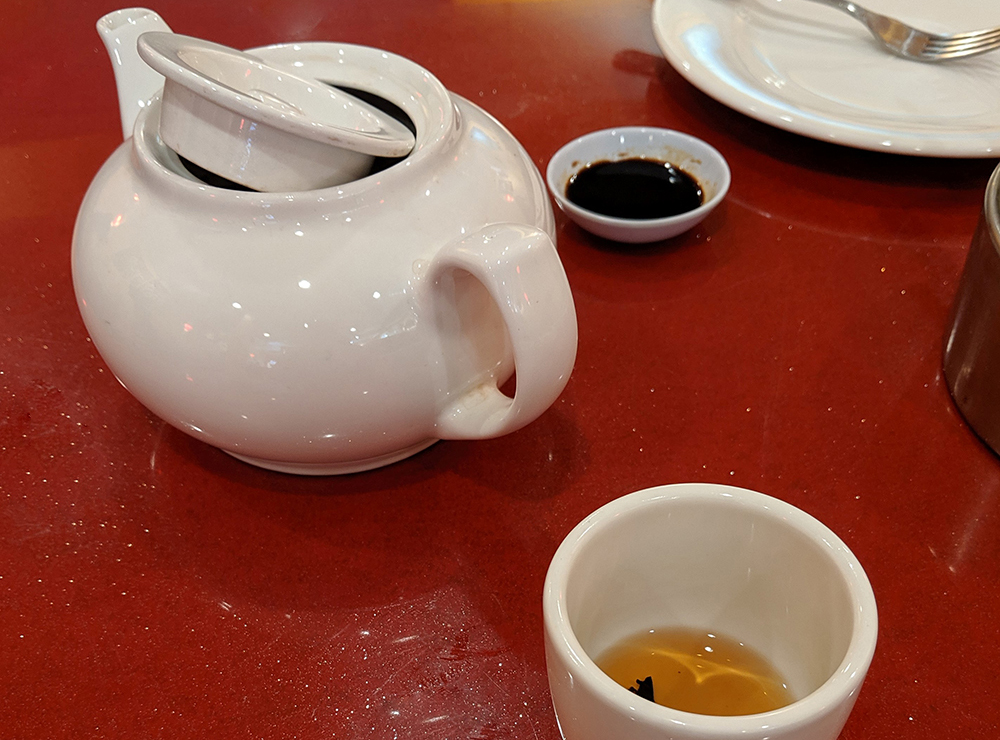
To signal for more tea, the cover is upturned.
Your Sifu Is Not Your Friend
The first and foremost rule to remember with your sifu is: Your sifu is your teacher. There are boundaries and protocols implicit with this traditional title. While it is very easy to assume a casual and perhaps even close relationship with your teacher in today’s times, this should not diminish the courtesy and respect that is due to someone in such an authoritative role. The title of sifu is used to highlight that person’s expertise with a definitive sense of clarity and purpose. That being said, it would be a great faux pas to greet your teacher the way that you would greet your best friend. However, it is also not necessary to debase yourself with an overly exaggerated form of humility. It would be most advantageous to be yourself with boundaries for both your sifu as well as yourself. This is also necessary in modeling the appropriate behavior for other school members to follow in order to maintain the integrity of the mou gun.
As with all human beings, your sifu will have days where “Sifu is on” and there will be days where “Sifu is not his/her best.” When your teacher is comfortable and accommodating, the variety of talk and topics come very freely:
“When I started learning Kung Fu at 13, it was very different than now. I would train 8 hours a day. No problem."
“Bat yung maan lik (不用蠻力)” – Do not use brute/reckless force.
“Your si baak (elder uncle 師伯) does it different from the way I teach you."
Personal anecdotes, coaching tips, and biases are all possibilities that can come up in the course of conversations. On the flip side, there may be occasions where your sifu may not say a single word beyond, “More tea.” Traditionally, the latter occurred more often due to the possibility of deceitful students seeking martial trade secrets.
In any case, there are lessons to be learned from every occasion of yum cha. While they are experiences that can be captioned on Instagram, they truly need to be experienced in person the way that we were traditionally meant to socialize with each other.


