
 For The Silk Road Kung Fu Friendship Tour Part 26, click here.
Visit with the National Wushu Team in Jakarta, Meeting Hobbits, Buddhas and Hindu Gods in the National Museum, Introduction to Pencat Silat and Journey up Kawah Putih, or White Crater Volcano
At the nexus of Oceania and Asia and our own little blue planet’s massive tectonic plates lies a string of 17,500 tropical paradise-like islands, all formed from volcanos, with some 7,000 of them remaining free of human habitation. One group of islands in Indonesia formerly known as the Maluku or Spice Islands were part of the Maritime Silk Roads at least since the 4th Century when Arab traders introduced cloves to Europeans. At that time, nutmeg and cloves, indigenous to the Malukus, were worth their weight in gold. However, it was in Jakarta, the bustling capital city of Indonesia with 10-million-plus people on the northwest coast of Indonesia’s largest island Java, where we woke up on Friday, July 19, 2019. Those who follow these Silk Road Kung Fu Friendship Tour series of articles already know these days I’m often accompanied by my fiancé Miao Hui, who dabbles in gems and jewelry along the fabled Silk Roads.
Hooking up with a Wushu Federation usually takes a few days, so for me it was a “day off.” And a “day off” for me means a trip to the National Museum which in Indonesia is known as the “Elephant Building” (Gedung Gajah) where the roots of indigenous cultures can be found, and indeed in such museums I usually meet up with the most unlikely of old friends, in this case the original Hobbits.
According to the Smithsonian National Museum of Natural History, “Remains of one of the most recently discovered early human species, Homo floresiensis (nicknamed ‘Hobbit’), have so far only been found on the Island of Flores, Indonesia. The fossils of H. floresiensis date to between about 100,000 and 60,000 years ago, and stone tools made by this species date to between about 190,000 and 50,000 years old.”
The collection there is a magic teleportation through time. Upon entry I was met by a colossal 4.5m (14.7 foot) stone image of a Bhairawa (Hindu Tantric deity; manifestation of Shiva) king from Rambahan (possibly Nepal) found in Sumatra (3rd largest of the Indonesian Islands), who was calmly standing upon an alter supported by human skulls and then all manner of Hindu Gods and Goddesses, Buddhas and Bodhisattvas. There is also fabulous collections of clothing belonging to the ancient high and mighty, Chinese porcelain, weapons, and the full panorama of human endeavor and international civilization one might expect to find in an extremely ancient maritime Silk Road nation.
On July 23rd, we had the honor and privilege of visiting the Indonesian National Wushu Training Center and the opportunity to interview the coaches and some of the team. First, we talked with Assistant Coach Anatjhan who in his day was three times Asian Games and SEA Games Champion. He’s a successful Chinese Indonesian whose grandfather moved here from China. From my first phone calls and throughout our stay, he was very helpful during our visit. Also helpful is the fact his English is very good. He trained in Wushu in Shanghai, Guangzhou and Fujian, specializing in spear and sword.
He then introduced us to Iwan Kwok, Deputy Secretary General of the Indonesia Wushu Association, Technical Committee Member of International Wushu Federation and FISU (Fédération Internationale du Sport Universitaire) Technical Delegate for Wushu Sport. I asked him about Wushu’s popularity in Indonesia and he said there were about 30 Wushu clubs in Jakarta, 20 to 30 clubs in Surabaya, and others around the country. “Former athletes retire and open new clubs,” he said, “with some teaching at a few clubs.” I also found out the Taolu team trains every year in China whereas the Sanda team trains in Iran. This doesn’t surprise me as Iranian teams have some of the best coached and spirited fighters in the world – in all martial arts.

I asked about his Wushu background and he said he started at age 16 in 1995, which he reported “really is too old.” He first started learning Wushu in North Sumatra. His first teacher he described as a “normal person,” but good enough to help him get selected for the provincial team. Then, tragedy struck and he needed eye surgery, though he kept practicing. Two years ago, he trained as an International Judge and earned certification. He said Indonesia currently has six coaches certified for judging international Taolu and five for Sanda.
He said the Technical Committee of the International Wushu Federation and found out the Wushu Federation in China in 2018 started working on standardizing the grading and promotion systems, a development most will agree is a worthy task indeed. Researching the Wushu Federation Technical Committee, I found there are only 11 members in the world and thus Mr. Kwok is at the vanguard of developments in the Wushu world.
 I asked about the stars of the Indonesian team and heard about Lindswell Kwok, who though now retired was many times world champion. Any relationship to Iwan Kwok? Yep! His sister who reported he was her first teacher. According to IWUF’s website:
“When Taiji athlete Lindswell steps onto the carpet a certain magic falls over even the biggest arena. With a combination of ethereal grace, precise yet soulful technique, and dynamic power, this young Indonesian star has risen to the top of the international podium numerous times to take home the gold...”
I’ve been interviewing officials from national Wushu federations for several years now and was quite surprised at the answer when I asked about funding for the Wushu team. Iwan informed me that President Joko Widodo (usually called “Jokowi” who won reelection for a second term this past May) is very supportive of sports and their teams can afford to compete in international competitions as they come along. Wow!
After the highly informative interview with Coach Iwan, we got to talk with the National Team Head Coach Mr. Zhang Yue Ning. He started training in Nanjing city in Jiangsu Province in 1972. He was a national champion in China in the 1970s and 1980s and team leader of the Jiangsu Team for six years. He was the National Team Head Coach in Singapore from 2003 to 2008, the Head Coach of the Hong Kong team from 2009 to 2010, and Indonesia Wushu Head Coach from 2011 to the present. His list of accomplishments as a competitor however are far from over and he was the winner in the Tai Chi division of the Asian Games 2018. This interview was in Chinese language by the way, many thanks to Miao for help in translations.
Before long I walked to the far side of the gym and got a chance to talk with Sanda Coach Mukhlis. He’s been a national coach for four months now. Previously he was the head coach of the Java Wushu team for two years. I found out his first martial art training was in Taekwondo then Karate. During my time in Indonesia I found out most seasoned martial artists here started their martial arts careers training in Karate-do.
Sanda Coach Mukhlis was the national champion for four years from 2010 to 2014 and won gold in the SEA games in 2011. He’s a soft-spoken coach that really knows how to motivate and train his team with detailed precision. He’s a very bright young man, soft-spoken and powerful, and speaks English reasonably well.
In sum, Wushu in Indonesia is strong and getting better. They’ve got a great team, great coaches and government support. That’s what I call a winning combination.

Introduction to Pencak Silat – Indonesian Martial Arts and a Spooky Volcano
 Kawah Putih, or White Crater Volcano, lies 50 km south of the flower city of Bandung in West Java, Indonesia. It's only a four-hour drive from Jakarta to Bandung, and a couple more hours to the base park of Kawah Putih. We’d bargained with a local taxi driver named Duti, who spoke good English and came up with a very reasonable price together. Duti turned out to be a very interesting person indeed, though he said he learned everything he knew from talking to people while driving a taxi. We left Jakarta about 10 PM and that’s when my Pencak Silat education began.
First, he reported all evolved martial art systems have a spiritual base and moral backbone defined by where the martial art system originated. “Without those things it will be dangerous for everyone in the community,” he said. “The moral philosophy and spiritual dimension work together in Nusantara,” he added, with Nusantara referring to an Old Javanese term for the Indonesian archipelago. “Intertwined noble mind and character” are the goals of Silat training. He also talked at some length about faith and devotion to God, gratitude to God for being alive, and the requirement that Silat practitioners pursue peace and friendship. This moral philosophy he explained harmonizes with three teachings of the Noble Mind, asih (loving), asah (developing) and asuh (protecting).

KawahPutih, White Crater Volcano.
He mentioned examples from history, and that there are more than 800 styles of Pencak Silat. “All styles of Silat have some other things in common too,” he added like four sets of techniques, positioning, stepping, attacking and defending. Often related but different styles of Pencak Silat are like most traditional martial arts, passed down through families. Consequently, Pencak Silat styles in West Java for example are divided into many streams. Among them are Cimande, Cikalong, Syahbandar and many other schools. Here are some descriptions of some the styles of Silat.
Silat Chimande - Initially the Cimande Silat was created and popularized by Abah Kahir in the 17th Century. He lived on the banks of the river Cimande, Bogor, West Java. According to legend, Abah Kahir created movements based on the movements of a monkey and tiger. Cimande martial arts are comprised of movements made by a warrior that utilize the components of the human body as a gift from God. This school teaches in the sky there is still another sky higher. At the top of the mountain, there is a higher mountain peak. As great as any human being may be, there must be another life entity who is more powerful. It is on this philosophical basis that Cimande's Silat teachings lead one to distance himself from the nature of arrogance.
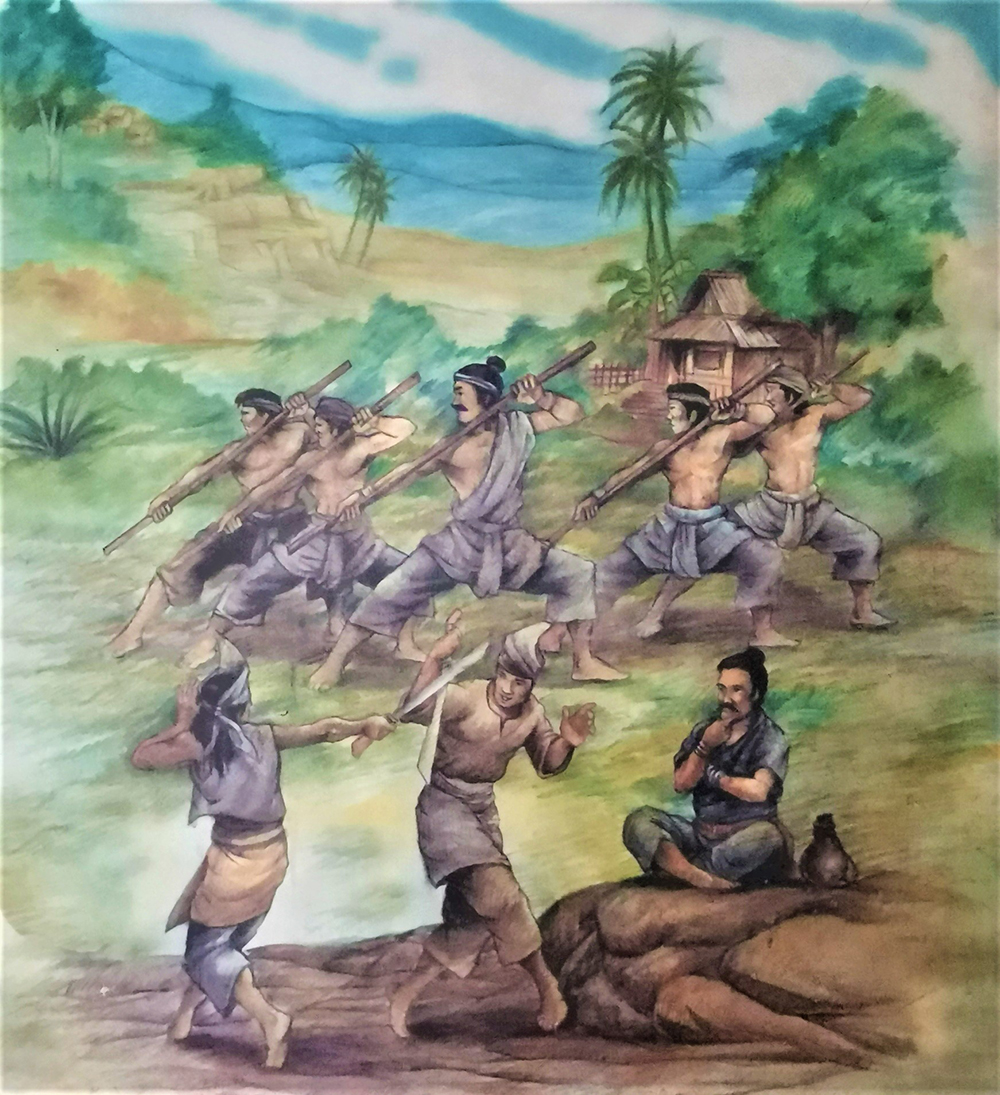 Silat Chikalong – Like Tai Chi, Silat Chikalong looks for the weakness in the opponent.
Silat Beksi – This looks a lot like Chinese Wushu.
Silat Pariangan – In West Sumatra (Padang) there was a style sometimes called the “Mother' of all Silat-styles.” The Sumatran Minangkabau tribe is one of the oldest and most influential tribes in Pencak Silat.
Tige Berantai – The Three Chains School, which he said uses ultra-rapid repeater punches. He also said this was a very popular style in Jakarta too, and further popularized in the movie THE RAID 2.
Duti mentioned many other styles all too fast for my rudimentary notes in the taxi speeding along the highway in the very early morning.
Duti told me Silat is not about ability so much as attitude. He explained that in Indonesia a holy man is called a “Kyai,” and when I asked for an example, he mentioned Abah Anom, who I later found out followed the Naqshbandi path, a major Sunni spiritual order of Sufism. I’ve met Naqshbandi brothers before, notably in Turkey. Just from what I observed they appear to live heart and soul as social workers without the money. In a way they remind me of Chan (Zen) Buddhists in that they appear to experience God (or the Oneness of all) directly and have very high levels of empathy, respect and help for all living things. Say what people will, I respect that. Duti was a most amazing teacher. “Never blame, never be selfish,” he concluded. “Wow” I wondered, did he ever read B.F. Skinner? Yeah, I’m trained as a scientist, but Duti spoke to the inner heart and came to the same conclusions as the greatest scientists. People are the way they are because of their learning (and blaming them for bad learning usually doesn’t help much). The task of good people is to try to educate those who we can when we can. And in the end, that loving kindness bonds our humanity into something greater than material spreadsheets can measure. Yes, our dichotomous minds are wonderful at separating this from that, and so how easy it becomes to forget how much all us living things have in common.
Duti explained that being “holy” was founded on having good basic character. “A winner is the man who can make a friend of his enemy. Students are not taught to win, but to win the hearts of their enemies. “Don’t use power to hit but to overcome the struggle within,” he said.
Interestingly Duti never referred to “God” using the Arabic “Allah” but rather the simple English word. Why? It was my impression all around Indonesia, no one wants to impose any sort of cultural chauvinism on anyone. Indonesia is a diverse country where all can participate on an equal footing. I was curious how all this might be communicated if an atheist wandered through, though I suspect some sort of transcendent meta-cognate might have sufficed for communicating a greater good or higher power in the universe (beyond the human ego).

The six-hour drive to the volcano was enlightening. We also talked about many other things too on our way to Kawah Putih Volcano near Bandung. He told me about the Grasberg mine which is the largest gold mine in the world and the second largest copper mine in the world located near Puncak Jaya, the highest mountain in Papua, and one amazing thing after another.
When we reached the park around 3:00 AM on July 24, the gate was closed, but we convinced Duti to park nearby. And then we started walking, up, up and up the small winding road through the heavily-forested quite-cold mountain. The temperature was about 45 º - 50º Fahrenheit by my reckoning, pretty darned cold for late July in Indonesia! We moved fairly quickly because we wanted to see and photograph the sunrise at the top, and of course, the lake in the center of the volcano. It was only a five-kilometer walk (three miles maybe) but it was a steep incline and seemed longer perhaps, maybe because we were in a hurry. I also briefly wondered if the gravity was simply stronger there.
The long hike was worth it however when we got to the top and saw the sun rise above the clouds on the horizon. Then we walked a couple hundred meters further up to the rather unusual lake in the center of the volcano. It was whitish and blueish, smoking a lot, and smelled strongly of sulfur. It was spooky. Even the sand and rocks surrounding the lake were bleached into whitish colors from the highly acidic (pH 0.5-1.3) lake water. Small skeletal black dead trees were all around the shore of the lake. A lot of things made the lake spooky besides the smoke, including the deep particularly smelly mine caves dug into the hills alongside the lake. These were first dug by Dutch colonialists and later expanded during World War II by the Japanese military for extracting sulfur, presumably for firearms (in making gunpowder, sulfur and charcoal act as fuels while saltpeter is the oxidizer.)

Miao and I remained at the eerily beautiful smoking volcano pit lake for about an hour walking around and taking photos, but the acrid air was nauseating and on the way out saw a sign at the entrance saying for health reasons it was best not to remain near the volcano’s lake for more than 15 minutes. Oops! Missed that somehow.
Uphill from the volcano lake, the air was forest clean and fresh again so we took a little nap on the soft grass in the cool morning air, a quiet, blissful relief from the fires, history, smoke and gasses connecting to the earth’s molten core. We then hitched a ride on the back of a water truck and bumped our way down to the parking lot at the base area to enjoy a spot of Indonesian coffee at a pleasant rest area with food stalls, strawberry sellers and so on. By the way, there are rumors of wild eagles, owls, monkeys, mouse deer, forest pigs, panthers, leopards and pythons living in the nearby forests. Come to think of it the forest was a bit noisy during our climb. Further down the mountain there are some splendid tea farms where visitors are permitted to wander, take photos and enjoy the beauty and tranquility of the surrounding landscapes.
Click here for our second installment of Wushu in Indonesia, where we are treated to an extraordinarily beautiful and powerful Pencak Silat festival on the island of Kalimantan, visit, dig, and pan in the traditional ways in Indonesia’s second largest diamond fields at Cempaka and then stay a few peaceful, beautiful days at Indonesia’s largest Pencak Silat Training Center in South Jakarta.
For more information on Pencak Silat, see our FALL 2019 cover story, “Meet the Martial Star of Netflix’s Wu Assassins, Iko Uwais” by Gene Ching
For The Silk Road Kung Fu Friendship Tour Part 26, click here.


