
 For The Silk Road Kung Fu Friendship Tour Part 29, click here.
Interviews with Wushu Federation presidents, coaches, athletes and journeys to the ancient Maritime Silk Road Port in Zhenhai District of Ningbo City in Zhejiang Province (just a hop across the bay from Shanghai), Tientong Temple that passed the torch of Zen to a major branch of Japanese Buddhism, and back in time some 7,000 years to the archeological site of Hemudu where some of the most ancient domesticated rice in China was found.
As competitive athletes know, competition is exciting. There’s an exhilaration, a supercharged feeling that goes along with challenging yourself and other competitors to do your best and win. There’s another really positive side to sports competitions, specifically the social benefits of mixing with like-minded and spirited people. Sports people tend to be cleaner, happier and healthier than most people. A really positive mind-set is required to push one’s self beyond self-imposed limits in every workout and competition.

So, even though I wasn’t competing in this World Wushu Championship I was definitely looking forward to meeting with coaches and other Wushu Federation people because many are like me, former competitors who hang in the game for the love of the arts and the people that do them. Meeting the athletes is also hugely fun because they’re really at the top of their game, hopeful, energized and ready to challenge the world with their hard-earned skills.
But hooking up with people at an event like the 15th World Wushu Championships posed certain logistical challenges. For example, security at this event was extremely tight. There were facial recognition cameras at the entrances for everyone. This isn’t some local competition where people can wander in and out freely, where a photographer can “work the room” seeking out the best angles for every Taolu performance or Sanda fight. Nope! Nothing like that. In fact, there was a bit of uncertainty amongst security where I was allowed to go as I wasn’t an IWUF photographer and yet I had media credentials. All photographers at both Sanda and Taolu venues were stationary and apparently not allowed to move. After the first 15 minutes of the first day, I was assigned to sit in a specific place amongst the audience, which made meeting coaches and federation people quite impossible. Ah ha!
So what to do? That’s obvious really, leave a few minutes before lunch break and hang around outside the sports competition areas and meet people on the way to lunch which is exactly what I did and first hooked up with some members of the Spanish Wushu Federation except, there is no Spanish Wushu Federation, except there is, sort of.
They - several honorable gentlemen and a couple of ladies - were looking for a restaurant, accompanied by the team coach from Hong Kong, uncertain where to eat. Eager to be helpful, I mentioned I’d seen several groups of Chinese from the sports competition heading up this street following their phones to food, which is the way most people do things these days around here in China. Phones know everything and one can get great coupons for restaurants, GPS directions and then pay for everything with one’s phone. After 10 minutes or so, the Hong Kong Coach seemed to think one restaurant in particular looked good, and I cordially asked if I might join them for almuerzo, lunch in Spanish (my second and maybe best foreign language) and so I got an invitation to lunch and into the curious situation of Wushu in Spain and Europe in general.
Chatting with my new Wushu friends, they first told me that in Europe, they don’t make a separation between Wushu and Kung Fu Federations. Second, I learned that Wushu in Spain is relegated to being a subsidiary of the Judo Federation rather than having a Federation of its own, because that’s the way the President of the Judo Federation likes it. Apparently in Spain, Wushu is hugely popular with some 10,000 players, many more than Judo or Karate, but it appears the vicissitudes of life have interfered with its natural development. In response, the Wushu federation (that isn’t a federation) tried various things like changing itself from a federation to a coalition union of associations to no avail - which reminds me why I always loved Spain so much:
“When life itself seems lunatic, who knows where madness lies? Perhaps to be too practical is madness. To surrender dreams — this may be madness. Too much sanity may be madness — and maddest of all: to see life as it is, and not as it should be!” ― Miguel de Cervantes Saavedra, Don Quixote
There is a Zen-like quality to Spanish thinking that cuts to the core of things directly such that one has no choice but to laugh about the absurdity of life sometimes.
Seated at the table with me were real Wushu people who collectively had a century or more experience, with Juan Carlos from Valencia the President of the Wushu/Kung Fu Coalition there, as well as Pablo Ortega, former Sanda Coach, who seemed to really understand the incompressibility of life sometimes. Our merry party of six or seven had a great lunch and then back to The Games!

The next day I met with some members of the Turkish Federation I’d met at few years ago in Ankara, specifically the patriarch of Wushu in Turkey, Abdurrahman Akyuz who had come with a large team of Taolu and Sanda competitors and several assistants, coaches, a doctor and so on. We all quickly became good friends and we chatted for a while on various topics including one young gentleman working on a research project into US, Turkish and Chinese trilateral trade, how that works to promote international peace and the role of international law in all this for his dissertation. Very cool topic. And then, back to the Games!
Also on the road to lunch, I met a lovely older married couple from Germany, Roland Czermi, President of the German Wushu Federation and his wife on and first found out they’d brought seven Taolu people, two coaches and five players as well as one Sanda competitor. Chatting about my Silk Road exploits for a few moments I found President Czerni was from Duisburg in German, and that Duisburg is actually the western end of the new Silk Roads with a rail connection between metropolis Ruhr in Germany and the megacity Chongqing in China. Funny how this works as I was also in the process of planning my post competition Silk Road travel to the major port at the eastern end of the new Silk Roads in China from the Song Dynasty to the Qing Dynasty in a city called Ninbo. In any case, it was an idyllic conversation on a beautiful early autumn day with a lovely couple from Germany, bringing back happy memories of my childhood on what were the best playgrounds in Europe at that time - in Germany. People sometimes ask me why I work on the Silk Roads Kung Fu Friendship Tour and one major reason is to encourage everyone to travel more, especially meeting like-minded martial artists and other friends with whom to share this path or Tao of life.
Every day I met enthusiastic athletes and 20-year-old Halim on the Tunisian team is a supercharged young Sanda man who was inspired as a boy by the likes of... who does he mention first? Bruce Lee of course, Jackie Chan and Jet Li. A member of one of the larger teams Halim did pretty well winning his first two bouts but lost on points in his third match against Russian Rustam Kakraev. But hay, even making it into the quarterfinals in this crowd is pretty good in my opinion. In any case, the Tunisian team was one of the most enthusiastic groups at this competition and we spent half an hour or more chatting about this and that.
Next, I found myself sitting next to Hong Kong Team Leader and Honorary Deputy Treasurer of the Hong Kong Wu Shu Union Kent Hong, who brought 10 Taolu and four Sanda people with him to the Shanghai 15th WWC. I have to say his Sanda people stood out as great fighters, and I was particularly impressed by young Hoi Lan Tsang, who was just a cool tempered kicking and punching machine out there winning battle after battle against some very tough opponents, especially the Thai fighter Suchaya Bualuang who also put her whole heart into it. There’s a reason the Hong Kong team came in third in the overall medal count: Their athletes are all just amazing and their coaches obviously have to be as well.
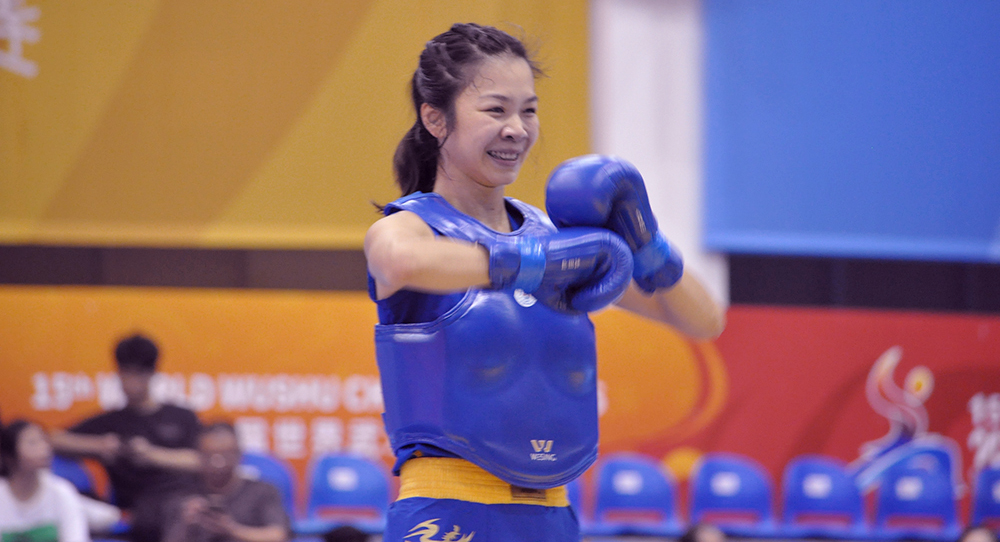
After that I met Priscilla from Switzerland. At age 34, she says she doesn’t have time for a husband as she’s too in love with sports, and sitting there we got to watch her coach and Federation President Sami Ben Mahmoud – with one parent from Tunisia - battle it out on the Sanda floor. Even though his opponent was quite a bit taller, Sami not just held his own but managed to dominate for just about all of the fight and he competed in Men's Nanquan as well. Quite an amazing athlete and coach!
Then I noticed Grandmaster Sayed Rahman Youresh, President of the Wushu Federation of Afghanistan sitting practically in front of me. He brought a team of at least five and certainly knew all the federation people quite well that I noticed as we were seated between the officials and the backstage area. He told me about some of his champions including Jamshid Ebram, a Taolu player and 90 Kg. 24-year-old Khaled Omar Noor. I also heard they have a great training center in Kabul these days.
Taking a walk to go over to the Taolu competition in the next-door stadium, I happened by the Mexican Team led by Coach Pedro Garcia Mascorro and couldn’t resist stopping for a while to get to know them a bit as they were such a lively and happy competitor group. I found out they brought six Sanda and seven Taolu people with them. Every group of competitors and coaches I met at this competition invited me to visit their nations’ training centers and this team was no exception. After a pleasant relaxing conversation, I took a photo of their inspirational team and was off to the Taolu competition.

The last morning of the competition I was lucky to have a few minutes to meet Sherif Mustafa, Vice President of the International Wushu Federation and President of the African Wushu Federation. From Morocco, he started his martial arts career in Judo, and then Wushu training in 1986. During his illustrious career he’s accomplished an amazing array of things including becoming an International Judge and Chief Referee, working in Egypt, working as the Vice President of the African Wushu Federation’s Technical Committee, and is currently in the process of finalizing the standardization of the ranking (duan) system for Africa and a thousand other things at least.
And then I had a very brief time to chat with Mohamed Adel Zahra, Vice President of the African Wushu Federation and Adjunct Treasurer of the Tunisian Olympic Committee. Wow! This was my golden day. He started Wushu back in 2005 and his background as a bank director must be very useful indeed for the Olympic Committee in Tunis and African Wushu Federation. Money may not make the world go around as some assert but it does help a lot now and then to be sure.
I consider myself very fortunate and honored to meet with such excellent individuals and groups and all the above people certainly exhibit the highest levels of Wushu culture, inclusiveness, friendliness and being real people. And the above were not all - not even half of the most excellent people I met, interviewed and liked during my four days in Shanghai. But, as George Harrison noted, 'all things must pass' and next I was on a new mission, yep, the Silk Road Express.
So I stopped at the hotel, picked up my bags and hoped a train for Ningbo – yep, last train for Ningbo – ALL ABOARD!

Gate to the ancient port Ningbo with ship in the background.
Ningbo - China’s Key East Asia Silk Road Port and a Jolly Good Old Ship
Ningbo is a medium sized absolutely beautiful very modern Chinese city and location of one of the oldest trading ports in the world. The name Ningbo is composed of two words, “Ning” which means serene, and “Bo” which means waves. Ningbo is the southernmost city of the Grand Canal of China and the junction between the canal and the Maritime Silk Road.
Located along the Yong River in Zhenhai District of Ningbo City in Zhejiang Province, just across the 100 kilometer wide bay from Shanghai in fact, surrounded by grass and commercial shipping enterprises one may find the dot-like scant remains of what was the Northern Song Dynasty’s (960-1127) greatest port, a stone’s throw from the East China Sea, though in fact this port’s history goes back to the 3rd Century BC.
It was from this ancient port that ships from China sailed north and south along China’s coast, to Korea and Japan and as far as Africa. So much history, culture and expertise poured through this ancient gateway to East Asia in addition to commercial items like porcelain, fashion clothing and accessories, precious oils, spices and other herbs, and teas. Likewise, Chan (Zen) Buddhism, Shaolin Kung Fu, infrastructure building skills and a thousand other things flowed through this gateway to the east. The south gate of Todaiji, a UNESCO listed world heritage site in Nara, Japan was built by Ningbo craftsman Chen Heqing in the Southern Song Dynasty (1127-1279), who traveled through the Maritime Silk Road from Ningbo to Japan.
Getting off the bus and walking a couple miles along the busy coastal road, I found what I was looking for, specifically an old ship and an old gate. There I met a relatively younger man (compared to me at least) named Zhu Xuen Bin. After chatting for while outside about history, he invited me into the small house-like building for a cup of tea. The following is part of what he told me (in Chinese of course).
“In the northern Song Dynasty what we now call Ningbo city was called Mingzhou.
“All of the Silk Roads of the Northern Song Dynasty (960–1279) started from Zheng Haikou. In the Northern Song Dynasty there were nine shipyards in China. The ships made by Zheng Hai in the northern Song Dynasty were 109 meters long, which was the largest ship in the whole central plains region of China at that time...
“We are thinking the government proposes to set up a Silk Road Art Gallery or museum here and show some of our exports from the Northern Song Dynasty.
“At this time the conditions here are not good enough. As you can see we have a small space in a large commercial shipping area. As a promotion of our East Asian cultural heritage, culture and commerce restoring this area to its former glory will be good for everyone.”
I couldn’t agree more Mr. Zhu! I’d love to see and experience the glory of the Song Dynasty Silk Road Port. For those wishing to visit the scant remains, or want to dance by the side of a reconstructed Ming Dynasty ship actually built by an art professor in 1906, try typing “Shen Zhou Gu Chuan” into the Gaode maps app you can download in China.

Inside the Tiantong Great Buddha Hall.
Tiantong Buddhist Temple
One evening after a two-hour bus ride east of Ningbo I made a stop at 1,700-year-old Tiantong Buddhist Temple located at the foot of Taibai Mountain in Yinzhou District. It is one of the ten sacred temples of the Buddhist Chan (Zen) sect in China. Like ascending towards a jewel in the crown of that mountain, I totally enjoyed the hike up the mountain road to get there in the brilliant early autumn twilight.
According to legend around 300 A.D. a monk named Yixing wanted to build a temple and the Heavenly King sent the god Taibai to earth to be reborn as a child to help him. This is how Tiantong got its name, which means “heavenly child.”
Tiantong Buddhist Temple is also the source of one of the largest traditional Zen sects in Japan, the Sōtō School founded at the massive Eihei-ji (Temple) transmitted from China to Japan by a group of Japanese monks led by Daoyuan (1200-1253). Fortunately, a good monk at Tiantong Temple very kindly gave me a tour of the main halls. As it was long after dark by the time we finished, I thanked him kindly, bid farewell, walked down the mountain, found a restaurant, joined a party, called a taxi to take me to the nearest subway stop and then walked to my hotel in Ningbo. A glorious evening of time traveling, touched by the oldest Buddhist Monastery I’ve ever entered with the enlightened mind of a Buddhist monk as guide stimulated by the forested mountain and other new friends! Really my visit to Tiantong was far too short and I’ll have to journey there again one day.
 There was one more stop I had to make before heading back to Beijing and that were a small town called Yuyao and then an archeological site called Hemudu which is in Yuyao County and led to all kinds of fascinating discoveries about ancient China.
First of all Yuyao has a huge futuristic museum stocked with everything from a Bubalus Mephistopheles skull (an extinct species of water buffalo) to seven thousand year old domesticated rice grains and even etchings of rice grains artistically carved into ancient pottery shards excavated from the Hemudu archeological site.
Thinking I’d found the oldest domesticated rice in China, I researched this and found an article published by the Chinese Academy of Sciences Headquarters that reported even older cultivated rice had been found in a nearby archeological site called Shangshan also in Zhejiang Province. That rice was radiocarbon dated at about 10,000 BCE. Domesticated rice can be differentiated from wild by the number of rice kernels on each stalk, which scientists call fish scales, with domesticated rice having more than nine.
 Apparently rice in China and wheat further west in Mesopotamia evolved nearly simultaneously with the warming of the earth during the Holocene Age the last 11,700 years of the Earth's history — the time since the end of the last ice age.
Still Hemudu site was a major Neolithic hub of the Yangtze River region and its architecture with pile-dwellings represented a great leap forward in human constructed habitation. Their lacquer-ware was the first of its kind and the wooden structured well is the earliest found in China thus far.
Right after the Museum in Yuyao, I headed out to the archeological site and found another museum adjacent. Walking inside I met a young lady that was a guide and spoke English quite well who showed me around first inside the museum then through the archeological site itself. I was really astonished at the high tech they had so early in history which included a portable clay oven used for baking, presumably rice cakes! That they also had what appears to a steamer was big surprise also. An intricately-carved bird-shaped ivory dagger really rocked my world; as the sophistication and precision work dated back 7,000 years.
I asked the guide if they found any evidence of inter-tribal warfare or anything of that nature and she said 'no'. Warfare is considerably different from personal protection, and the daggers from the Hemudu site I saw in the Shanghai, Ningbo, Yuyao and Hemudu museums didn’t look like military weapons but rather unique personal items. One does never know when a deranged water buffalo with Mephistopheles-like horns is about to attack, and having an intricately-carved bird-shaped ivory dagger can really save the day!
From the Hemudu archeological site I got a taxi, then a high-speed train, and another train, and another, then a subway and I was home in Beijing. Wow!
Again, as always, so many thanks to so many people that made this Silk Road Kung Fu Friendship Tour an exciting, enlightening fun and education filled journey I’ll never forget, because it’s the people that make it special and I was so fortunate to meet so many kind and wonderful people along these ancient and modern Silk Roads in Southeast China’s Shanghai, Ningbo, Yuyao and Hemudu archeological site.

For The Silk Road Kung Fu Friendship Tour Part 31, click here.


