
 History is full of women warriors, champions like China’s Mulan, Japan’s Tomoe Gozen, and France’s Joan of Arc. Many of them have been slighted, overlooked by historians, written off as anomalies and rarely the focus of feature films. However, in the wake of WONDER WOMAN lassoing box office success in 2017, Hollywood has been trending towards ‘Female-strong’ films, so revisiting the heroines of history is a hot topic. THE WARRIOR QUEEN OF JHANSI is a biopic of one of India’s great warrior women, Rani Lakshmibai (1828-1858), who fought against British colonialism as well as the Indian traditions that subjugated women. If you’re unfamiliar with her history, or perhaps better said ‘her-story’, THE WARRIOR QUEEN OF JHANSI is a good place to start.
Stepping into the role of Queen Lakshmibai is ingénue Devika Bhise, who also wrote and produced the film. Her mother, Swati Bhise, was the director. Both mother and daughter have been outstanding promoters of the arts. Swati is from Mumbai, a master of Bharatanatyam, an Indian classical dance, and an outspoken advocate for women’s empowerment. Devika is American, born and raised in Manhattan no less, and works to end human trafficking with many other noted celebrities. Devika’s first feature film appearance was in THE MAN WHO KNEW INFINITY (2015), another historical Indian biopic. That one was about Srinivasa Ramanujan (1887-1920), a pioneering Indian mathematician who broke racial barriers at the University of Cambridge while India was still under British rule. The film starred Dev Patel in the titular role, with Jeremy Irons as G. H Hardy, Ramanujan’s mentor at Cambridge. Devika played Janaki, Ramanujan’s wife left back in India, and although she doesn’t get that much screen time because the bulk of the story takes place in England, she effectively steals every scene she is in from her veteran cast mates. Devika’s mom Swati was an Associate Producer as well as the India Cultural Advisor on that film.

Nevertheless, securing the role of Rani Lakshmibai was far from nepotism. Beyond her Indian blood, Devika speaks English, Hindi and Marathi fluently, can ride a horse and has previous training in the martial arts, all of which were mandatory for this warrior queen. Those martial skills came in handy when THE WARRIOR QUEEN OF JHANSI was about to film its climactic finale battle. Just prior to the shoot, which was in Morocco, Swati Bhise fell ill and had to be rushed back to an ICU in New York, leaving Devika to complete the last 48 hours of production. Not only did she have to perform many of her own stunts, she had to direct hundreds of stunt people.
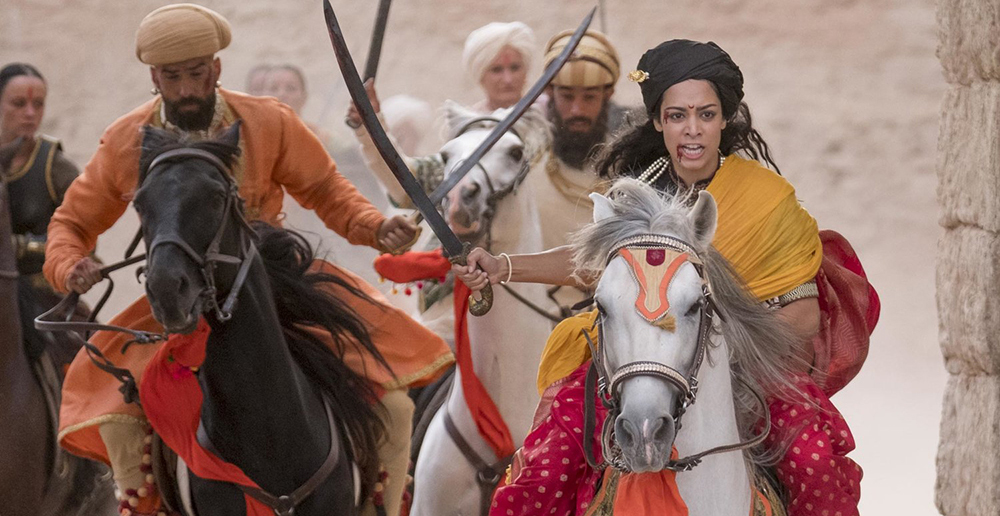
Devika handles a sword competently - double swords actually – and as anyone conversant in double weapons knows, that’s no small feat. Most of her sword work is with twin Talwar, the signature curved saber of India. Devika also manages to deliver a fight scene with an Urumi, the unique whip-like sword of Indian Martial Arts.
Glen Marks, a veteran stuntman and stunt coordinator, is credited as the Action Director for THE WARRIOR QUEEN OF JHANSI, but give credit where credit is due. The Kalaripayattu master is credited as K. Gopa Kumar. While many martial arts espouse double weapons, only India has the Urumi, so for that, a master of the Indian martial art of Kalari is necessary. However, there’s a continuity error in the finale fight. As Rani Laskmibai charges into battle on horseback, scenes alternate between her having a single or double swords.
The battles are brutal. In the 1850s, India was sorely outgunned, quite literally. Britain had rifles which India faced with swords and spears. In THE WARRIOR QUEEN OF JHANSI, the British troops are bearing the newly-introduced Enfield rifles, which could be seen as anachronistic because the Indian Rebellion led by Rani Lakshmibai against the British East India Company was in 1857, and the Enfield rifle didn’t go into service until 1895. Nevertheless, the historic warfare between cold arms and firearms represent a turning point for martial arts across cultures. It’s when martial arts become obsolete in the battlefield. The superiority of firearms over traditional martial arts is so brutally depicted in Akira Kurosawa’s KAGEMUSHA (1980) with his sanguineous interpretation of the Battle of Nagashino in 1575. That was a $6 million production, which was a lot back in the 80s.

THE WARRIOR QUEEN OF JHANSI is an independent film and the Bhises do the best they can with the constraints of a modest budget. Where that is most apparent is the big battles, the siege of Jhansi and the finale skirmish in Gwalior. Audiences have come to expect mass warfare to be such a spectacle nowadays in the wake of epic clashes like the Battle of the Bastards from GAME OF THRONES. But by Season 6 of GAME OF THRONES, each episode had an average budget greater than $10 million, and the Battle of the Bastards was surely the most expensive of that season. Big budget battles and CGI-enhanced troops have spoiled audiences, making it tough for independent films to capture that sense of ultraviolent grandeur.
However, the greater weakness of THE WARRIOR QUEEN OF JHANSI lies within its script. The dialog is stilted, more philosophical exposition than lively conversations. It plays out more like a history lesson than movie entertainment. Just as the United States has been apologetically grappling with race in 2019 with films like LUCE, HARRIET, and AMERICAN SON, Britain is dealing with its oppressive colonial past. These films walk the razor’s edge not wanting to offend the white audience while simultaneously examining a reprehensible history. The most common redemptive device is to have white characters that are sympathetic. Ben Lamb plays the dashing Major Robert Ellis, who not only struggles to help Rani Lakshmibai, there’s an implied romantic story arc, one that is never acted out upon because it never happened historically and in the film, Ellis knows his place. Even Queen Victoria (1819-1901), regally portrayed by Jodhi May, is sympathetic, constantly consulting with her Indian Muslim servant Mohammed Abdul Karim (1863-1909). Their relationship was the subject of another recent film, VICTORIA & ABDUL (2017). It’s the capitalists who are vilified not the British Empire. The baddies are East India Company, who rose to dominate half of the world’s trade and were instrumental in the colonization of India and Hong Kong.
Coincidentally, THE WARRIOR QUEEN OF JHANSI was not this year's only cinematic retelling of Rani Lakshmibai. In January, MANIKARNIKA: THE QUEEN OF JHANSI was released in India. Kangana Ranaut starred as the warrior queen. Kangana broke into action films with the Indian superhero sequel KRRISH 3 (2013), featuring leading male action star Hrithik Roshan and Priyanka Chopra (now Priyanka Chopra Jonas); KRRISH 3 remains in the top 25 highest-grossing Indian films at this writing. KRRISH 3, along with its predecessor KRRISH (2006), had a secret weapon when it came to fight scenes. Both had Tony Ching as their Action Choreographer. Kangana has been training in the martial arts since she signed on to the KRRISH franchise and often credits Jackie Chan as her inspirational hero.
MANIKARNIKA: THE QUEEN OF JHANSI is like THE WARRIOR QUEEN OF JHANSI on steroids, but you need to have a taste for Bollywood cinema before tackling this one. The film opens with Kangana fighting a CGI tiger with her hair and sari billowing like Merida in BRAVE (2012). Almost immediately after, she’s facing three men in a ballistic sword fight scene in a palace, replete with wire-work, CGI-acrobatics and the absurd physics so pervasive in Kung Fu cinema. Kangana can handle double Talwar too, with great lethality assisted by some judicious digitally-enhanced blood splatters. The Action Choreographer is Todor Lazarov, a veteran Hollywood stuntman.
However, Bollywood cinema isn’t for everyone. For one thing, Bollywood films are twice as long as most Hollywood films. MANIKARNIKA: THE QUEEN OF JHANSI clocks in at two-and-a-half hours complete with an ‘Interval’ (intermission) whereas THE WARRIOR QUEEN OF JHANSI is a far more digestible hour and 42 minutes. MANIKARNIKA: THE QUEEN OF JHANSI has all of the trappings of Bollywood cinema, eye-popping panoramas, retina-searing color schemes, ubiquitous slo-mo shots and of course, catchy dance numbers. What’s more, it’s unapologetic about its depiction of their British overlords. They are as loathsome as can be, greedy vicious pillagers and rapists. It’s a far bigger film than Devika Bhise’s independent retelling. But then again, MANIKARNIKA: THE QUEEN OF JHANSI had a budget north of $17.5 million. If you’ve never seen a Bollywood film, it’s better to start with Devika’s THE WARRIOR QUEEN OF JHANSI.

While THE WARRIOR QUEEN OF JHANSI is an imperfect film, it is a significant chapter in history, particularly for women warriors and the conflicts when east meets west. Rani Lakshmibai is a figure that every martial practitioner should know and the easiest way is to watch this film. More so, watch Devika Bhise. She has such potential as both a dramatic actress and an action star. If the MCU or the DCEU have vision, they’ll be quick to add her to their stable of superheroes.
THE WARRIOR QUEEN OF JHANSI will have a limited U.S. theatrical release premiering on November 15, 2019.
About author:
Subscribe to KungFuMagazine.com here.
Get your print edition of the MID-AUTUMN 2026 here.
Gene Ching is the Publisher of KungFuMagazine.com and the author of Shaolin Trips.


