Over 350 years ago, during the time of the Ming and Qing Dynasty struggles, the Wing Chun system was created and all modern lineages share the same root: the Southern Shaolin Temple. The Ving Tsun Museum was founded and officially opened in 1998. For 20 years, the VTM has researched, investigated, connected with, and promoted over 10 major Wing Chun lineages. We have categorized the 10 major lineages into 4 groups, or eras of evolution. The first, and earliest, was the Southern Shaolin Secret Society era, represented by 2 lineages: Red Flag Wing Chun and Black Flag Wing Chun. The second era was the Opera or Red Boat era, with 3 major lineages still active from this timeframe. The third era was the Public era in China, which started after the destruction of the Red Boat Opera troupe in the mid-1800s. More than 5 major lineages are still active from this era, and each branch has thousands of practitioners. The fourth era is the International era, a time of international expansion, with one major lineage standing out (accounting for 90% of today’s Wing Chun practitioners): the branch founded by the late Grand Master Ip Man. One of the youngest Wing Chun lineages, it has its own unique character which stands apart from the teachings of Grand Master Chun Wah Shun (Ip Man’s Sifu). Ip Man escaped China’s civil war in 1949 and ended up in Hong Kong. He started teaching Wing Chun in the early 1950s, and continued until his passing in 1972. He quickly earned a reputation as a good teacher, built on the success of his students in street-fighting “challenge matches” or gong sau. In the early days, Grand Master Ip Man produced many good teachers and fighters, as well as students who went on to earn international fame and celebrity status such as Bruce Lee. By 1967, after 3 generations of students, he firmly established himself as one of the most well-known Wing Chun masters both inside and outside China. From the 1950s to the early 1970s, traditional Chinese martial arts were in dark times in China due to the political climate, with many systems in hiding or dispersed outside China. There was one shining star for the art of Wing Chun, the Ip Man lineage.
Responding to the growing popularity of the Ip Man lineage, the Ip Man Athletic Association was founded; in 1968 it was replaced by the Ving Tsun Athletic Association (VTAA) as the official organization representing the Ip Man lineage. Grand Master Ip Man started teaching in the Restaurant Union in 1950; many of his students were staff within the local restaurants. By 1960, the Grand Master was teaching in multiple locations such as Lei Cheng UK Estate, Hing Yip Apartments on Castle Road, and Tai Sun Restaurant. His student base expanded to include staff from Kowloon Motors Bus, secondary school staff, and even policemen. As the number of students increased, space for training became cramped. Mr. Tang Sang, a student of Ip Man, suggested the establishment of the Ving Tsun Athletic Association. Students donated $1000HK to be recognized as directors or $200HK to be recognized as permanent members. The funds were used to purchase the space still used today by the VTAA. Real estate in Hong Kong is very expensive, so owning the space within their building is a very significant accomplishment. Starting with just 10 students in 1950, the VTAA has issued more than 1,000 licenses for Recognized Ving Tsun Kung Fu Instructors around the world to date. With the support of the Wing Chun practitioners throughout the world, the spirit of Ip Man Wing Chun continues to spread.
Last year (2017) was the 50-anniversary of the founding of VTAA by Grand Master Ip Man and his disciplines. VTAA has played a major role in promoting Wing Chun all over the world. It has been well received by the Hong Kong International Kung Fu community and now by the Chinese government. Helped by the opening of the Ving Tsun Museum in Dayton, OH, the First World Conference hosted in Hong Kong in 1999, and over 8 major movies about the life and times of Ip Man, the Ip Man lineage has grown into the largest and most recognized martial arts style in the world. The VTM took a team from four countries to participate in this monumental anniversary celebration.
To commemorate 50 years, the VTAA held 4 days of activities in Hong Kong and Fatsaan. Events included: Oct. 7, 2017 – The Fourth Ip Man Ving Tsun Taolu (Forms) and Sticking Hands Match; Oct. 8, 2017 – The Gala Dinner for 50th Anniversary of Ving Tsun Athletic Association; Oct. 9 and 10, 2017 – Foshan Visit & the 4th World Ving Tsun Conference; and Oct. 7, 2017 – The Fourth Ip Man Ving Tsun Taolu (Forms) and Sticking Hands Match.
About 300 people competed from more than 8 countries. The competition was well-organized; the judges and referees were trained separately in preparation for running a professional event, and it showed. The forms (taolu) divisions were broken down into Beginner (Siu Nim Tau division), Intermediate (Chum Kiu Division), and Advanced (Biu Ji Division). These major classifications were further divided by age, rank, and gender to promote a fair and balanced competition. Separate Chi Sau divisions were arranged by weight and gender. The safety equipment included gloves, head gear, and an electronically scored chest protector. The rules for the Chi Sau divisions were set up to express the core skills of Wing Chun: sticking and hitting, as well as hitting with no bridge. Participants could grab or anti-grab as a strategy to move an opponent out of the ring, and no sweeps or kicks were allowed. Over the years, they continue to refine the rules to best express the nature of the Wing Chun system.
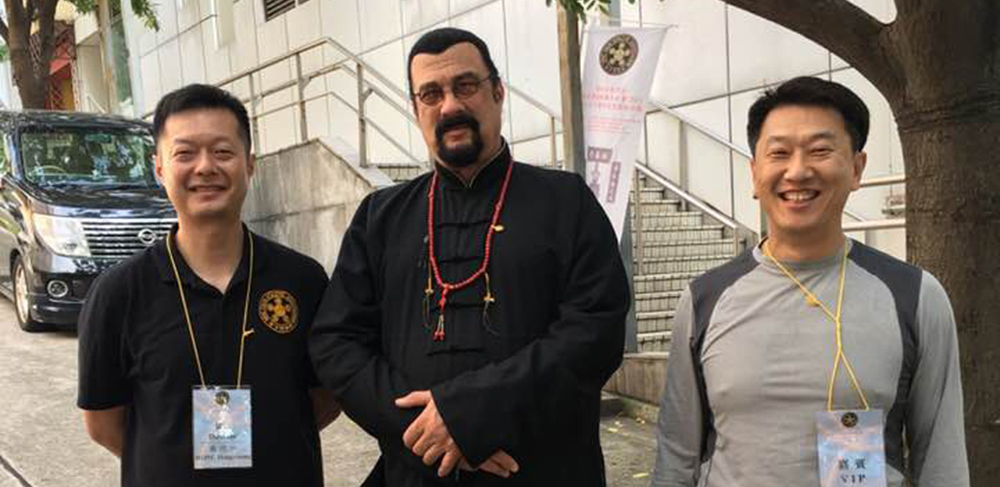
It was a well-run event, and many of Ip Man's active first-generation students were present to show their support. Even celebrities such as Steven Seagal were in attendance. Special announcements were made and many group photos were taken.
- Established a permanent venue with a self-owned property in 1968
- Organized the Worship Ceremony of the late Grand Master Ip Man after his passing, in memory of the ancestral origin of our martial art and showing great respect for his contribution.
- Established a licensing system for Recognized Ving Tsun Instructor since 1985
- In 1998, supported the establishment of the Ving Tsun Museum in Dayton, Ohio, USA. This was the first workshop to feature multiple, direct students of Ip Man teaching together. This event was the genesis of the World Conferences and Ip Man Tong detailed below.
- Organized the World Conferences since 1999 featuring multiple, direct students of Ip Man teaching the system together.
- In 2002, supported the establishment of the Ip Man Museum (Ip Man Tong) in Foshan, Zumiao, China. The Ip Man Tong was born initially out of the efforts of Ip Chun and Ip Ching.
- Established Ip Man Taolu (forms) and Sticking Hand Match rules and successfully conducted competitions.
- Established the Ving Tsun Referee Training course to create qualified Ving Tsun Referees.
Representing the US team, coming from the Ving Tsun Museum team and Moy Yat family, were Sifu Benny Meng together with 17 team members from 4 international groups assisted by Sifu Chango Noaks and Sifu Brad Ryan. Also representing the US in attendance from the Moy Yat family was Sifu Anthony Dandridge.
On October 8, the VTAA 50th Anniversary Gala Dinner was held. Over 700 members showed up to celebrate this momentous occasion. It was a major milestone to celebrate 50 years, made all the more memorable by being the largest gathering of direct students of Ip Man, ranging in age from early 60s to late 90s. The senior members of the Ip Man lineage in attendance included Ip Ching, Ip Chun, Tong Jo Che, Siu Yuk Man, Chan Chi Man, Ma Hang Lam, Lee Wai Chi, Pang Chi Yum, Lee kim Yum, Mok Ho Ching, Yueng Wing, Chung Yau, and Chan Wai Hong. Some are still very active in teaching, such as Sifu Ip Ching, who is 94. Some are retired and show signs of age catching up with them. It was a very special moment to see all of them gathered together for this amazing evening of great food and wonderful fellowship. It was also motivating to see the torch of leadership being passed to the next generation of Ip Man's lineage – such as current Chairman, Sifu Dennis Lee Yuk Cheong. It is Sifu Cheong’s express desire that events such as this will help unify the many families and branches within the Ip Man lineage of Wing Chun. Special commemorative items were passed out, such as golf shirts, pins, keychains, and anniversary booklets. The dinner was an impressive 10-course banquet, and members of the VTM team took full advantage of the time to get photos, interact with old friends, make new friends, and collect autographs (and even give a few autographs, too!).