
 If you’ve ever watched fight videos on the internet involving the martial art of Wing Chun, you probably click away shortly thereafter. If you’re someone interested in this art, you need only to search Youtube for a Wing Chun fight – and then try not to feel like it’s Christmas morning and you just found dad passed out on the couch dressed in Santa garb.
More times than not, you’ll see some poor Wing Chun slob getting his hat handed to him. Maybe it’s an MMA guy destroying the Wing Chun opponent with a takedown, or a Boxing or Mui Thai guy pummeling a Wing Chun "artist" into sad submission.
This is harder to view if you come from the WC camp.
A person, untrained or not, watching these videos might conclude there’s no valuable take-away from this Chinese martial art. Other fighting systems must be far superior styles to learn from. But if Wing Chun practitioners would just practice one aspect of their style, these videos and this conversation would not be happening. Unfortunately, many won’t put in the time or effort.
And because they won’t, we can look forward (or not) to more videos of "shots to the surprised face" and wounded ego banter.
Modern Wing Chun Has Lost Its "Sticky" with Reality
For years, Wing Chun was a mysterious art, taught behind closed doors. Teaching it to any western world "cowboy" was not only frowned upon but forbidden. Its history is a bit vague, with different takes on its beginnings over 200 years ago, centering on political upheaval in southern China and a group called the Red Boat Opera Company. It appears these stories may have been embellished in an attempt to draw more people into martial arts in the 1970s and 1980s.
The fighting system was largely brought to light and popularized by one of the most famous martial arts movie stars: Bruce Lee. His Jeet Kune Do fighting system was inspired by the Wing Chun style (You can see Bruce using a classic WC move here in the movie ENTER THE DRAGON).
Lee was a pupil of Ip Man, now one of the recognized names floating around the fighting world as the father of Wing Chun. He’s known mostly due to recent productions of the Donnie Yen IP MAN movies released since 2008. And yet, current internet video testimony is undisputable and would say something much different than what these movies profess.
The West, after being locked out for years, is seeing this art in real-world application. Finding it a bit disappointing, they pounce on it, calling to have it sent back to the dark ages.
On the internet, MMA fighters and the like love to bitch-slap WC with trolling comments and blistering reviews while other fighting styles, retaining their own blaring weaknesses, live peacefully, left alone to be what they wish. There’s not a more "red-headed stepchild" in the world of fighting than Wing Chun.
Where is Wing Chun's disconnect in today' world? Is this fighting style truly outdated, having little value compared to other styles that show greater efficiency and effectiveness? Has this martial art been overrun like email over the fax machine? Starbucks over Folgers Instant Coffee?
From myths to the mats and rings, Wing Chun went from the big bully on the block, unrivaled in its approach, to a sad joke. Sacred and holy, Wing Chun’s curtain has been suddenly pulled back.
Or has it?
There is one thing these Wing Chun students could do to turn this bloody tide around – and it's not complicated. If these WC video "stars" would just practice this one simple technique, it would turn their humiliation films into promos.
The Root of the Problem
Western boxing striking power dominates the fight world. There may be some dispute about this, but in delivering a single overhand punch, most would agree that the western boxing technique wins the day.
In boxing, power starts from the legs and stance. The rotation of hips and shoulders is only part of the equation. Most of the real power comes from below – the legs. Mike Tyson was a big powerful boxer, but his hook knockout power was an upward force that started from the ground.
The connection between the boxer's stance, posture, and the rotation of the upper body define this "beautiful violence" (timing completes an effective strike, but this point is about pure power). Wing Chun was taught in this method of root power at one time, but today it’s rare to witness anyone doing it properly.
Hint: If your sifu, on the first day of class, does not put you in a corner of the room in a yee gee kim yeung ma stance and keep you there for months prior to teaching you any exercises, then leave. He or she is doing you a great disservice.
It's easy enough for you to know, deep down in your pummeled gut, that you have no rooting power: If you touch your opponent’s arm and cannot locate or feel where his right and left legs are positioned, then your stance is weak! If you cannot feel your opponent down into your heels and feet when pressed, then your stance is weak! If, when sparring close contact, you cannot slow down the action within your awareness of what is taking place, easily seeing the strikes coming in to smash your face, then your stance is weak! If you deliver a snap punch to your opponent’s centerline that has no effect or damage, then your stance is weak! If you cannot move flawlessly and fluidly through the second set, “Bridging the Gap,” then your stance is weak! If your opponent can easily back you off, push you, grapple and trip you for a nasty takedown, then your stance is weak!

Root Is Power
The only way to achieve rooting – and thereby power – is by continued pursuit of static muscle strength for your legs. That process starts by sitting down in Wing Chun’s classic posture and staying there. A lot.
If you’re not sunk down into your ma stance while doing "sticky hands" or when performing your sets for hours at a time, then just stop. You’re cheating yourself. You won’t get the power you need and you won’t get better.
(Years ago, the "old timers," the good ones, would find amusement in watching new students try to drive away after practice. The impossibility of operating the gas and brake pedal from thoroughly exhausted legs was comic relief. God forbid you drove a clutch!).
This is not strength you can achieve from doing heavy squats or lunges or sprinting forties. The beginning of power leading to a strike comes from the kinetic link to the whole-body muscle and skeletal frame, all in unison, acting in one fluid motion. And that power starts with the legs. From leg strength, the Wing Chun fighter starts to understand the next ingredient that must follow.
When Soft Is Hardcore
Wing Chun differentiates itself from other martial arts by being a "soft style." The only other fighting art being softer is Tai Chi. (Yes, Tai Chi is an effective fighting style. If you’ve never been thrown by someone well-versed in Tai Chi, you’re missing out on a lifesaving truth). Judo and Aikido styles incorporate similar ideas of "softness," though not at this level.
Wing Chun is designed to be sensitive to all movement. A block is never just a block alone, but a tool to locate and decipher in fractions of a second where your opponent is and the openings available to exploit. Much like western boxing, the important fighting takes place inside, at close range, with positioning, angles, and straight lines.
And being relaxed.
Though it appears on YouTube, not many Wing Chun practitioners understand the importance of staying relaxed. It looks like WC is all form and structure – rote punching without understanding and never asking the question, "What’s the outcome?" It's the difference between learning to write English well versus communicating effectively with someone. In a bad situation, you might try to explain the immediate dangers of the combined chemical reactions of oxygen, heat, and fuel – or you could more effectively just yell "Fire!”
There are differences in how well you get a point across. Learning important subtleties leaves no question about what is most vital.
The Chill Pill for All Your Fighting Ills
One issue seen in most of these videos is that as soon as the fight begins, the Wing Chun fighter almost immediately tightens up: The shoulders rise; the arms become static and stiff; the fight degenerates into a defensive flailing about. This is the beginning of any end.
Look at any successful fighter or athlete in history; watch them move through their entire motion. You will notice something important. They remain relaxed. Muhamad Ali was always in a set, relaxed balanced stance, poised to rain devastating blows. Kobe Bryant was impossibly fluid when moving to the rim – a kinetic connection of perfection. WC students today could learn a lot about the way these guys used their bodies to excel. If there’s a notion that Wing Chun must be structured and robotic, it’s a misinterpretation, probably learned from watching movies. And this surely leads to its demise.
Though the different Wing Chun forms are important exercises and form the basis of the system, this shouldn’t be the way one approaches a fight. So, you’re able to get your punch through and hit your opponent? So what? If you’re on the street, you better make that hit count – especially if that someone knows how to take a punch. When the proverbial "poop" hits the fan, the fighter more relaxed through the entire event wins out.
And for a Wing Chun fighter, in every instance, if you’re not controlling your opponent, you should be stopping them with an injury.
Wing Chun’s famed 3-inch punch works only because of this rooted, relaxed posture. The power starts from the ground, travels up through the legs, and into the fist – all in one fluid, kinetic-controlled explosion.
(As a devotee of Wing Chun, I can offer testimony of how a larger person’s jaw can be fractured from a fist strike no more than a few inches away. This result is tough to reproduce without dedicated practice. But it’s anecdotal evidence of how a relaxed punch, generated from leg power, can quickly end a fight).
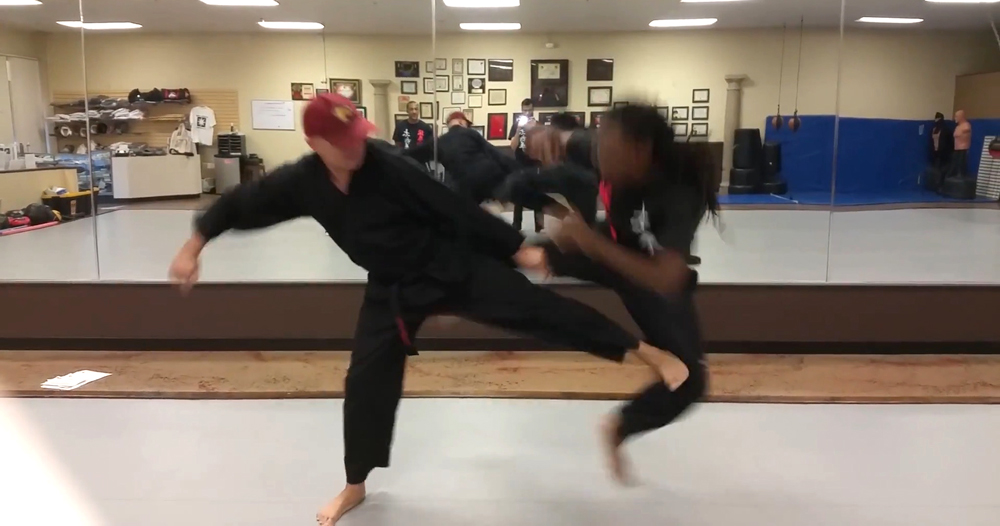
Root, Relax, Reward
If you want to punish your opponent and reward yourself for having chosen an effective fighting style, remember: 1) Being rooted means sensitivity (No, you won’t suddenly run out to buy throw pillows and start writing poetry, I promise). You need to be feeling your opponent’s movements, knowing where all the important body parts are at any time. This is critical in any fighting system. 2) Being rooted lets you relax; that leads to finding the speed needed for delivering a powerful strike or deflecting any incoming strike. 3) Being rooted lets you sink deeper into your stance; all the power is waiting, coiled, and ready.
So, get in your stance and stay there for as long as you can take it. Then do it again – over and over again.
Quit screwing around with your centerlines, angles, rabbit-punches, and footwork – and find your damned root!
Once you get it, you’ll know it. You’ll feel it. Your awareness while sparring or in a real confrontation will expand beyond what you ever thought possible. You’ll begin to understand the unique and effective essentials that make up the "lost" art of Wing Chun.
Then you can start working on the more advanced aspects of this fighting style. The poise of being "quiet" in the middle of flying fists-to-your-face will begin to astonish you and leave you with greater, real confidence to face anyone. Do this, and the Wing Chun fighting style – and you – will become respected and dangerous again.
Until then, try to stay off someone else’s highlight reel on YouTube. Unless you enjoy celebrity status as a heavy bag. If you’re looking for a teacher or a link to a website of a good Sifu, I wish you luck. Best to become one yourself.


