
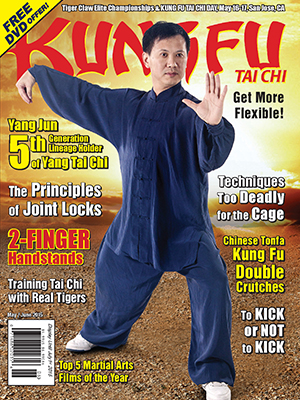
 The May+June 2015 issue features Master Yang Jun (杨军) on the cover. Master Yang is the fifth generation inheritor of Yang family Taijiquan in the direct bloodline to the founder of Yang style, Yang Luchan (杨露禅) (1799–1872). When most people think of Taiji, it is Yang style that they envision. It’s the foremost style of Taiji in the world today. At present, the lineage head of Yang Taijiquan is Master Yang Jun’s grandfather, Yang Zhenduo (杨振), now in his late eighties. In 2009, he named Yang Jun as the official fifth generation inheritor of the most popular martial art in the world.
Master Yang Jun visited the Kung Fu Tai Chi offices in late January 2015 for the interview. The interview ran long, as Master Yang is very passionate about Taiji, and much more was discussed than could fit into the cover story. Here is more from that interview.
A Son of the Cultural Revolution
Despite the massive spread of Yang Taiji, it went through some hard times just as all of China did. Master Yang Jun began his personal journey into his family’s art during one of its darkest periods. “When I was born, it was not really good time. I born in 1968; the Cultural Revolution just started at that time. And all I remember is soon after I born, my parents have to go someplace. My grandparents also need to go someplace. All I remember, they are preparing for attack. From who? I don’t really know – maybe Russia. That time was kind of broken up.
“I was born in Taiyuan. My grandfather, he move [to] Taiyuan – when my great grandfather passed away. My great grandmother bring all [the] children back to my hometown. My hometown is actually Hubei. So at that time, [the] Japanese war start. My grandfather, he is just like 14–15 but he looked like 20-something. He looked older than his actual age. That time, it’s dangerous if you are young boy. Japanese would like [to] kill you before you go to service for the military. He could not keep in town very much. My great grandmother actually send him out. He actually left home when he was 16 or something. He don’t like talk this very much.
“My grandfather joined the military, and he went to the western front in China. When he come out at the end of the Japanese war, he became a nationalist and fight communist. Then he’s on the wrong side [laughs]. Then later on, he quit. They lost the fight with the communists. In Beijing, he was helped by one of my great grandfather's disciples, Cui Yishi (崔毅士); other name was Cui Lizhi (崔立志) (1892−1970). He was the student of Yang Chengpu (杨澄甫). Later on, he found a job in Shanxi province. He never thought he’d teach Taiji anymore.
“Then suddenly, there is an opportunity, basically fall down from the sky. One of our leaders, [with a] high position in the government, his name Li Xuefeng (李雪峰) (1907–2003). He was former politburo alternate member (原中共中央政治局候补委员). He likes Taijiquan. And he asks, ‘Where’s the Yang family? Why they don’t teach?’ Then they find my grandfather and also my granduncle. They don’t teach in the public. They teach in Baojian (保健) – a health club especially to take care of official’s health issues.
“I didn’t live with my parents but my grandparents. Until I think I’m like three or four years old, our family start reunion, but reunion is me, my grandfather and my grandmother. They reunion in Taiyuan. My parents didn’t come back until 1980s. They were just in the countryside. For today, it’s not too far. It’s just like 300 kilometer away. In the past, it not that easy. Actually I growing up with my grandparents and lived with them until I married. Then you know, I started training with my grandfather. Not I wished to.
“In China, they practice morning. Normally, I don’t wake up very early. One time I visit my grandfather. He was in farm relocated – it’s not a jail; it’s like demoted. It’s really difficult. They really working so hard as a farmer. But he had people follow him and practice every morning. One morning I woke up and just me. And I feel so scared. Through the window I saw them far away practicing. Next day I told my grandfather, ‘Please don’t leave me alone in the room. Bring me together.’ Then I start following them. From that time, I start practice. I was five or six, I think. I don’t exactly remember what was my age, but I was really young. Then when we come back, I want to quit, but cannot quit anymore. [laughs]
“Before I really don’t like Taiji. Stay shorter is better for practice. Not try to do more. Try to do less.
“In past, we have no TV. The most fancy thing we had was a radio. In past we have this kind of habit – morning we practice, after dinner, we have nothing to do, and people gather together and practice. We have two sessions – morning session and night session of the practice every day. After later on, we move to the high building, people starting disconnect.”
Taiji Today
 After the Cultural Revolution, the Chinese martial arts underwent many changes. Modern Wushu
began, a sport version of Chinese martial arts. And standardized compulsory forms began to get disseminated across the nation through schools and health programs. One of the most popular Taiji forms in the world today is a modern standardized form, the Simplified 24 Tai Chi routine . It is extracted from Yang Taiji, but Master Yang Jun doesn’t consider it a regular component to the Yang Taiji curriculum. “The 24 has one difference – they come from traditional form, but they did too much modification. The history of the 24 is very weird. The one in charge for its creation, he’s not the one doing the performing. The one doing the performing was from Chen style, I think. Then you know, they made the posture, everything, is different. That’s one of the reason people argued too much. The 24 too much different from the original way of practice. But me, I do consider 24 is a Yang style because no movement was created. Every moment is pulled out from Yang style. It’s just a different way of arranging. I find out many people who practice 24, later on they are more interested in learning Taijiquan, most come to Yang.
“Related to this, we have some new forms. We don’t really concern too much. It followed the needs in China that time, 1980-something, we had organization in China and organized competition. The long form in competition – there’s no way to do that. In the beginning, we had an alternate way. Either you choose the first two sections or the third section. Third section is the longest one. Then people had arguments – which way is best. Following that, my grandfather think, there’s so many repeat movements, and we tried the best to take out the repeat. Then basically, make the connection that flowed, then we had 49. No techniques changed, they rearranged the sequence.
“Many people did this. Cheng Man Ching did 37. He did create more different connections than the original one, which is more looked like him. The 49 is similar. I don’t practice 49 actually. On special purpose I use it, but I don’t really practice. The way of the arrangement of the original form is much reasonable – starts from easy, build up difficulty, then they have some difficult movements, then some conditioning, then difficult again, then conditioning again, then have high kick, then they finish the whole form. It’s around 20–30 minutes, so this is a good amount of time of practice to calm down yourself. Before 15 minutes, you don’t feel it. After 20 minutes you start feeling your inside lowering, breath out. If you practice short, like 5 minutes, you even don’t feel it yet and done. So that’s why personally, for the training or even for the health, long form is still the best.”
After China’s Cultural Revolution, the sport of Modern Wushu arose and included an acrobatic form of Taiji as one of its major divisions. It includes spectacular flying kicks and gymnastic exhibitions that lie far outside the realm of traditional Taiji. Like any international sport, Modern Wushu is extreme and requires top-notch athletes to perform it. Yang Jun isn’t involved with competition much, but surprisingly he does support it. “To me, the martial arts today has a different way of using. Most people practice martial arts for your own health. But martial arts also have technique for fighting. [It] also has techniques for entertainment and performance. That is a really big part of martial arts today. Modern martial arts have made it really beautiful for the stage. The traditional, most of the art is simple. They are not doing complicated [techniques], which is less interesting to watch. The modern way, they really did very good, which is go to different direction. We need everything actually. Every area has some people interested on it. Some people, they know they can’t do it. But they like to watch it, even they cannot do exact like them.”
About author:
Subscribe to KungFuMagazine.com here.
Get your print edition of the MID-AUTUMN 2026 here.
Gene Ching is the Publisher of KungFuMagazine.com and the author of Shaolin Trips.


