
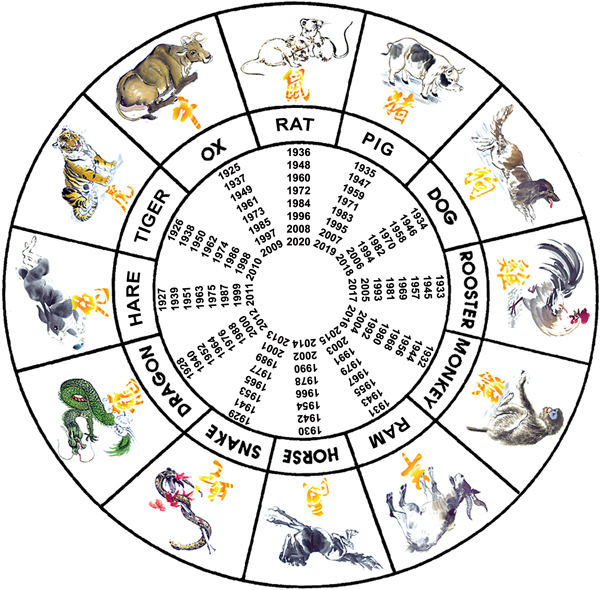
 On February 19, 2015, we celebrated Chinese New Year, the Year of the Wood Ram. As usual, we published our annual Kung Fu Horoscopes both in print in our March April issue (which hits newsstands in early February) and online. Our primary sponsor MartialArtsMart.com even ran a special promotion in celebration by giving away a complete Chinese Lion to one lucky customer. The Chinese New Year Festival actually runs for fifteen days with rituals and observations for each day for the particularly pious. It ends on the Lantern Festival, which lands on March 5th this year. I thought I was done with my work duties for Chinese New Year, but watching the web as I always do, I saw this trending topic question about this particular Chinese New Year – is it a Ram or a Goat or a Sheep or what? It was a ‘teaching moment’ that I just couldn’t resist.
Since 2000, I’ve been working with our Feng Shui columnist Wilson Sun and our publisher Gigi Oh to bring Kung Fu Horoscopes to you, our loyal readers. It’s somewhat ironic as I’m not that I’m not a great advocate or believer in astrology or Feng Shui. Being trained as a scientist in graduate school made me into a skeptic. Nevertheless, I am always intrigued by culture and its translation to other cultures – plus I love the power of myth – so the Chinese zodiac fascinates me.
The Chinese zodiac is as follows: Rat (Shu 鼠), Ox (Niu 牛), Tiger (Hu 虎), Hare (Tu 兔), Dragon (Long 龍), Snake (She 蛇), Horse (Ma 馬), Ram (Yang 羊), Monkey (Hou 猴), Rooster (Ji 雞), Dog (Gou 狗), and Pig (Zhu 豬). There are many variations of the legend of why this zodiac order came to be. The roots of the Chinese zodiac go back to the Zhou Dynasty (1046–256 BCE), so there’s been a lot of time for the game of Chinese whispers to cause deviations in the legends. Generally, it is said that the zodiac was organized so based on the results of celestial race. Perhaps the most popular version says the race was held by the Gods specifically to determine the order of the years for this very zodiac. My personal favorite is Buddhist – when Buddha was passing into Nirvana, he summoned all of the animals to attend as witnesses, and this was the order in which they arrived. There’s another story arc about how the Rat, being very clever, tricked the Ox into allowing him to ride on top of him, knowing that the Ox had the most endurance so would likely be the winner. Just before the Ox crossed the finish line, the Rat jumped off ahead of him, securing the first place spot. In some retellings, the race is to cross a river. This also has Buddhist connotations because ‘crossing over to the other shore’ is a common Buddhist metaphor for enlightenment.
Despite researching the Chinese zodiac for a decade and a half now, I have yet to unearth the root of these myths. There are plenty of charming stories and nowadays, there are several websites that provide Chinese horoscopes. However, many of them are supplementary to Western Astrology sites (I should note that ‘horoscope’ has figured extremely high as a web search topic since the web began so there are a lot of astrology sites). Working with Wilson Sun for all these years has given me better insight into the nature of Chinese Feng Shui and Horoscopes. They are slightly different in tone to Western Horoscopes. Many of the Chinese Horoscope sites have an amateur feel that is clearly modelled after Western Horoscopes. For the record, Wilson Sun is a professional Feng Shui master and has demonstrated his skills with all sorts of uncanny predictions.
We call this zodiac Chinese because that is where it originated, however the same zodiac order is observed in Japan and Korean and across Asia. There is only one significant variation. The Vietnamese zodiac swaps the Year of the Hare with the Year of the Cat. I’m not sure why but as Vietnamese Tet Festivals are growing in popularity, this caused some confusion in 2011 and might do so again in 2023. So be warned.
Perhaps the Hare to Cat switch was a translation error, which brings us back to this year. Is it a Ram or a Goat or a Sheep or what? The Chinese character is yang (羊) and it one of those pictogram characters that look like what they are, although in this case, it is from a unique bird’s eye perspective. The central stroke is the spine. The two topmost angled strokes are horns. This topmost portion is reminiscent of the symbol for the Western Zodiac Ram sign of Aries (♈). The two large horizontal strokes are the legs. This is actually a suffix character. It needs a prefix character to distinguish it. To translate this accurately makes it indecipherable to the common reader (and certainly to the pithy web poster). Yang really means the subfamily Caprinae. Caprinae, which coincidentally comes from the same root word as the other Western Zodiac Ram sign of Capricorn, includes sheep, goats, ibex, chamois, and even the musk ox. The Chinese word Yang isn’t nearly as scientifically categorized, but remarkably, it’s not that far off.
So is it a Ram or a Goat or a Sheep or what? Well, a Ram is a male goat or sheep, so those that posed this question really don’t know their animal terminology. In Chinese, a male prefix is added to distinguish Ram (gongyang 公羊). For our horoscope, we’ve always translated it as Ram just like we translate the Ji year as Year of the Rooster instead of Year of the Chicken or Year of the Hen. Ram and Rooster have more machismo, and we are a martial arts magazine, after all. Although in the wake of this web kerfuffle, I am now leaning towards Year of the Ewe. Like Ram, a female prefix is added to distinguish Ewe (muyang 母羊).
The real question for literate English speakers is ‘Is it a Goat or a Sheep?” It’s both. To specify a Goat, the prefix character for mountain is added (shanyang 山羊). Just like with Yang, this pictogram is easily identified because it looks like three peaks of a mountain. There are two prefix characters that might indicate a sheep. A wild sheep is called mianyang (绵羊); mian means ‘wool’ or ‘cotton’ (thank goodness there is no Year of the mian; Just imagine the kerfuffle over that with English speakers). A domesticated sheep is called panyang (盘羊); pan means ‘plate’ or ‘dish.’
Interestingly enough, the Year of the Yang is the only Chinese Zodiac that suffers from this ambiguity. The rest of the signs translate fairly clearly. For example, a Horse is a Horse, of course, of course. Some might swap Rabbit for Hare, Serpent for Snake, or Boar for Pig, but those don’t cause the same kind of species issues with English speakers (In 1993, we produced our most controversial official KungFuMagazine.com Zodiac T-shirt – the Year of the Cock; It was the best-selling one ever). Shu is almost always translated as Rat even though it could also mean Mouse, and when depicted in festive Chinese New Year decorations, it’s almost always characterized by a cute little Mouse instead of a dirty Rat. Niu is a little problematic because it can mean Ox or Cow, what science categorizes as the subfamily Bovinae, but I’ve never seen it called Year of the Cow. For Vietnamese Tet, they call it Year of the Water Buffalo, which some mediocre translators to English see as a swap as significant as Hare to Cat, but in Chinese, niu could mean Water Buffalo too. Tu never means Cat; the word for Cat sounds like a Cat: Mao (貓). It’s a perfect example of a Chinese onomatopoeia. I’ve heard that the pronunciation of the Chinese character for Hare in Vietnamese is phonetically similar to the pronunciation for that of Cat. I used to keep a rescued lab rabbit as a pet. It never made such a sound whereas my tamed feral cat always does (usually at odd hours in the morning when I’m trying to sleep). This leads me to think that the Vietnamese don’t understand the power of a good onomatopoeia.
 Despite the machismo of Rams, there is no popular style of Ram Kung Fu. There might be some obscure folk style of Ram Kung Fu, just as there are rare folk styles for animals like Duck, Toad and Scorpion. There are very common Kung Fu styles for almost half of the zodiac: Tiger, Dragon, Snake, Monkey, and Dog. Rats, Oxen, Hares, and Pigs are generally overlooked by Kung Fu. There might be some passing references in the names of techniques, and like with the Ram, there may be some uncommon folk style. Perhaps there is a Pig Kung Fu practiced in some farming village somewhere in China. I’d love to see that. The Horse, Rooster and Ram are evoked in Kung Fu fundamentals, specifically the stances. The most rudimentary stance in Chinese martial arts is the Horse Stance. And it is always said that when practicing one-legged stances, one should stand erect like the Rooster.
For Rams, there is a special Southern-style stance called in Cantonese “Yee Gee Kim Yeung Ma (in Mandarin it is er zi qian YANG ma 二字箝羊馬). It’s a basic stance of Wing Chun Kung Fu. Yee Gee describes the orientation of the feet which are angled like the Chinese character for two. Kim literally means pliers or pincers, but here it refers to the dynamic tension of the legs. Yeung, or as I’ve been saying throughout this article Yang, means Ram (or sheep or goat or ewe). Ma means Horse, just like the zodiac sign, but within Kung Fu, it means stance because horse stance is fundamental. This year’s official KungFuMagazine.com T-shirt is based on this. I hope you’ll support us for this Year of the Ram, buy this shirt, and have a fortuitous 2015. Xin Nian Kuai Le!
About author:
Subscribe to KungFuMagazine.com here.
Get your print edition of the MID-AUTUMN 2026 here.
Gene Ching is the Publisher of KungFuMagazine.com and the author of Shaolin Trips.


