
 For The Silk Road Kung Fu Friendship Tour Part 28, click here.
Held in the Minhang Gymnasium in Shanghai, October 20-23, the 15th World Wushu Championships would have pleased Yao Shu (1201 - 1278) and Liu Bingzhong (1216–1274), and that’s saying a lot. There is a history to great martial arts competitions unknown to most, and it was the above mentioned gentlemen that encouraged Kublai Khan (1215-1294) at the dawning of the Yuan Dynasty (1279-1368) in China to collect the world’s finest martial artists for grand tournaments held at Songshan Shaolin to find who were the greatest martial artists of all time, and also led to a revitalization of martial arts at Songshan and worldwide.
Over the last 55 years or so I’ve been to maybe 500 or more martial arts tournaments in a variety of countries and yet never could have imagined the kind of spectacular events I witnessed at this four-day competition in Shanghai. The Opening Ceremony displayed a startling new level of harmony between martial arts and techno-savvy, with wushu artists flying in like Asparas from the ceilings of Mogao Caves, 3-D sections of floor appearing out of thin air to form a bridge between Wushu masters, supernovas of light and sound synced with brilliantly-colored Chinese philosophical symbology, phosphorescent dragons and flowers, series of highly artistic beautifully-choreographed group Taolu, accentuating masterful center-stage performances with and without weapons, all ebbing and flowing across the landscape of mind and the stage without missing a beat. How that many people can perform so perfectly in harmony with the music and technology is beyond me. The creators, directors, writers, techno-wizards and performers really should all get medals for that show. All the typical adjectives used to describe breakthrough events like “spectacular,” “amazing,” and so on just don’t do this Opening Event justice. Jet Li, known as Li Lianjie in China, was there too and made an inspirational speech that brought goosebumps to many.
Before looking at the competition particulars, it’s useful to know that in August 2018 the IWUF Executive Board led by President Yu Zaiqing met in Macao to make some changes intended to reduce the possibility of bias, resulting in some changes in this year’s World Wushu Championships. For example, in previous World Wushu Championships the Head Judge had the ability to change scores. No more. The Head Judge of the B group was removed altogether, making for a more level decision-making process while the number of B-Group judges was increased from 3 to 5, again intended to increase objectivity. Just as or more important the Jury of the Appeals was made independent of the judges, again, designed to ensure fairness. The IWUF Executive Board also came up a brilliant addition to Wushu Taolu competition specifically a “Creative Group Event,” which was held the last day of this history making championship.
As most Wushu Kung Fu people know there are two main branches in training and competition, Taolu, or forms, and Sanda, which is fighting.

Taolu
 On the morning of the first day of competition, I started in the Taolu Hall and basked in the radiance of world class performances by all. In the beginning, I really didn’t envy the judges being forced to made decisions regarding which were better as all appeared so good. During my competition years, I only competed in the fighting competitions before the word “Sanda” was introduced to the world’s vocabulary. And yet, I simultaneously learned many Taolu in classes as they contain the essential techniques and philosophies of the styles I learned.
Now I just said 'In the beginning I really didn’t envy the judges...' but it’s also true that I was able to make my own judgements pretty quickly because I’d read the scoring criteria the night before. In brief competitors are:
“required to perform with standard movements, correct methods, full force flowing smoothly to the right points, good coordination between hands and eyes, between body and steps (between apparatus and body for events with apparatus), distinct rhythm, conspicuous style, and unison between movements and accompanying music. All these elements should be taken into consideration in grading the technical execution of a competitor’s routine”
Points are added for the “degree of difficulty” of the movements, and points are deducted for errors in regard to the structure, composition and musical accompaniment of the routine when music is used. This all seems quite straightforward, but it gets a little complicated given that these Wushu Taolu performances are not traditional Taolu, but rather creative innovations of the competitors. Still, right is right, and inefficient, and/or misplaced techniques stand out boldly for those familiar with the essential elements of the traditional styles
For example, I watched Myanmar’s Myat Noe Eain’s Taolu and was stunned at the perfection and difficulty of her movements, yet was very surprised at the comparatively low scores she received compared to other competitors whose movements were not nearly so difficult or – in my opinion - perfectly executed. Maybe there were some compulsory moves absent from her routine? I don’t know about that because I’m not a qualified international judge, but it seems unlikely as her coach surely would have caught that during preparation for this competition. Am I writing that I think the judges were biased or made mistakes? No, I’m really not an expert in Taolu, whereas the judges are. Her final placing in this event, Women's Taijijian was 15th of 22 competitors which disappointed me, and I’m sure her as well. She scored 12th in the FOP 2 Group 2 with a 9.370.

The Nanchuan Taolu by Mohammad Adi Salihin Bin Roslan from Brunei was superb and some were surprised he didn't score higher than 18th in that division. That guy was like a living tiger and remember Brunei is mostly tropical rainforest jungle.
Talking later with some of the Federation Presidents I heard that judging is complicated by the fact that the judges have to make decisions regarding “standard movements” and “correct methods” (as noted in the rules above), which is complex given vast array of Taolu within most styles.
I was also disappointed that Elif Akyuz of Turkey only placed 4th in the Women's Shuangjian division, as I thought her performance was perfection itself, but again, I'm not really an expert. At the World Wushu Championships in 2017 she scored 4th in the Women's Shuangjian division also. Her performance in this competition can be found starting at 26:41 in the video below.
Her aerial into a cartwheel split was splendidly executed. The narrators thought her performance good enough to “break into the top three,” but alas it was not meant to be. The technical deduction for balance seemed just ridiculous to me, but again, I’m not an internationally certified judge. The gold medal winner’s performance immediately followed Elif’s Taolu and the reader is invited to compare the two and make up their own minds. The narrators complimented her wrist dexterity and suggested she too could make it into the top three places.

The Turkish team is a bit controversial in some ways.
Turkey opts out of European Wushu due to ‘headscarf ban’
“Turkey will not participate in any event organized by the European Wushu Federation because of its ban on women wearing headscarves, says Turkish official”
Elif shouldn’t feel too bad however as at the 8th World Kungfu Championships held in Emeishan, China, in June this year she won Silver in the Women's Group D Other Types of Traditional Styles, Silver in the Women's Group D Other Traditional Double Weapon and again Silver in the Single Type Weapon Group Routine.

In other words, it appears she places higher in International Kung Fu competitions with the emphasis on traditional styles than she has in international Wushu competition with its emphasis on creative Taolu. Does this mean her Taolu was not creative enough at this 15th World Wushu Championships? I can’t say for sure, however I suspect in the future someone will write a computer algorithm programmed for objective analysis of Taolu performance based on refined criteria and 4-D kinesiological analysis to add another voice to judges’ decisions in all world-level sports competitions. In any case I’m going to be practicing that aerial cartwheel into a splits position as I think it will sufficiently intimidate any would be muggers provided I don’t scream when I hit that full side-splits position.
For those not familiar with the broad range of Taolu styles and competition event in international Wushu competition categories please refer to the International Wushu Federation’s website page which has succinct descriptions of the vast array of styles most people learn and are competition events. Though most readers of Kung Fu Tai Chi Magazine probably already know these broad categories, I’m listing the names below because some do not and personally, I dislike being left “out in the cold” by “experts” who can’t condescend to enlighten the uninitiated!
- • Changquan (Long-range boxing; CQ)
- • Nanquan (Southern-style boxing; NQ)
- • Taijiquan (Taiji boxing; TJQ)
- • Jianshu (Swordplay; JS)
- • Daoshu (Broadsword play; DS)
- • Qiangshu (Spear play; QS)
- • Gunshu (Cudgel play; GS)
- • Taijijian (Taiji swordplay; TJJ)
- • Nandao (Southern-style broadsword play; ND)
- • Nangun (Southern-style cudgel play; NG)
- • Duilian (Dual events; DL), subdivided into duilian without weapons; duilian with weapons; and duilian with bare hands against weapons.
- • Jiti (Group events; JT)
There are a few categories that I am especially interested in including broadsword, and noted the results at the end of this 15th World Wushu Competition (WWC):
Men's Daoshu (Broadsword)
1st place: Zhao Hua Wu of China - Didn't participate in the 2017 WWC 2nd place: Ilias Khusnutdinov of Russia - 8th in 2017 3rd place: Si Wei Jowen Lim of Singapore - 3rd in 2017
In other words, there isn’t a strong correlation between past and current performances in International Wushu competitions on a personal level, though on a team basis, some teams reliably do better over the years. It also happened in several divisions that competitors who never participated in World Wushu Championships before won gold, while 2nd and 3rd places went to more seasoned practitioners proving the truism that anything can happen in sports.

Lastly in regards to Taolu, specifically the creative group Taolu, the winners were: China, Taipei, Hong Kong, Ukraine, Malaysia and Brunei. I was happy seeing these latter three groups doing relatively well. A few years ago I got to spend time with the Ukraine Kung Fu team, specifically I took them swimming at a lake near my house in Beijing. In regards to Malaysia I lived there for several years “back in the day” so naturally I like to see them do well, and in regards to Brunei, they’re such a small country to make it into even the top six appeals to the Irish in me that always enjoys watching the less renowned teams perform very well.
Sanda
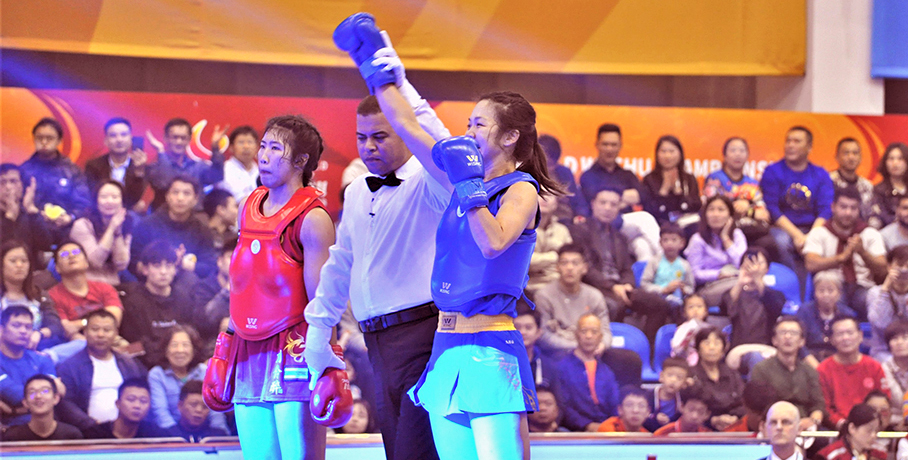
 In regards to the Sanda competition, I noticed not so many good kicks, but a tendency to move quite directly to wrestling after brief boxing displays sometimes accompanied by clinches. It made me wonder if most of the competitors are watching too much MMA and not enough time stretching their legs. This is a similar observation I made watching Muay Thai a couple of months ago in Bangkok. I have to give the judges credit for breaking fighters out of clinches very quickly and minimizing time spent on the mat. That said the takedowns and throws were sometimes quite excellent.
In Sanda, the big winners were China, Iran, Vietnam, India, and Lebanon. That China should place first isn’t surprising for a dozen good reasons, and Iran second again is not at all surprising to me, having noticed them soundly defeating practically everyone in most international martial arts competitions since the early 1990s. Likewise Vietnam is not surprising coming in the top three, as I learned visiting their lovely nation earlier this year, they have extraordinary leadership and teams of coaches and athletes. India fielded the best Sanda team I’ve seen from there yet, and Saidi Yasmina coming in 3rd in the women's 65 Kg. division, and Ade Permana taking gold in the men's 48 Kilo division is very good indeed.
One of the most entertaining Sanda fighters was a young lady named Hoi Lan Tsang from Hong Kong who just relentlessly battered her opponents with mostly turning kicks, straight kicks, and flurries of punches. Eventually she lost to Yumei Qi of China, but put on a great show through every one of her matches.
What is bad luck in Sanda? Competing against China or Iran in the first or second round. (Ha, ha, usually true in fighting arts competitions I’ve learned over the years.)
Overall Medal Counts
Not surprisingly China scored first in this year’s 15th World Wushu Championships with 14 gold, one silver, and one bronze medal for a total of 16 medals. Two years ago in the 14th World Wushu Championships they earned fifteen golds. Iran came in 2nd with nine gold, two silver, and one bronze medals for a total of 12 medals, and Hong Kong came in third with five golds, four silvers and one bronze for a total of 10 medals.
In the 14th World Wushu Championships the the same countries took first, second and third, respectively.
Fourth, fifth and six places in the overall medal counts were Indonesia, Macao and Malaysia. Indonesia is understandable, given what regular KungFuMagazine.com readers know about their top-notch coaches, training and leadership. That Macao should come in fifth is pretty darned good given that the total population there is only 622,000 people, yet they were competing against entire national teams. Malaysia only does a complete census every 10 years, but as of 2010 the number of Malaysians of Chinese origin was a little less than six and a half million, slightly less than Hong Kong which has a population of seven and half million. In any case, Chinese Malaysians have a proud cultural heritage to celebrate and Kung Fu/Wushu is a bastion of that heritage.
The USA came in a somewhat disappointing 23rd place this year with only three bronze medals out of 38 international teams. Stay tuned for more about Shanghai and the 15th World Wushu Championships in Silk Road Kung Fu Friendship Tour Part 30. This includes interviews with presidents, coaches, athletes and journeys to the ancient Maritime Silk Road Port in Zhenhai District of Ningbo City in Zhejiang Province (just a hop across the bay from Shanghai), Moon Lake, the Intellectual Center at the Hub of China’s Silk Road Maritime greatest East Sea port for a thousand years or so, and a trip really far back in time some 7,000 years to the archeological site of Hemudu where some of the most ancient domesticated rice in China was found.
For The Silk Road Kung Fu Friendship Tour Part 30, click here.


